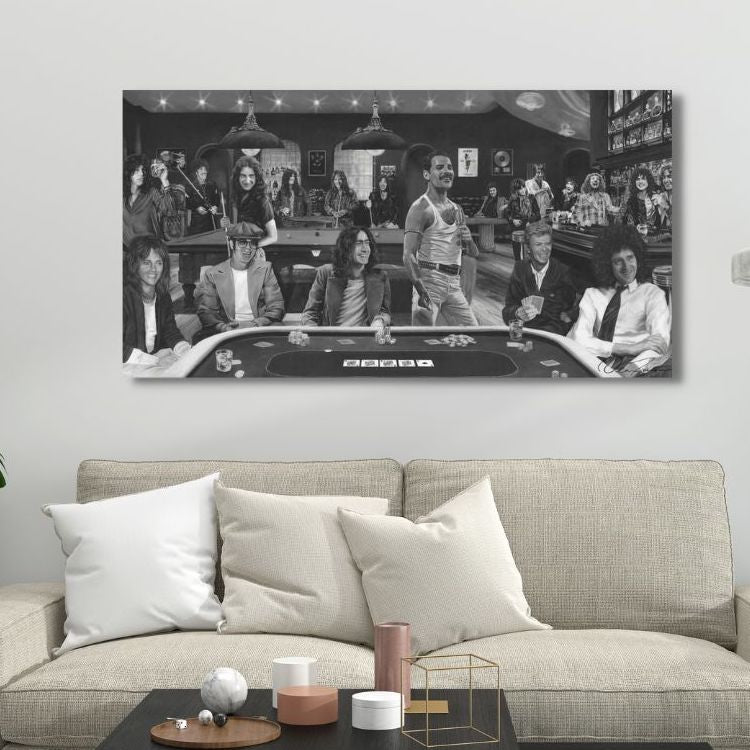

Dean has painted Jimmy Page into two of his paintings, and each one puts him in different company.

Hang this painting and someone will always point at a face and ask, “Who’s that?” Dean Turner’s Ultimate Guitarist Reunion is a hand-painted original of 45 guitar greats, 12 months from planning and hand painting to finish. Jimmy Page is one of them.

There’s a whole era of loud records in this one, ten bands’ worth, gathered at one roadside store. Dean Turner’s Highway to Hell is a hand-painted original of hard rock and metal musicians on a desert highway, with Jimmy standing in a row with his Led Zeppelin bandmates John Bonham and Robert Plant. It was painted over 12 months.
Each one is available as a framed canvas print, made from the original, for the room where your music lives. This is Jimmy Page’s story.
No. 32 Who’s Who Ultimate Guitarist Reunion
three sessions a day, then Led Zeppelin
Before Led Zeppelin he was the guitarist London’s studios rang first, sometimes three times in a day. Then he built the band and produced its records himself.
 32of 45
In this story 13 sections
Why fans still care
JIMMY PAGE is in the Rock & Roll Hall of Fame twice, once with the Yardbirds and once with Led Zeppelin. The Rock Hall calls him Zeppelin’s “guitarist-producer-mastermind”.
He put Led Zeppelin together himself, paid for their first album before they had a record deal, and produced every record they made. Led Zeppelin IV, the album with Stairway to Heaven on it, was 24 times Platinum in the US by November 2021.
When the surviving members played one reunion night in London in 2007, Guinness counted more than 20 million ticket requests.
Early life
Page was born in Heston, near London, on 9 January 1944, and his family moved to Epsom in Surrey when he was about eight. “I was bored so I taught myself the guitar from listening to records,” he has said. The records were early rock and roll, and the guitarists he names are Scotty Moore, who played with Elvis Presley, and James Burton.
At 13 he was on BBC television with his band, on a programme called All Your Own. At 18 he made his first record, The Road to Love, with the Crusaders. Glandular fever cut his touring short, and he went to Sutton Art College instead.
Career chapters
- 1957On the BBC’s All Your Own, aged 13
- 1964Session guitar on Goldfinger, Abbey Road
- 1966Joins the Yardbirds
- 1968Led Zeppelin, with Robert Plant, Who’s Who number 7 in · Highway to Hell (story coming soon), John Bonham, Who’s Who number 6 in · Highway to Hell (story coming soon) and John Paul Jones; first show 7 September
- 1969Led Zeppelin released in the US, 12 January
- 1971Led Zeppelin IV, with Stairway to Heaven
- 1980The end of Led Zeppelin
- 1992Rock & Roll Hall of Fame with the Yardbirds
- 1995Rock & Roll Hall of Fame with Led Zeppelin
- 2007Reunion at London’s O2 Arena, with Jason Bonham on drums
- 2012Kennedy Center Honors
The session years early 1960s
Page became one of London’s busiest studio guitarists, playing as many as three sessions a day, six days a week. He played second guitar on The Who’s I Can’t Explain, next to Pete Townshend, Who’s Who number 8, and he’s modest about it: “I wasn’t really needed or necessary.” In August 1964 he was at Abbey Road for Shirley Bassey’s Goldfinger.
The bass player on a lot of those sessions was John Paul Jones. He remembers the line-up as “Big Jim and Little Jim”: Big Jim Sullivan, the senior session guitarist, and the young Page, who usually ended up on rhythm guitar because he didn’t read music well.
The Yardbirds 1966 to 1968
He joined the Yardbirds and played alongside his old friend Jeff Beck, Who’s Who number 15, and they’re both in the band’s scene in the film Blow-Up. Beck, Who’s Who number 15 also gave him a Fender Telecaster, which Page played through the Yardbirds and on into Led Zeppelin.
A 1966 session for Beck’s, Who’s Who number 15 Beck’s Bolero, with Jones on bass and Keith Moon, Who’s Who number 10 in · Ultimate Queen Reunion (story coming soon) on drums, gave Page the idea of a band built on that kind of power. When the Yardbirds ended in 1968, he set out to build it.
Putting Led Zeppelin together 1968
He needed a singer first. Terry Reid turned him down but told him about a 19-year-old in the Midlands, Robert Plant, Who’s Who number 7 in · Highway to Hell (story coming soon), then singing in a band called Hobbstweedle. Page and manager Peter Grant drove up to see him at a teachers’ training college, and Page invited him down to his boathouse on the Thames. They spent the afternoon playing records, including Joan Baez’s version of Babe I’m Gonna Leave You, and talking about what they could do with it.
Plant, Who’s Who number 7 in · Highway to Hell (story coming soon) knew the drummer. John Bonham, Who’s Who number 6 in · Highway to Hell (story coming soon) was an old friend from the Midlands, but he had a paying job backing the singer Tim Rose. Page and Grant raised their offer until he said yes.
The bass player came to them. Jones’s wife saw a note in the music press that Page was forming a group and told him to ring. “My wife made me,” Jones joked later. He called Page and offered to play bass, and Page told him he was on his way to Birmingham to see a singer.
The four of them met in a small room in London in August 1968, and it worked from the first song. They rehearsed, played on a P.J. Proby session that Jones had already booked, and on 7 September 1968 played their first show in Denmark as the New Yardbirds. “Nobody would book us under anything else,” Jones said. By October they were Led Zeppelin.
The first album 1969
Page didn’t wait for a record company. He and Grant paid for the sessions themselves, at Olympic Studios in London from late September 1968, and Page produced. The guitar sound on it is simple: the Telecaster from Beck, Who’s Who number 15, a Supro amp, a Tone Bender fuzz, an Echoplex and a Vox wah. Then they took the finished tapes to Atlantic Records, and Ahmet Ertegun signed them.
Led Zeppelin came out in the US on 12 January 1969, with Good Times Bad Times, Dazed and Confused and Communication Breakdown on it. Other musicians heard the planning in it straight away. “He had the whole thing mapped out in his head,” Joe Perry, Who’s Who number 17 said of the debut, and Aerosmith learned what he called “the arena-rock sound” from those records.
Led Zeppelin 1969 to 1980
The Rock Hall’s list runs from Led Zeppelin and Led Zeppelin II in 1969, through III and IV, to Physical Graffiti in 1975. Led Zeppelin II, IV and Physical Graffiti went 12, 24 and 16 times Platinum in the US. Page wrote, played and produced.
Their last concert with Bonham, Who’s Who number 6 in · Highway to Hell (story coming soon) was in Berlin on 7 July 1980. He died on 25 September 1980, aged 32, at Page’s house in Windsor. On 4 December the others said they “could not continue as we were”.
Writing as a band
Zeppelin songs came out of all four of them. In the spring of 1970, worn out after their fifth US tour, Page and Plant, Who’s Who number 7 in · Highway to Hell (story coming soon) went with their families to Bron-Yr-Aur, a cottage in the Welsh hills with no electricity. “The only song we really finished up there was That’s the Way,” Page said, but the trip set the tone for Led Zeppelin III and its acoustic side.
For the fourth album they took over Headley Grange, an old poorhouse in Hampshire, and lived and recorded there. Jones wrote the main riff of Black Dog on a train home from a rehearsal, jotting it down in a number system his father had taught him. The song was named after an old black Labrador that wandered around the Grange. Bonham, Who’s Who number 6 in · Highway to Hell (story coming soon) had to hold a straight beat under its shifting riff, and Plant, Who’s Who number 7 in · Highway to Hell (story coming soon) sang over the top.
Writing Stairway to Heaven 1970 to 1971
Stairway started as “the long one”. Its bones came together at Bron-Yr-Aur in 1970, and Page worked out the sections at his home in Pangbourne, near Reading.
At Headley Grange, Page sent Plant, Who’s Who number 7 in · Highway to Hell (story coming soon) and Bonham, Who’s Who number 6 in · Highway to Hell (story coming soon) to the pub and sat down with Jones to settle the arrangement for the next day. While the band ran it through, Plant, Who’s Who number 7 in · Highway to Hell (story coming soon) sat on the floor against the wall, writing. “From my recollection he had a good 90% of it then,” Page said. Page kept Bonham, Who’s Who number 6 in · Highway to Hell (story coming soon) out until well into the song, a trick he’d used before, so the drums would hit harder when they arrived.
Page tried the solo at Headley Grange for three hours without getting it. He finished it later at Island’s Basing Street studios in London. To play it all live he needed a double-neck guitar, six-string for the intro and solo and 12-string for the rest.
What Stairway became
Led Zeppelin IV came out in November 1971, and Stairway went to radio without ever being released as a commercial single in the UK or US. (Atlantic did press a promo-only 7-inch for American radio stations in 1972.) By its 20th anniversary, in 1991, it was claimed to have been played 2,874,000 times on the radio, about 44 years of airtime. Page noticed early. At the LA Forum in August 1971, before the album was even out, part of the crowd gave it a standing ovation.
Ann Wilson of Heart, who first heard it on the radio at 19, called it “a complete marriage of music to lyrics”.
After Zeppelin 1980s to 2008
Page went on to the Honeydrippers with Plant, Who’s Who number 7 in · Highway to Hell (story coming soon), the Firm, and No Quarter, again with Plant, Who’s Who number 7 in · Highway to Hell (story coming soon).
In 2008 he appeared with The Edge, Who’s Who number 7 and Jack White, Who’s Who number 26 in the guitar documentary It Might Get Loud, where he showed The Edge, Who’s Who number 7 how Kashmir goes. The same year he rode into the stadium in Beijing on a double-decker flatbed to play Whole Lotta Love at the Olympics.
The O2 reunion with Jason Bonham 2007
On 10 December 2007 Page, Plant, Who’s Who number 7 in · Highway to Hell (story coming soon) and Jones played a full two-hour Led Zeppelin show at the O2 Arena in London. It was a tribute to Ahmet Ertegun, the Atlantic founder who had signed them in 1968, and the drummer was John Bonham’s, Who’s Who number 6 in · Highway to Hell (story coming soon) son, Jason Bonham.
The demand was huge. Only 9,000 pairs of tickets went to the public, at £125 each, given out by ballot through Ertegun’s website, and more than 20 million requests came in. Guinness lists it as the highest demand for tickets for one music concert. Tickets were reported selling for up to £1,800 on eBay.
The show came out in 2012 as the film and album Celebration Day, which won the Grammy for Best Rock Album in 2014.
The Hall of Fame, again 2023
On 3 November 2023 he inducted Link Wray into the Rock Hall and played Wray’s Rumble, which he called “the essence of cool”. It was his first public performance since 2014. He’d been hearing Rumble in his own playing for years: the slashing chords in Immigrant Song have, he once said, “the feel and sound of the way Link plays”.
Craft, sound and style
The bow
A session violinist, the father of the actor David McCallum, asked Page one day if he’d ever tried bowing a guitar. Page said it wouldn’t work. “Have a go,” the violinist said, and handed him a bow. He used it in the Yardbirds, and it became the sound of Dazed and Confused, live and on the first album.
Theremin and Echoplex
On stage Page treated effects such as the theremin and the Echoplex tape delay as instruments in their own right, and he preferred working them by hand so he could shape the sound on the night. On the record of Whole Lotta Love, the eerie high sounds in the middle section are his theremin.
Open tunings and the Danelectro
Page was using DADGAD tuning in the Yardbirds, on White Summer, and on Led Zeppelin’s Black Mountain Side. He kept a Danelectro in that tuning, and on stage it was his guitar for Kashmir and In My Time of Dying, both on Physical Graffiti. Kashmir’s riffs use open strings against the same notes higher up, so the guitar sounds doubled. On Led Zeppelin III he used open G for That’s the Way and a C tuning for Friends.
The guitars
The first album was all the Telecaster from Jeff Beck, Who’s Who number 15, which Page later painted with a dragon. From the second album he moved to the Gibson Les Paul, including his Number One, which he bought from Joe Walsh, Who’s Who number 25. By Presence the setup was the Les Paul and Marshalls.
Who he influenced
The Rock Hall names Van Halen, Guns N’ Roses, Heart, Queen, Aerosmith and Def Leppard among the bands Led Zeppelin influenced. Slash, Who’s Who number 43 heard Whole Lotta Love at seven and linked its sound to the Les Paul because he’d seen pictures of Page holding one.
Black Beauty
Before the sessions he traded a Fender Stratocaster for a 1960 Gretsch Chet Atkins 6120 with a Bigsby, because he wanted Chet Atkins’s fingerpicking sound. His session guitar was a black 1960 Gibson Les Paul Custom, the “Black Beauty”, with three pickups, gold hardware and a Bigsby, bought at Lew Davis on Charing Cross Road. He added two extra switches so he could use any mix of pickups, change the phase or turn them off. It was stolen at a Minneapolis airport in April 1970. It turned up refinished, and was identified from the inlay at the 12th fret in film of the Royal Albert Hall show that January. Collector Perry Margouleff got it back to him around 2015, the news came out in 2016, and it went on show at the Met in New York in 2019.
The Dragon Telecaster
The Telecaster was a late 1959 model, a gift from Jeff Beck, Who’s Who number 15 for getting him into the Yardbirds. After Beck left in late 1966, Page glued small mirrors on it, then stripped it and painted the dragon. In 1969 a friend repainted it and ruined the wiring. Page put its neck on another Tele and, for the Met show in 2019, repainted the body. Guitar World places it on the Stairway to Heaven solo as well as the first album.
Number One and the double neck
He bought his 1959 sunburst Les Paul Standard from Joe Walsh, Who’s Who number 25 for about $1,200, by Walsh’s 2012 account, and Guitar World dates the sale to the April 1969 US tour. The two men tell the handover differently. Page says Walsh brought it to a Fillmore East show, and Walsh says he flew to New York with it. It was soon on Whole Lotta Love and What Is and What Should Never Be. For Stairway live he played a Gibson EDS-1275 double neck, so one guitar could cover the record’s acoustic and two electric 12 strings. He called it a real working tool in the band.
The amps
Page said the first album was the Telecaster, a modified Supro combo, a wah pedal and a Tone Bender MkII. The rig shown at the Met adds a Vox UL4120 head with a Rickenbacker Transonic cabinet, Marshall JMP Super Lead heads, which suited the 1959 Les Paul, and a 4x12 cabinet with “Zoso” on the grille cloth. Engineer Eddie Kramer said Page was the director of Led Zeppelin’s sound, and added that John Paul Jones deserves equal credit for the arrangements.
What other players say
“He was like Eisenhower looking at Normandy Beach.”
“one of the coolest records ever made”
“It’s beautiful, a complete marriage of music to lyrics.”
“He had this vision to transcend the stereotypes of what the guitar can do”
“the master of the riff”
“the meanest, coolest, most refreshing, alive, vibrant, visceral attack on the strings”
“He was the bloody director”
Stories people still tell
-
The Stairway case.
In 2014 the trustee for Randy Wolfe of Spirit sued, saying Stairway to Heaven copied the Spirit song Taurus. A jury found for Led Zeppelin in 2016, an appeals court ruled for the band again in 2020, and in October 2020 the US Supreme Court declined to hear it. The estate’s lawyer said the band won “on a technicality”.
-
The black dog.
The Labrador at Headley Grange disappeared one night and came back worn out, and the band assumed he’d been out on the tiles. They named the song after him.
-
The guitar that went missing.
Before the Telecaster and the Number One there was the Black Beauty, a black 1960 Gibson Les Paul Custom with three pickups and a Bigsby. He saw it hanging in Lew Davis’s shop on Charing Cross Road and “knew this was it”, and he’d played it since his early session days. In April 1970, on Led Zeppelin’s flight from Minneapolis to Montreal, it went missing. “It had evaporated,” he wrote in Jimmy Page: The Anthology. He ran a missing guitar ad in Rolling Stone for a year and heard nothing. Years before it turned up, he’d asked his friend Perry Margouleff, a collector, to find it. In 2015 Margouleff did, in Minnesota, swapped the man who had it another 1960 Custom, and carried it to Page’s house in London by hand. Page held it back from display until April 2019, when it appeared at the Metropolitan Museum of Art’s Play It Loud exhibition in New York.
-
A clean head.
Page has said he doesn’t drink. “So really the intoxicant was the music,” he told the Academy of Achievement.
Legacy
Steven Tyler, Who’s Who number 23 in · Highway to Hell (story coming soon) and Joe Perry, Who’s Who number 17 inducted Zeppelin into the Rock Hall in 1995, and The Edge, Who’s Who number 7 presented the Yardbirds three years earlier. Page produced every Zeppelin album himself.
In the painting
Jimmy Page | Led Zeppelin/Yardbirds


Ultimate Guitarist Reunion
Number 32 of 45 on the Who’s Who
Number 32 of 45 on the Who’s Who list for Ultimate Guitarist Reunion by Dean Turner Art, published as Jimmy Page | Led Zeppelin/Yardbirds.
Dean painted Eric Clapton, Who’s Who number 3 just behind him. In 1965 Page turned down the chance to replace Clapton, Who’s Who number 3 in the Yardbirds (“Eric had been a friend of mine”) and suggested Jeff Beck, Who’s Who number 15 instead. Page joined the band himself in 1966.
Collectors lean in, argue over faces and pull the names list. If you’re looking for the man behind Led Zeppelin’s sound, start with Page.
More names on the same list turn up in his story: Pete Townshend, Who’s Who number 8, whose session he played on, Joe Walsh, Who’s Who number 25, who sold him his Number One Les Paul, Joe Perry, Who’s Who number 17, who helped induct Zeppelin, Slash, Who’s Who number 43, and The Edge, Who’s Who number 7 and Jack White, Who’s Who number 26, his co-stars in It Might Get Loud.


Highway to Hell
Number 5 of 30 on the Who’s Who
Number 5 of 30 on the Who’s Who list for Highway to Hell, published as Jimmy Page | Led Zeppelin.
Dean painted Led Zeppelin together: Page, then John Bonham, Who’s Who number 6 (story coming soon), then Robert Plant, Who’s Who number 7 (story coming soon), standing in a row. Plant, Who’s Who number 7 (story coming soon) is the singer Page drove to the Midlands to hear in 1968, and Bonham, Who’s Who number 6 (story coming soon) the old friend Plant, Who’s Who number 7 (story coming soon) brought in.
See Jimmy Page among all 45 guitarists in Ultimate Guitarist Reunion.
Who’s Who in the Ultimate Guitarist Reunion
Numbered as on the painting’s key. Pick a name to read their story.
- Story live
- Coming soon
- You’re reading
 Find the numbers on the painting
- 1Albert King
- 2B.B. King
- 3Eric Clapton | Cream/Yardbirds
- 4Stevie Ray Vaughan | Stevie Ray Vaughan & Double Trouble
- 5Billy Gibbons | ZZ TOP
- 6Jimi Hendrix | The Jimi Hendrix Experience/Solo
- 7The Edge | U2
- 8Pete Townshend | The Who
- 9David Gilmour | Pink Floyd
- 10Kirk Hammett | Metallica
- 11Peter Frampton | Solo/Humble Pie/The Herd
- 12George Thorogood | George Thorogood & the Destroyers
- 13Mark Knopfler | Dire Straits
- 14Ritchie Blackmore | Deep Purple/Rainbow
- 15Jeff Beck | Solo/Yardbirds
- 16Gary Moore
- 17Joe Perry | Aerosmith
- 18Prince
- 19Ronnie Wood | Rolling Stones
- 20Brian May | Queen
- 21Rory Gallagher | Solo/Taste
- 22Tom Morello | Rage Against the machine /Audioslave
- 23Tony Iommi | Black Sabbath
- 24Carlos Santana
- 25Joe Walsh | Eagles
- 26Jack White | Solo/White Stripes
- 27Zakk Wylde | Ozzy Osbourne/Black Label Society
- 28Randy Rhoads | Ozzy Osbourne
- 29Joe Satriani
- 30Steve Vai
- 31Keith Richards | Rolling Stones
- 32Jimmy Page | Led Zeppelin/YardbirdsYou’re reading
- 33James Hetfield | Metallica
- 34Eddie Van Halen | Van Halen
- 35Angus Young | AC/DC
- 36Chuck Berry
- 37Kurt Cobain | Nirvana
- 38Les Paul
- 39Lenny Kravitz
- 40Bo Diddley
- 41Johnny Winter
- 42Malcolm Young | AC/DC
- 43Slash | Guns N Roses
- 44George Harrison | Beatles/Traveling Wilburys/Solo
- 45Robert Johnson
Jimmy Page is also on the Who’s Who in 1 more painting
Highway to Hell29 names · Jimmy Page is number 5 of 30
Find the numbers on the painting
- 1Brian Johnson | AC/DC (story coming soon)
- 2Axl Rose | Guns N' Roses (story coming soon)
- 3Duff McKagan | Guns N' Roses (story coming soon)
- 4Slash | Guns N' Roses
- 5Jimmy Page | Led ZeppelinYou’re reading
- 6John Bonham | Led Zeppelin (story coming soon)
- 7Robert Plant | Led Zeppelin (story coming soon)
- 8Eddie Van Halen | Van Halen
- 9Dusty Hill | ZZ Top (story coming soon)
- 10Billy Gibbons | ZZ Top
- 11Frank Beard | ZZ Top (story coming soon)
- 12Kirk Hammett | Metallica
- 13Lars Ulrich | Metallica (story coming soon)
- 14James Hetfield | Metallica
- 15Phil Rudd | AC/DC (story coming soon)
- 17Vince Neil | Mötley Crüe (story coming soon)
- 18Tommy Lee | Mötley Crüe (story coming soon)
- 19Nikki Sixx | Mötley Crüe (story coming soon)
- 20Mark Evans | AC/DC (story coming soon)
- 21Cliff Williams | AC/DC (story coming soon)
- 22Joe Perry | Aerosmith
- 23Steven Tyler | Aerosmith (story coming soon)
- 24Bon Scott | AC/DC (story coming soon)
- 25Lemmy Kilmister | Motörhead (story coming soon)
- 26Geezer Butler | Black Sabbath (story coming soon)
- 27Tony Iommi | Black Sabbath
- 28Malcolm Young | AC/DC
- 29Ozzy Osbourne | Black Sabbath (story coming soon)
- 30Angus Young | AC/DC
Sources
- Rock & Roll Hall of Fame, Led Zeppelin. rockhall.com
- Rock & Roll Hall of Fame, The Yardbirds. rockhall.com
- Polar Music Prize, Led Zeppelin. polarmusicprize.org
- American Academy of Achievement, Jimmy Page. achievement.org
- Montana Public Radio (NPR), Supreme Court declines to hear Led Zeppelin case (5 Oct 2020). mtpr.org
- Loudwire, Led Zeppelin IV Platinum 24 times (9 Nov 2021). loudwire.com
- Guinness World Records, Highest demand for tickets for one music concert. guinnessworldrecords.com
- Recording Academy, Best Rock Album 2014. grammy.com
- BANG Showbiz via Yahoo News UK, Jimmy Page turns 80 (9 Jan 2024). uk.news.yahoo.com
- Ultimate Classic Rock, Jimmy Page and the Goldfinger theme (19 Jan 2021). ultimateclassicrock.com
- Ultimate Classic Rock, Jimmy Page at the Rock Hall, 2023 (3 Nov 2023). ultimateclassicrock.com
- Radio X, Led Zeppelin’s last concert with John Bonham. radiox.co.uk
- Blabbermouth, Led Zeppelin awarded lifetime achievement Grammy (Feb 2005). blabbermouth.net
- Guitar World, Why Jimmy Page first turned down the Yardbirds (21 Aug 2026). guitarworld.com
- TeachRock, Jimmy Page: the Trouser Press interview (1977). teachrock.org
- Led Zeppelin official site, December 4, 1980. ledzeppelin.com
- Ultimate Classic Rock, Led Zeppelin’s break-up. ultimateclassicrock.com
- The Independent, The untimely death of Led Zeppelin. the-independent.com
- Led Zeppelin official site, September 7, 1968 (first show, as the New Yardbirds). ledzeppelin.com
- Rolling Stone, How Jimmy Page formed Led Zeppelin (7 Sep 2018). rollingstone.com
- RIAA Gold & Platinum database (Led Zeppelin II 12x, 15 Nov 1999; Led Zeppelin IV 24x, 8 Nov 2021; Physical Graffiti 16x, 30 Jan 2006). riaa.com
- Louder, How John Paul Jones came to join Led Zeppelin, by Niall Doherty (12 Jul 2023). loudersound.com
- Guitar World, Jimmy Page on Anthology and the gear that made rock history (9 Jan 2024). guitarworld.com
- Rhino, January 1969: Led Zeppelin debut with Led Zeppelin. rhino.com
- Led Zeppelin official site, September 25, 1968 (Olympic Studios sessions). ledzeppelin.com
- Blabbermouth, Joe Perry explains how Aerosmith was influenced by Led Zeppelin (30 Nov 2007). blabbermouth.net
- Guitar World, Jimmy Page discusses Led Zeppelin III (23 Dec 2010). guitarworld.com
- Louder, Black Dog: the story behind the song (20 Aug 2026). loudersound.com
- Louder, Stairway to Heaven: the story behind the song (29 May 2026). loudersound.com
- The Guardian, Stairway to Heaven: the story of a song and its legacy (22 Oct 2014). theguardian.com
- Rolling Stone, Q&A: Jimmy Page (12 Jun 2008). rollingstone.com
- Guitar World, Jimmy Page explains the roots of Kashmir (9 Jan 2019). guitarworld.com
- Radio X, Slash reveals his guitar heroes, by Jenny Mensah (21 Mar 2023), quoting Slash’s interview in Total Guitar (April 2023 issue); quote checked verbatim. radiox.co.uk
- Led Zeppelin official site, December 10, 2007 (O2 reunion with Jason Bonham). ledzeppelin.com
- ABC News (Australia), Fifty years of Led Zeppelin’s Stairway to Heaven (6 Nov 2021): “never released as a commercial single”; Atlantic asked, the band refused. abc.net.au
- 45cat, Led Zeppelin, Stairway To Heaven (mono/stereo), Atlantic PR-175, USA, 1972 promo 7-inch. 45cat.com
- Friktech, Led Zeppelin pressings guide (PR-175, 1972 US radio promo, not for sale). friktech.com
- The Independent, Led Zeppelin: The rise to heavenly heights (Plant fronting Hobbstweedle; Birmingham Teacher Training College, 20 July 1968). independent.co.uk
- Ultimate Classic Rock, 50 Years Ago: Led Zeppelin play their first show as Led Zeppelin (University of Surrey, 25 Oct 1968). ultimateclassicrock.com
- Led Zeppelin official site, University of Surrey, October 25, 1968. ledzeppelin.com
- Ultimate Classic Rock, Jimmy Page on the making of Whole Lotta Love (Page: “The Theremin generates most of higher pitches”). ultimateclassicrock.com
- The New York Times, A.O. Scott, review of It Might Get Loud (13 Aug 2009), with The Edge, Jimmy Page and Jack White. nytimes.com
- NPR, It Might Get Loud review (13 Aug 2009). npr.org
- Guitar World, Brad Tolinski, “How Jimmy Page was reunited with his beloved 1960 Les Paul Custom” (18 Mar 2021, with Page’s words from Jimmy Page: The Anthology). guitarworld.com
- MusicRadar, Michael Astley-Brown, “Jimmy Page reunited with 1960 Gibson Black Beauty Les Paul guitar” (20 Apr 2016). musicradar.com
- LedZepNews, Black Beauty at the Met (8 Apr 2019: lost April 1970, returned to Page on 12 November 2015). ledzepnews.com
- Guitar World, Chris Gill, “The story of the Fender Telecaster that unites Jeff Beck and Jimmy Page”, 20 Jul 2026. guitarworld.com
- Guitar World, Brad Tolinski, “How Jimmy Page was reunited with his beloved 1960 Les Paul Custom”, 18 Mar 2021. guitarworld.com
- Guitar World, “How one of rock’s most storied Les Pauls changed hands from one guitar hero to another”, 13 Mar 2025. guitarworld.com
- MusicRadar, Jonathan Horsley, Jimmy Page demos his guitars and amps at the Met, 24 Mar 2023. musicradar.com
- MusicRadar, “Jimmy Page reunited with 1960 Gibson Black Beauty Les Paul guitar”, 20 Apr 2016. musicradar.com
- Rolling Stone Australia, “The 250 Greatest Guitarists of All Time: Jimmy Page”, 16 Oct 2023. au.rollingstone.com
- Louder, Rob Hughes, “Eddie Kramer: why I loved working with Led Zeppelin”, 22 Jun 2021. loudersound.com
- Guitar.com, Crystal Koe, Steve Vai on Heartbreaker, 6 May 2022. guitar.com
- Ultimate Classic Rock, Martin Kielty, Brian May on Queen and Led Zeppelin’s influence, 19 Jan 2023. ultimateclassicrock.com
Names appear exactly as published on the Who’s Who lists for Ultimate Guitarist Reunion and Highway to Hell.
See the names list for other Ultimate Series artworks
Every painting has its own numbered Who’s Who. Pick a scene and see who’s in it.
 Ultimate Aussie Pub Rock ReunionSee who’s in it
  Ultimate Aussie Reunion - Part 2See who’s in it
 - Highway to HellSee who’s in it
 The Ultimate ReunionSee who’s in it
  Ultimate Eagles ReunionSee who’s in it
  Ultimate Queen ReunionSee who’s in it
  Ultimate Beatles ReunionSee who’s in it
  Ultimate Classic Country ReunionSee who’s in it
  Ultimate Hip Hop ReunionSee who’s in it
  Ultimate Gangster ReunionSee who’s in it
  Ultimate Boxing ReunionSee who’s in it
  Ultimate Fighter ReunionSee who’s in it