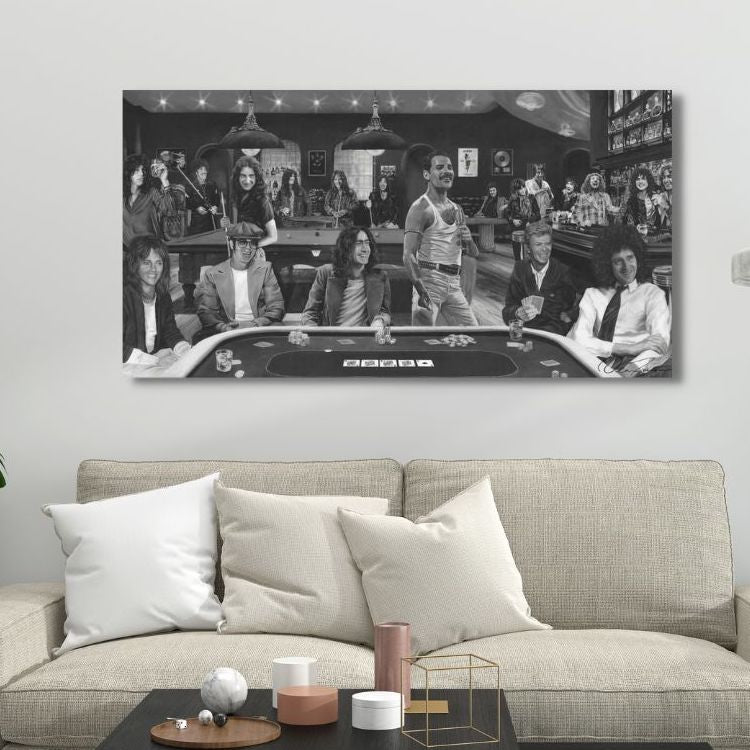


Hang this painting and someone will always point at a face and ask, “Who’s that?” Dean Turner’s Ultimate Guitarist Reunion is a hand-painted original of 45 guitar greats, 12 months from planning and hand painting to finish. This is the story of one of them, Albert King. It’s available as a framed canvas print, made from the original, for the room where your music lives.
No. 1 Who’s Who Ultimate Guitarist Reunion
The left-hander who played it upside down
He turned a right-handed guitar over and played it left-handed, and the Rock & Roll Hall of Fame counts Eric Clapton, Who’s Who number 3, Jimi Hendrix, Who’s Who number 6 and Stevie Ray Vaughan, Who’s Who number 4 among his disciples.
 1of 45

In this story 13 sections
Why fans still care
ALBERT KING was left-handed, and he played a right-handed guitar turned upside down. He never switched, and he built a whole sound on it.
He had his own name for it. “I play the singing guitar,” he told the writer Alan Paul in 1991.
The Rock & Roll Hall of Fame lists Eric Clapton, Who’s Who number 3, Jimi Hendrix, Who’s Who number 6 and Stevie Ray Vaughan, Who’s Who number 4 among his disciples. When John Mayer inducted him in 2013, he had a shorter way of saying it: “He is the reason guitar players break high E strings.”
People are still finding him. On Spotify, Born Under a Bad Sign had passed 76 million plays by September 2026, about three and a half times the count for Crosscut Saw, his next most played track.
Early life and training
He was born Albert Nelson, one of 13 children of Will Nelson and Mary Blevins. The date usually given is 25 April 1923, though he sometimes said 1924, and the paperwork from the time is thin.
Where he was born is argued over too. Stax, the Memphis Music Hall of Fame and the Encyclopedia of Arkansas all say Indianola, Mississippi, and the encyclopedia puts it on a cotton plantation near the town. The Mississippi Blues Trail notes that his 1942 Social Security application lists “Aboden”, which is most likely Aberdeen, Mississippi.
The family moved across the river to Arkansas while he was young. The Encyclopedia of Arkansas says they settled in Osceola in 1931. Other accounts put them near Forrest City.
His first guitars come with two stories. He remembered paying $1.25 for a “real” guitar as a boy. Stax says his first electric cost $125 at a pawnshop in Little Rock. They may well be two different guitars. Either way, he held them the wrong way round and kept them like that.
He did take one thing from another player: an idea. He told the writer Steve Newton in 1990 that hearing T-Bone Walker made him want to find a way of playing that was his own.
Career chapters
- 1953Debut single, “Bad Luck Blues”, on Parrot
- 1959Starts recording for Bobbin
- Early 1960sDon’t Throw Your Love on Me So Strong reaches number 14 on the R&B chart
- 1966Signs with Stax in Memphis
- 1967Born Under a Bad Sign
- 1968Opens at the Fillmore, San Francisco, 1 February
- 1972Takes delivery of the walnut Lucy, built by Dan Erlewine
- 1974Leaves Stax
- 1990Guests on Oh Pretty Woman with Gary Moore, Who’s Who number 16
- 1992Dies in Memphis, 21 December
- 2013Rock & Roll Hall of Fame
Osceola and the first records 1950s
Before he was a guitarist people paid to see, Albert King sat behind a kit. He formed a band in Osceola called the In the Groove Boys, and he played drums for Jimmy Reed.
His first single, “Bad Luck Blues”, came out on Parrot in 1953. In 1959 he began recording for the Bobbin label. The biggest single of those early years was “Don’t Throw Your Love on Me So Strong”, which reached number 14 on the R&B chart. uDiscover Music dates it to 1961. The Encyclopedia of Arkansas calls it his most successful single.
Stax and Born Under a Bad Sign 1966 to 1967
In 1966 he signed with Stax in Memphis, and he stayed until 1974.
The Stax singles came quickly. Laundromat Blues reached number 29 on the R&B chart in 1966, and Crosscut Saw number 34 the next year.
His first LP for the label, Born Under a Bad Sign, came out in 1967. The title track was written by William Bell and Booker T. Jones. The album also has his Oh, Pretty Woman, a blues of his own and nothing to do with the Roy Orbison hit. The Memphis Music Hall of Fame credits the album with bringing him a wider rock audience, and it’s still the record most people start with.
The rock audience heard the title song from another side as well. Cream recorded Born Under a Bad Sign, with Eric Clapton, Who’s Who number 3 on guitar, and uDiscover credits Cream’s version with helping make it a blues standard. Craft Recordings put out a centennial edition of King’s album in April 2023, a hundred years after his birth.
Clapton, Who’s Who number 3 took something from another song on that album. Guitar World says he lifted King’s solo from Oh, Pretty Woman for Strange Brew, the opening track on Cream’s 1967 album Disraeli Gears. In the Classic Albums documentary on Disraeli Gears, Clapton, Who’s Who number 3 described it as a trade. Producer Felix Pappalardi had turned the song into a pop single, and if Clapton went along with it, “I could play an Albert King guitar solo”.
The Fillmore 1968
On 1 February 1968, Albert King opened at the Fillmore in San Francisco. He became a regular there. A Rick Griffin poster from that run, now held by the University of Delaware Library, puts him on the same bill as Jimi Hendrix, Who’s Who number 6 and John Mayall.
According to Stax, the promoter Bill Graham offered him $1,600 for three days. King later said it was far more than he had ever earned for a few days’ work.
He recorded Live Wire/Blues Power at the Fillmore that same year.
The singles kept coming. Cold Feet reached number 20 on the R&B chart in 1968, and number 67 on the main US chart. That year he also put out (I Love) Lucy, a song that shares his guitar’s name.
I play the singing guitar. That’s what I’ve always called it.
The last Stax years 1969 to 1974
He was still with Stax into the 1970s. I’ll Play the Blues for You came out in 1972, and the single, labelled Part I, reached number 31 on the R&B chart. It’s his third most played track on Spotify now, in a shorter edit.
In May 1972 he also took delivery of a new guitar, built in black walnut by Dan Erlewine, with his own name inlaid in the fretboard. In 1974 That’s What the Blues Is All About reached number 15 on the R&B chart, and that year he left Stax.
The later years 1974 to 1992
He kept playing. In 1984 and 1985 he picked up Grammy nominations for Best Traditional Blues Recording, for San Francisco ’83 and I’m in a Phone Booth, Baby. He didn’t win either.
Rory Gallagher, Who’s Who number 21 sat in on one of his records, guesting on King’s album Live, according to uDiscover’s Gallagher biography.
In 1990 he guested on “Oh Pretty Woman”, from Still Got the Blues by Gary Moore, Who’s Who number 16.
He was still giving interviews at the end. He spoke to Steve Newton in August 1990, and to Alan Paul in 1991, which is where the “singing guitar” line comes from.
Craft, sound and style
Upside down, and no pick
He played left-handed on a guitar strung for a right-hander, turned over. That put the thin treble strings at the top and the heavy bass strings at the bottom.
He didn’t use a pick. He told Steve Newton so in 1990, and Premier Guitar says he did most of the work with his thumb. Stax quotes him saying he developed his own style, and you can hear it: there’s nobody else on the Fillmore records who sounds like him.
He was a big man, too. The Memphis Music Hall of Fame estimates he stood about six foot four and weighed over 250 pounds, and it records his nickname as “The Velvet Bulldozer”.
The Flying Vs
His guitar was a Gibson Flying V, and he called it Lucy. There was more than one.
The first is a Flying V that the actor and guitar collector Steven Seagal has now. Seagal told Vintage Guitar in 2009 that he reads its serial number as 1959, though some of the parts are early 1960s, and that he believes Gibson gave it to King around 1962. Seagal also passed on a story that King lost it in a dice game in the late 1960s, and that it then sat hidden in Memphis for more than 20 years. That part is his account only, and it’s the reason King needed another guitar.
Seagal believes Gibson then gave King a second Flying V, made in 1966, and that it’s the guitar on his late 1960s Stax records, Born Under a Bad Sign included. Again, that’s one man’s account, from the same 2009 article.
The walnut Lucy
In May 1972 the guitar maker Dan Erlewine delivered the Lucy most people picture. He built it from black walnut he had bought in 1965, with a strip of maple down the middle.
King asked for three things. He wanted his name inlaid in the fretboard and “Lucy” on the headstock. He also wanted abalone markers at the 3rd, 5th, 7th, 9th and 12th frets, so he could find them under stage lights.
That guitar had a hard life. In the mid to late 1980s a tornado threw King’s equipment trailer into a creek. Erlewine says the guitar sat underwater for 24 hours, and several of its joints came loose.
Amps and strings
The amp story is thin, and it rests on memory. Seagal believes King used solid-state Acoustic amps and later a Roland Jazz Chorus. Billy Gibbons, Who’s Who number 5 remembers a tall Acoustic amp and a Maestro chorus pedal. None of the sources we found give his amp settings.
Erlewine’s notes list Black Diamond “Silver” strings.
The tuning
Nobody can agree on his tuning, and the man who knew best isn’t sure. Erlewine says King tuned a whole step down, with the two lowest strings dropped a further whole step, which gives C, F, C, F, A, D from low to high. Erlewine’s own notes read D, G, D, G, B, E, and he admits his memory could be wrong. Premier Guitar printed the C version in 2024, possibly from the same source.
Both versions have him tuned well below standard, and those slack strings are what made his bends possible.
The bends
Because the guitar was upside down, King bent strings by pulling them down towards the floor, not pushing them up. Premier Guitar says that gave him extra leverage. Premier Guitar puts his famously wide bends down mainly to that slack, down-tuned setup.
He had a trick Premier Guitar calls the ghost bend. He bent a string up before picking it, so you heard only the note coming back down. Premier Guitar says the ring finger of his fretting hand muted the 2nd and 3rd strings while he did it. His vibrato worked the same way, wide and pulled down towards the floor. Stevie Ray Vaughan, Who’s Who number 4 later took it up, Premier Guitar says, and Seagal says Vaughan copied a lot of King’s bending.
On the theory side, Premier Guitar notes that he often slid his minor pentatonic box up two frets to play over the V chord. It’s a simple move, and it’s all over his records.
What other players say
“he was essentially the Immaculate Conception as a guitar player”
“He was pounding it into the guitar.”
“Nobody before Albert played the way he did.”
Stories people still tell
-
The brother who wasn’t.
For years Albert King said he was B.B. King’s, Who’s Who number 2 half-brother. B.B. King, Who’s Who number 2 said he was just a friend, not a relative.
-
The kid at Antone’s.
During King’s run at Antone’s in Austin, from 29 April to 1 May 1976, a young Stevie Ray Vaughan, Who’s Who number 4 sat in with him. Vaughan was still years away from his first album.
-
The Three Kings.
Critics like to group Albert with B.B. King, Who’s Who number 2 and Freddie King as the “Three Kings”. It’s a label for the music. It isn’t a family tree.
21 December 1992
Albert King died of a heart attack in Memphis on 21 December 1992. He was 69. His funeral was a blues funeral: the procession went down Beale Street with the Memphis Horns playing. He is buried at Paradise Gardens Cemetery in Edmondson, Arkansas.
Legacy
The Blues Hall of Fame took him in in 1983, while he was still working. The Arkansas Entertainers Hall of Fame followed in 2010, and the Memphis Music Hall of Fame has him on its list too.
The Rock & Roll Hall of Fame waited until 2013. John Mayer did the honours, and the Hall’s page names Clapton, Who’s Who number 3, Hendrix, Who’s Who number 6 and Vaughan, Who’s Who number 4 as players who learned from him. Three of the guitarists in this painting, in other words.
uDiscover goes further with Born Under a Bad Sign alone. It names Clapton, Who’s Who number 3, Led Zeppelin, Hendrix, Who’s Who number 6 and Vaughan, Who’s Who number 4 as players the album shaped.
Born Under a Bad Sign got its centennial edition in 2023. Somewhere right now, a guitarist is working out one of its bends and snapping a high E string.

on the
Who’s Who
In the painting
Albert King
Number 1 of 45 on the Who’s Who list for Ultimate Guitarist Reunion, published as Albert King.
Dean painted him right beside B.B. King, Who’s Who number 2, so the two Kings open the Who’s Who at numbers 1 and 2. For years Albert said he was B.B.’s half-brother, but the few surviving records suggest they weren’t related, and B.B. said Albert was just a friend, not a relative. They did have one habit in common: Albert called his Flying V Lucy, and B.B. called his guitars Lucille.
Find Albert King among all 45 guitarists in Ultimate Guitarist Reunion.
Who’s Who in the Ultimate Guitarist Reunion
Numbered as on the painting’s key. Pick a name to read their story.
- Story live
- Coming soon
- You’re reading
 Find the numbers on the painting
- 1Albert KingYou’re reading
- 2B.B. King
- 3Eric Clapton | Cream/Yardbirds
- 4Stevie Ray Vaughan | Stevie Ray Vaughan & Double Trouble
- 5Billy Gibbons | ZZ TOP
- 6Jimi Hendrix | The Jimi Hendrix Experience/Solo
- 7The Edge | U2
- 8Pete Townshend | The Who
- 9David Gilmour | Pink Floyd
- 10Kirk Hammett | Metallica
- 11Peter Frampton | Solo/Humble Pie/The Herd
- 12George Thorogood | George Thorogood & the Destroyers
- 13Mark Knopfler | Dire Straits
- 14Ritchie Blackmore | Deep Purple/Rainbow
- 15Jeff Beck | Solo/Yardbirds
- 16Gary Moore
- 17Joe Perry | Aerosmith
- 18Prince
- 19Ronnie Wood | Rolling Stones
- 20Brian May | Queen
- 21Rory Gallagher | Solo/Taste
- 22Tom Morello | Rage Against the machine /Audioslave
- 23Tony Iommi | Black Sabbath
- 24Carlos Santana
- 25Joe Walsh | Eagles
- 26Jack White | Solo/White Stripes
- 27Zakk Wylde | Ozzy Osbourne/Black Label Society
- 28Randy Rhoads | Ozzy Osbourne
- 29Joe Satriani
- 30Steve Vai
- 31Keith Richards | Rolling Stones
- 32Jimmy Page | Led Zeppelin/Yardbirds
- 33James Hetfield | Metallica
- 34Eddie Van Halen | Van Halen
- 35Angus Young | AC/DC
- 36Chuck Berry
- 37Kurt Cobain | Nirvana
- 38Les Paul
- 39Lenny Kravitz
- 40Bo Diddley
- 41Johnny Winter
- 42Malcolm Young | AC/DC
- 43Slash | Guns N Roses
- 44George Harrison | Beatles/Traveling Wilburys/Solo
- 45Robert Johnson
Sources
- Mississippi Blues Trail, Albert King marker (birth name, parents, SSA record, B.B. denial, Blues Hall of Fame, death). msbluestrail.org
- Stax Records, Albert King (13 children, pawnshop guitar, debut single, Bobbin, Stax years, Fillmore offer). staxrecords.com
- Rock & Roll Hall of Fame, Albert King (2013 induction, Mayer, disciples). rockhall.com
- Memphis Music Hall of Fame, Albert King (nickname, size, wider rock audience). memphismusichalloffame.com
- CALS Encyclopedia of Arkansas, Albert King (Osceola, Fillmore 1968, Live Wire/Blues Power, R&B No. 14, funeral, burial, Arkansas Hall of Fame). encyclopediaofarkansas.net
- Grammy.com, Albert King (two nominations). grammy.com
- The Current (MPR), remembering Albert King (Three Kings). thecurrent.org
- American Blues Scene, Rock Hall induction (Gary Moore guest spot). americanbluesscene.com
- No Depression, Born Under a Bad Sign (title track writers). nodepression.org
- uDiscover Music, Albert King (1961 date for the R&B hit). udiscovermusic.com
- uDiscover Music, Born Under a Bad Sign centennial reissue. udiscovermusic.com
- Alan Paul, “We all stand on the shoulder of giants” (upside-down playing, Lucy, Antone’s 1976, “singing guitar” quote). alanpaul.substack.com
- University of Delaware Library, Rick Griffin Fillmore poster BG-105. exhibitions.lib.udel.edu
- Vintage Guitar, “Kings Ransom: Seagal, Gibbons, and Albert King’s Flying Vs”, June 2009 (1959 and 1966 Flying Vs, Seagal’s accounts, Erlewine’s walnut Lucy, tornado, amps, tuning, strings, Gibbons quote). vintageguitar.com
- Premier Guitar, Jeff Jacobson, “Unleashing the Power of the Blues Avengers: B.B., Albert, and Freddie King”, 20 Jan 2024 (thumb, pull-down bends, vibrato, ghost bend, Vaughan, pentatonic move, tuning). premierguitar.com
- Guitar.com, Sophie McVinnie, “Albert King ’Immaculate Conception as a guitarist’, says Joe Bonamassa”, 24 Mar 2023 (both Bonamassa quotes). guitar.com
- MusicVF, Albert King chart singles, from Billboard (Laundromat Blues, Crosscut Saw, Born Under a Bad Sign, Cold Feet, (I Love) Lucy, I’ll Play the Blues for You, That’s What the Blues Is All About). musicvf.com
- Steve Newton, “My one and only interview with legendary bluesman Albert King”, interview 30 Aug 1990, reposted 6 Apr 2014 (no pick, T-Bone Walker). earofnewt.com
- kworb.net, Albert King Spotify top songs, updated 2 Sep 2026 (stream counts and order). kworb.net
- uDiscover Music, Rory Gallagher (guest spot on King’s Live). udiscovermusic.com
- MusicBrainz, Albert King, album release groups (studio albums and first-release years; read 12 Oct 2026). musicbrainz.org
- Discogs, Albert King discography (albums, with label and year). discogs.com
- AllMusic, The Pinch (1977) discography timeline. allmusic.com
- Concord (Stax catalogue owner): The Lost Session, “Recorded in 1971 but not issued until 1986”, produced by John Mayall; The Blues Don’t Change (The Pinch on LP), cut in 1973 and 1974. https://concord.com/concord-albums/albert-king-the-lost-session/ and concord.com
- Sam Houston State University, Frank Hoffmann, Roots of Rock: Albert King (R&B chart peaks with Stax catalogue numbers: Laundromat Blues 29, Crosscut Saw 34, Cold Feet 20 and pop 67, I’ll Play the Blues for You 31, That’s What the Blues Is All About 15; Don’t Throw Your Love on Me So Strong 14). profiles.shsu.edu
- Guitar World, Alan di Perna, the life and legacy of Albert King (25 Apr 2023: Clapton lifting the Oh, Pretty Woman solo for Strange Brew). guitarworld.com
- MusicRadar, Matt Frost, “Cream and the trouble with Strange Brew” (6 Apr 2024; Clapton’s words from the documentary Classic Albums: Cream, Disraeli Gears, Eagle Rock, 2006). musicradar.com
Names appear exactly as published on the Who’s Who list for Ultimate Guitarist Reunion.
See the names list for other Ultimate Series artworks
Every painting has its own numbered Who’s Who. Pick a scene and see who’s in it.
 Ultimate Aussie Pub Rock ReunionSee who’s in it
  Ultimate Aussie Reunion - Part 2See who’s in it
  Highway to HellSee who’s in it
  The Ultimate ReunionSee who’s in it
  Ultimate Eagles ReunionSee who’s in it
  Ultimate Queen ReunionSee who’s in it
  Ultimate Beatles ReunionSee who’s in it
  Ultimate Classic Country ReunionSee who’s in it
  Ultimate Hip Hop ReunionSee who’s in it
  Ultimate Gangster ReunionSee who’s in it
  Ultimate Boxing ReunionSee who’s in it
  Ultimate Fighter ReunionSee who’s in it