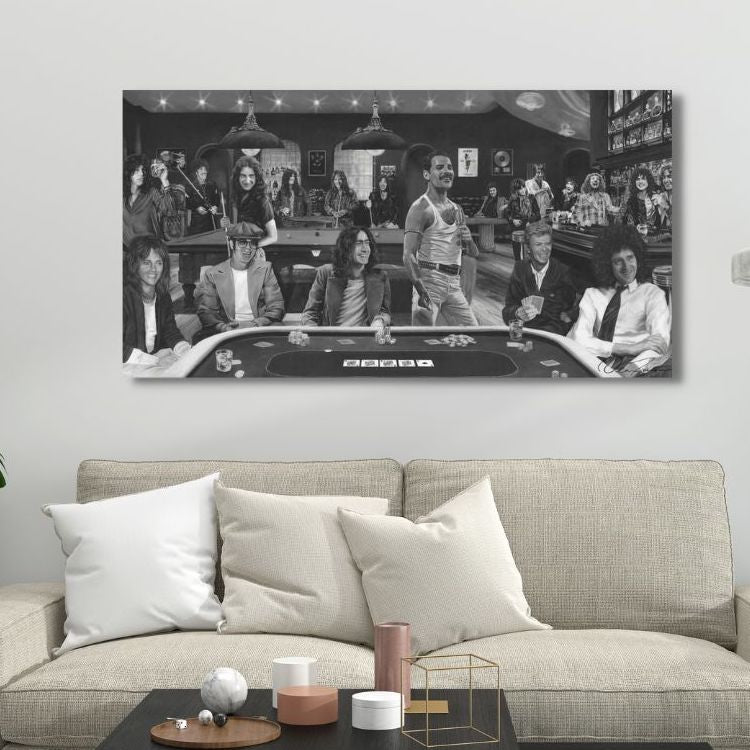


Hang this painting and someone will always point at a face and ask, “Who’s that?” Dean Turner’s Ultimate Guitarist Reunion is a hand-painted original of 45 guitar greats, 12 months from planning and hand painting to finish. This is the story of one of them, Eric Clapton. It’s available as a framed canvas print, made from the original, for the room where your music lives.
No. 3 Who’s Who Ultimate Guitarist Reunion
Three bands, three times into the Rock Hall
He’s the only artist the Rock & Roll Hall of Fame has inducted three times, and in September 2026, at 81, he was still headlining his own guitar festival in Austin.
 3of 45

In this story 13 sections
Why fans still care
ERIC CLAPTON walked on during Tedeschi Trucks Band’s set at the Moody Center in Austin in September 2026 and played an electric “Layla” with them. The next night he headlined. He was 81, and it was the seventh Crossroads Guitar Festival he’s put on to raise money for the treatment centre he founded in Antigua.
That’s the long view. The short version is a list of bands other guitarists still argue about: the Yardbirds, John Mayall’s Bluesbreakers, Cream, Blind Faith, Derek and the Dominos, then decades under his own name. The Rock & Roll Hall of Fame has inducted him three times, which nobody else can say.
And the list of people who learned from him is long. Eddie Van Halen, Who’s Who number 34 wrote in his Rock Hall essay that Clapton was the only guitarist who influenced him.
The songs haven’t gone anywhere either. On Spotify, Wonderful Tonight is his most played recording, at about 700 million plays by October 2026, and the original Derek and the Dominos Layla is close behind at about 625 million. Fans on setlist.fm have logged more than 1,400 live performances of Layla, more than any other song he plays.
Early life and training
Eric Clapton was born on 30 March 1945 at his grandparents’ house, 1 The Green, in the Surrey village of Ripley. His mother, Patricia, was 16. His father, Edward Fryer, was a Canadian soldier.
He was raised by his grandmother, Rose, and her husband, Jack Clapp, and grew up believing they were his parents. He found out the truth at about nine.
School went through St Bede’s Secondary Modern, then the art branch of Holyfield Road School, then Kingston College of Art, which expelled him around 1961 or 1962.
Music was going better than art school. He asked for a guitar for his 13th birthday and got a German-made Hoyer that he found hard to play. Guitar.com says he sold it two years later for five pounds. A George Washburn Spanish acoustic came next. Around 1962 his grandparents helped him buy a £100 Kay electric, a copy of the Gibson ES-335, and Guitar.com says he played that double-cutaway Kay in his first band, The Roosters.
Career chapters
- 1963Joins the Yardbirds
- 1965Joins John Mayall’s Bluesbreakers
- 1966Cream forms
- 1970Derek and the Dominos record Layla
- 1974“I Shot the Sheriff” goes to number 1 in the US
- 1990Alpine Valley
- 1993Six Grammys in one night
- 2000Third Rock Hall induction
- 20267th Crossroads Guitar Festival, Austin
The Yardbirds 1963
He joined the Yardbirds in October 1963 and stayed about 18 months. It’s where he picked up the nickname “Slowhand”.
His main guitar in the Yardbirds wasn’t even his. Guitar.com says it was a red 1963 Fender Telecaster owned by the band’s management, played through a Vox AC30. While he was in the band he bought a guitar of his own, a cherry red 1964 Gibson ES-335, and he kept it for decades.
The Bluesbreakers 1965 to 1966
In April 1965 he joined John Mayall’s Bluesbreakers. He came and went, and left for good in July 1966.
The album he made with them, Blues Breakers with Eric Clapton, came out in 1966. Fans call it the Beano album, after the comic he’s reading on the cover. He plugged a Gibson Les Paul Standard, probably a 1960 by his memory of its very slim neck, into a 45-watt 1962 Marshall combo and played at full stage volume in the studio. Vintage Guitar says the engineer, Gus Dudgeon, was taken aback when he turned up to gig volume. The producer, Mike Vernon, says there were no pedals.
Guitarists still point to it. Its Hideaway is number 42 on Rolling Stone’s 2008 list of the 100 greatest guitar songs, and Brian May, Who’s Who number 20 has called his solo on Key to Love one of his great inspirations. That guitar didn’t last. It was stolen at an early Cream rehearsal.
The back of the Blues Breakers with Eric Clapton album turned out to matter to at least one young Texan. Billy Gibbons, Who’s Who number 5 has said the photo of Clapton with a sunburst Les Paul there set him looking for one of his own.
Cream 1966 to 1968
Cream formed in July 1966: Clapton on guitar, Jack Bruce on bass and Ginger Baker on drums.
On 1 October 1966, at the Regent Street Polytechnic in London, Jimi Hendrix, Who’s Who number 6 asked to sit in. Jack Bruce said Clapton agreed at once. Clapton’s memory of Hendrix, Who’s Who number 6 that night was that he was “very, very flash, even in the dressing room”.
Cream stretched songs into long improvisations on stage, and the peak of it on record is the live Crossroads, number 3 on Rolling Stone’s 2008 guitar songs list. White Room is on the same list at number 55.
Cream said goodbye at the Royal Albert Hall on 26 November 1968.
A Beatles session 1968
That same year George Harrison, Who’s Who number 44 asked him to play on “While My Guitar Gently Weeps”. Guitar Player has told the story of how he nearly said no. He didn’t, and the lead solo on The Beatles’ track is his.
Blind Faith, Delaney & Bonnie and Derek and the Dominos 1969 to 1970
Next came Blind Faith, with Steve Winwood, Ginger Baker and Rick Grech. They made one album. Clapton played a Telecaster fitted with a Stratocaster neck, and a 12-string Tony Zemaitis built for him in 1969, which he nicknamed “Ivan The Terrible”. Clapton then went out on tour as a sideman with Delaney & Bonnie & Friends, which is about as far from the spotlight as he could get.
In the summer of 1970 he formed Derek and the Dominos, and they recorded Layla and Other Assorted Love Songs. His main Strat for the album was Brownie, a sunburst 1956 Stratocaster with a maple neck, and it’s on the back sleeve. Layla is number 13 on Rolling Stone’s 2008 guitar songs list.
Duane Allman of the Allman Brothers Band joined them for those sessions. By his own account, he’d asked the producer, Tom Dowd, to call him when Clapton came to town, and the two hit it off on the spot. Allman told Good Times magazine in 1971 that Clapton said they were “going to have two guitar players instead of one”. Guitar World says Allman’s slide is all over I Am Yours and Nobody Knows You, and that he plays the opening riff of Layla with Clapton.
The Rainbow and 461 Ocean Boulevard 1973 to 1974
The early 1970s were hard years, and he has spoken openly about his heroin addiction. His way back on stage was two concerts at the Rainbow Theatre in January 1973, organised by Pete Townshend, Who’s Who number 8.
Then came 461 Ocean Boulevard in 1974. He didn’t want to record “I Shot the Sheriff”. His bandmate George Terry brought him the song, he recorded it anyway, and on 14 September 1974 it went to number 1 on the US Hot 100 for a week. It’s still his only US number 1.
Slowhand to Journeyman 1977 to 1989
The albums kept coming: Slowhand, Behind the Sun, August, Journeyman. Slowhand gave him Wonderful Tonight and his version of JJ Cale’s Cocaine, and the RIAA certified the album three times platinum in 1993. He played Live Aid in 1985.
Away from the records, in January 1982 he went into Hazelden for treatment, and his official site says he has been sober since 1987.
Alpine Valley 1990
On 25 and 26 August 1990, Clapton’s tour played Alpine Valley in East Troy, Wisconsin, to about 40,000 people on the sold-out Saturday and 35,000 on the Sunday. Stevie Ray Vaughan, Who’s Who number 4 was on the bill and joined the closing jam on “Sweet Home Chicago”.
Early the next morning, the helicopter carrying Vaughan, Who’s Who number 4 and three members of Clapton’s team crashed after takeoff. Everyone aboard died: Vaughan, Who’s Who number 4, Bobby Brooks, Nigel Browne, Colin Smythe and the pilot. Clapton was not on board. Through his press agent he called the men “my companions, my associates and my friends”.
Tears in Heaven and Unplugged 1991 to 1993
In March 1991 his four-year-old son, Conor, died after a fall from a high window in Manhattan. An inquest in January 1992 found it was an accident, and Clapton said he blamed no one. He wrote “Tears in Heaven” in Conor’s memory.
His Unplugged album came out in 1992 and is certified Diamond in the US. He played it on two old Martins, a 1939 000-42 and a 1966 000-28. At the Grammys in 1993 he won six awards in one night, including Record of the Year for “Tears in Heaven”. No British artist had done that before.
Back to the blues 1994 to 1998
From the Cradle in 1994 was a straight blues album. Guitar.com says he had about 50 guitars at the sessions, among them the cherry ES-335 from his Yardbirds days. In 1995 “Love Can Build a Bridge”, credited to Cher, Who’s Who number 8 in · The Ultimate Reunion (story coming soon), Chrissie Hynde and Neneh Cherry with Eric Clapton, went to number 1 in the UK. It’s still his only UK number 1 single.
In February 1998 he announced the Crossroads Centre in Antigua, a treatment centre for addiction.
Riding with the King and Crossroads 2000 to 2018
In 2000 he made a whole album with B.B. King, Who’s Who number 2. Riding with the King won a Grammy and went double platinum in the US.
More records followed: Reptile, Me and Mr. Johnson, Back Home and The Road to Escondido, made with JJ Cale, which won a Grammy in 2008.
The first Crossroads Guitar Festival ran from 4 to 6 June 2004 in Dallas. His autobiography, Clapton, came out in 2007. At 70, in 2015, he said he was giving up long world tours. He kept playing anyway, and in 2018 his official site counted 65,000 people at his Hyde Park show.
Meanwhile 2024 to now
Meanwhile came out digitally on 4 October 2024, with CD and vinyl following in January 2025. Van Morrison and Judith Hill turn up as guests, and Jeff Beck, Who’s Who number 15 plays on “Moon River”.
Then Austin, September 2026, and “Layla” again.
very, very flash, even in the dressing room
Craft, sound and style
Ask a Clapton fan about guitars and you’ll hear about Blackie. It’s a Stratocaster he put together from the parts of three vintage Strats, and it became the basis of Fender’s Eric Clapton Signature Model.
Before that came the cheap stuff: the Hoyer he couldn’t get on with, and the £100 Kay that was meant to look like an ES-335.
The Rock & Roll Hall of Fame lists the players he learned from, and three of them are in this painting: Robert Johnson, Who’s Who number 45, B.B. King, Who’s Who number 2 and Albert King, Who’s Who number 1. Freddie King, Muddy Waters, Buddy Guy, T-Bone Walker and Scotty Moore are on that list too. The same page lists Dire Straits, Guns N’ Roses, Metallica, Black Sabbath and Deep Purple among the acts that came after and learned from him.
Light strings and a slow hand
Until about 1967 he strung his guitars very light on the top strings, and used a Fender Rock ’n’ Roll string for the G. Guitar.com ties the “Slowhand” nickname to a joke about how often those strings broke. Accounts of where the nickname came from differ, so take that as Guitar.com’s version.
The Beano sound
The Bluesbreakers album set the template. Guitar.com says the 1962 Marshall combo he used ran KT66 valves, which it credits with a more refined midrange and a clearer top end than EL34 or 6L6 valves. Guitar Player says the sound he got that way is now a guitar industry standard.
Jim Campilongo, writing in Guitar Player for the album’s 60th birthday in 2026, points to the feedback note that ends Steppin’ Out, the swing of Hideaway and his solo on Have You Heard.
Cream and the woman tone
With Cream the rig got bigger: 100-watt Marshall heads into two full stacks of 4x12 cabinets, and a Vox wah. He stayed with Vox wahs for decades.
The guitars changed fast. After the Bluesbreakers guitar was stolen he bought the “Summers Burst”, a Gibson Les Paul, from Andy Summers, and he also played a black 1950s Gibson Les Paul Custom that had belonged to Paul Kossoff. Then came the Gibson SG known as “The Fool”. Guitar.com says it made its debut at the RKO Theater in Manhattan in March 1967 and was his main live guitar until late spring 1968. A 1964 Firebird I came out at the first of the Royal Albert Hall farewell shows, and an ES-335 at the second and on Badge.
In 1967 he gave the sound a name. He told Beat Instrumental he was “developing what I call my ’woman tone.’” Guitar.com describes the method: a Gibson Les Paul or, more often, the SG into a 100-watt Marshall, with the guitar’s tone control turned almost all the way down and the volume full up. He said it “calls for the correct use of distortion”. Hear it on Sunshine of Your Love, Tales of Brave Ulysses and Strange Brew.
Brownie and Blackie
By 1970 he had moved to the Fender Stratocaster. Brownie, the 1956 Strat he’d bought in 1967, hardly came out with Cream but carried the Layla album. It sold at Christie’s in New York in June 1999 for US$497,500, including the buyer’s premium (US$450,000 at the hammer).
Blackie came next, in 1970. He bought several late 1950s Strats cheaply at the Sho-Bud shop in Nashville and built one guitar from the best parts. He gave Strats from the same batch to Steve Winwood, George Harrison, Who’s Who number 44 and Pete Townshend, Who’s Who number 8. He called the result “a hybrid, a mongrel”. His guitar tech Lee Dickson put it more exactly: “a ’56 body, a ’57 neck, and the pickups from a third guitar”.
Blackie was his main guitar from 1970 until he retired it in 1985. Vintage Guitar says it’s the guitar on Cocaine, and you can see it in The Last Waltz and at Live Aid.
The signature Strat
Fender’s Eric Clapton Stratocaster came out in 1988, loosely based on Blackie. The first prototype had a 14 dB boost, and it wasn’t enough for him. The production guitar got three Fender Gold Lace Sensor pickups and a circuit with a 25 dB mid-boost. It has a softer V-shaped neck than Blackie, a black finish arrived in 1991, and today’s models use Vintage Noiseless pickups.
Other players took to it. Townshend, Who’s Who number 8 has played Strats since 1989, and told Premier Guitar in 2010, “when I found the Eric Clapton Strat I got the best of two worlds”.
Acoustics, amps and the rest
For acoustic work he went to Martin. Besides the two on Unplugged, Martin had made six Clapton signature models by 2020.
From the 1970s he used old tweed Fender Champs in the studio and Fender Twins live, which Fender’s Custom Shop later copied for him. He’s also named Marshalls, a Soldano SL-100 and a Cornell amp built for him. Guitar.com’s 2020 overview lists the later pedals, with no dates: a Boss CE-3 chorus, a Dunlop 535 Cry Baby, a Hendrix signature wah and a Vox wah, a Boss TR-2 tremolo, a Boss Heavy Metal and the discontinued DigiTech Crossroads.
Most of the original guitars are gone now. Many were sold at the 1999, 2004 and 2011 auctions for the Crossroads Centre.
What other players say
“My main influence was Eric Clapton”
“Clapton was unbelievable, just so sparkling and fluid”
“the hottest, burning, high-passion piece I’ve ever heard in my life”
“I know every solo he’s ever played, note-for-note”
“I didn’t realize the depth or emotion there was in it”
Stories people still tell
“Clapton is God.” Someone painted those three words on a wall when he was about 20, after he’d left the Yardbirds. He wasn’t embarrassed at the time. “I suppose I felt that I deserved it,” he told Guitar World in 1994. “My head was huge!” In 2016 he told Classic Rock it had given him “a real cross to bear”. In the same interview he said he suspects Hamish Grimes, who worked for the Yardbirds’ manager, Giorgio Gomelsky, warming up the crowd at the Crawdaddy club, painted it himself. “I really doubt that it was a genuine fan,” he said.
-
The night Hendrix sat in.
London, 1 October 1966. A guitarist few people had heard of asked to jam with Cream. Clapton said yes. Louder has called it the night Hendrix, Who’s Who number 6 “killed god”.
-
The Beatles solo.
Harrison, Who’s Who number 44 wanted him on “While My Guitar Gently Weeps”. By Guitar Player’s account, he nearly didn’t do it.
-
The song he didn’t want to record.
He wasn’t keen on “I Shot the Sheriff”. George Terry brought it to him, and it became his only US number 1.
-
Blackmore’s first Strat.
In 1969 Ritchie Blackmore, Who’s Who number 14 bought his first Stratocaster for £60 from Clapton’s roadie, who brought it round to the house in Acton where Deep Purple were living. Blackmore told the story to Guitar World, and Guitar Player reported it in 2026.
-
Getting him back into the blues.
Rory Gallagher’s, Who’s Who number 21 band Taste supported Cream, and Gallagher’s official site says Clapton later credited him with “getting me back into the blues”.
-
Three inductions, three presenters.
The Edge, Who’s Who number 7 inducted the Yardbirds in 1992. ZZ Top inducted Cream in 1993. Robbie Robertson inducted Clapton as a solo artist in 2000.
Legacy
He’s in the Rock & Roll Hall of Fame three times. Grammy.com counts 17 wins from 37 nominations; his own site says 18. He was made a CBE in the 2004 New Year Honours for services to music, and he won a BAFTA for his score for Edge of Darkness.
The money side of the legacy goes to Crossroads, and three guitar sales in New York raised a large part of it. Christie’s sale in June 1999 made US$5.07 million. The second Christie’s sale, in June 2004, made US$7.44 million, and it included guitars given by friends as well as his own. Bonhams’ sale in March 2011 made about US$2.15 million. All three figures include the buyer’s premium, and together the three sales come to about US$14.7 million.
The festival is still going. At the 2026 edition in Austin, Australia’s Tommy Emmanuel, Who’s Who number 26 in · Ultimate Aussie Reunion - Part 2 (story coming soon) made his Crossroads debut.

on the
Who’s Who
In the painting
Eric Clapton | Cream/Yardbirds
Number 3 of 45 on the Who’s Who list for Ultimate Guitarist Reunion, published as Eric Clapton | Cream/Yardbirds.
Dean painted him and Stevie Ray Vaughan, Who’s Who number 4 next to each other, with Billy Gibbons, Who’s Who number 5 just past Vaughan in the same back row. Vaughan, Who’s Who number 4 was on the bill for Clapton’s two Alpine Valley shows on 25 and 26 August 1990, and early the next morning the helicopter carrying him and three members of Clapton’s team crashed after takeoff. The link with Gibbons, Who’s Who number 5 is a happier one: a photo of Clapton with a sunburst Les Paul on the back of the Blues Breakers album sent Gibbons hunting for one of his own, and in 1993 ZZ Top inducted Cream into the Rock & Roll Hall of Fame.
Find Eric Clapton among all 45 guitarists in Ultimate Guitarist Reunion.
Who’s Who in the Ultimate Guitarist Reunion
Numbered as on the painting’s key. Pick a name to read their story.
- Story live
- Coming soon
- You’re reading
 Find the numbers on the painting
- 1Albert King
- 2B.B. King
- 3Eric Clapton | Cream/YardbirdsYou’re reading
- 4Stevie Ray Vaughan | Stevie Ray Vaughan & Double Trouble
- 5Billy Gibbons | ZZ TOP
- 6Jimi Hendrix | The Jimi Hendrix Experience/Solo
- 7The Edge | U2
- 8Pete Townshend | The Who
- 9David Gilmour | Pink Floyd
- 10Kirk Hammett | Metallica
- 11Peter Frampton | Solo/Humble Pie/The Herd
- 12George Thorogood | George Thorogood & the Destroyers
- 13Mark Knopfler | Dire Straits
- 14Ritchie Blackmore | Deep Purple/Rainbow
- 15Jeff Beck | Solo/Yardbirds
- 16Gary Moore
- 17Joe Perry | Aerosmith
- 18Prince
- 19Ronnie Wood | Rolling Stones
- 20Brian May | Queen
- 21Rory Gallagher | Solo/Taste
- 22Tom Morello | Rage Against the machine /Audioslave
- 23Tony Iommi | Black Sabbath
- 24Carlos Santana
- 25Joe Walsh | Eagles
- 26Jack White | Solo/White Stripes
- 27Zakk Wylde | Ozzy Osbourne/Black Label Society
- 28Randy Rhoads | Ozzy Osbourne
- 29Joe Satriani
- 30Steve Vai
- 31Keith Richards | Rolling Stones
- 32Jimmy Page | Led Zeppelin/Yardbirds
- 33James Hetfield | Metallica
- 34Eddie Van Halen | Van Halen
- 35Angus Young | AC/DC
- 36Chuck Berry
- 37Kurt Cobain | Nirvana
- 38Les Paul
- 39Lenny Kravitz
- 40Bo Diddley
- 41Johnny Winter
- 42Malcolm Young | AC/DC
- 43Slash | Guns N Roses
- 44George Harrison | Beatles/Traveling Wilburys/Solo
- 45Robert Johnson
Sources
- Eric Clapton official site, About. ericclapton.com
- Rock & Roll Hall of Fame, Eric Clapton. rockhall.com
- Rock & Roll Hall of Fame, Cream. rockhall.com
- Rock & Roll Hall of Fame, The Yardbirds. rockhall.com
- Encyclopedia.com, Clapton, Eric 1945-. encyclopedia.com
- Grammy.com, Eric Clapton. grammy.com
- Official Charts Company, Eric Clapton. officialcharts.com
- RIAA Gold & Platinum, Eric Clapton. riaa.com
- Stereogum, The Number Ones: “I Shot the Sheriff”. stereogum.com
- UPI, Stevie Ray Vaughan and four others killed (1990). upi.com
- UPI, Clapton’s son dies (1991). upi.com
- UPI, coroner’s finding (1992). upi.com
- Ultimate Classic Rock, Meanwhile announced. ultimateclassicrock.com
- Blues Rock Review, Crossroads Guitar Festival 2026 recap. bluesrockreview.com
- Louder, the night Hendrix sat in with Cream. loudersound.com
- Guitar Player, the While My Guitar Gently Weeps solo. guitarplayer.com
- Hello! magazine, New Year Honours (CBE). hellomagazine.com
- Guitar Player, Billy Gibbons on Pearly Gates (Blues Breakers rear-sleeve photo). guitarplayer.com
- MusicRadar, Billy Gibbons on Pearly Gates (Clapton’s Beano Burst gave him the idea). musicradar.com
- Future Rock Legends, Rock and Roll Hall of Fame class of 1993 (Cream inducted by ZZ Top). futurerocklegends.com
- Guitar.com, Michael Leonard, “Guitar Legends: Eric Clapton, the birth of a legend”, 24 Nov 2020 (Hoyer, Washburn, Kay and The Roosters; Yardbirds Telecaster, AC30 and ES-335; Beano Les Paul and Marshall; Vernon; Cream guitars and amps; woman tone; strings and Slowhand). guitar.com
- Guitar.com, Michael Leonard, “Guitar Legends: Eric Clapton Pt 2, from Layla to the Crossroads”, 29 Dec 2020 (Blind Faith guitars, Brownie, Blackie, signature Strat, Martins, From the Cradle, later amps, auctions). guitar.com
- Vintage Guitar, Willie G. Moseley, “Eric Clapton’s Blackie”, June 2004 issue (Dickson quote, Brownie auction price, Cocaine, The Last Waltz, Live Aid, retirement). vintageguitar.com
- Guitar Player, Jim Campilongo, “Eric Clapton’s Beano album just turned 60, but you’re still missing the point”, 23 Jul 2026 (Dudgeon, Steppin’ Out, Hideaway, Have You Heard). guitarplayer.com
- Guitar Player, Jas Obrecht, Eddie Van Halen’s first interview, Nov 1978 (web 2 Nov 2020). guitarplayer.com
- Guitar Player, Christopher Scapelliti with Jas Obrecht, “Brian May on Eric Clapton and Jimi Hendrix”, 25 Sep 2026. guitarplayer.com
- Guitar Player, Phil Weller, “Brian May’s favorite guitar solo”, 25 Jun 2026 (Key to Love). guitarplayer.com
- Stereogum (reproducing Rolling Stone), “100 Greatest Guitar Songs Of All Time”, 30 May 2008 (Crossroads 3, Layla 13, Hideaway 42, White Room 55). stereogum.com
- kworb.net, Eric Clapton Spotify top songs, updated 7 Oct 2026; Derek and the Dominos, updated 30 Sep 2026. https://kworb.net/spotify/artist/6PAt558ZEZl0DmdXlnjMgD_songs.html and kworb.net
- setlist.fm, Eric Clapton song statistics (user-submitted), read 11 Oct 2026. setlist.fm
- Premier Guitar, “Pete Townshend: On Guitar-Smashing Regrets, Stylistic Evolution, and Becoming a Gear Aficionado”, 11 Mar 2010 (Clapton Strat quote). premierguitar.com
- Mixdown, “Fender Custom Shop Introduce Pete Townshend Stratocaster”, c. July 2016 (Strats since 1989). mixdownmag.com.au
- Guitar Player, Phil Weller, “Ritchie Blackmore says his first Stratocaster came from Eric Clapton”, 30 Sep 2026. guitarplayer.com
- Official Site of Rory Gallagher, “The Story” (Taste supported Cream; “getting me back into the blues”). rorygallagher.com
- MusicBrainz, Eric Clapton, album release groups (studio albums and first-release years; read 12 Oct 2026). musicbrainz.org
- Discogs, Eric Clapton discography (albums). discogs.com
- New York Post, “No slow hands as bidders give Clapton cause $5M”, 25 Jun 1999 (US$5,072,350 with premiums). nypost.com
- Christie’s, lot page, “Brownie” 1956 Fender Stratocaster, sold 24 Jun 1999 for US$497,500. christies.com
- Rolling Stone, “Clapton Guitars Fetch $5 Million at Auction” (1999). rollingstone.com
- Christie’s press release, Crossroads Guitar Auction, 24 Jun 2004 (US$7,438,624; Blackie US$959,500). christies.com
- CBS News, “New ’Record’ For Clapton” (2004 sale). cbsnews.com
- BBC News, “Eric Clapton auctions guitars for charity”, 10 Mar 2011 (Bonhams NY, about US$2.15m). bbc.com
- ABC News, “Clapton guitar auction raises $2.15m”, 10 Mar 2011. abc.net.au
- Vintage Guitar, “Eric Clapton in Mayall’s Blues Breakers” (Dudgeon taken aback; Clapton reading the Beano on the cover). vintageguitar.com
- Louder, “John Mayall & The Bluesbreakers: the story of the Beano album” (the Beano comic on the cover). loudersound.com
- Guitar World, Matt Owen, Duane Allman on meeting Eric Clapton and making Layla (8 Aug 2026; Allman’s 1971 Good Times interview, reprinted in Guitar World, Nov 1991). guitarworld.com
- Guitar World, Jackson Maxwell, why Clapton felt he “deserved” the “Clapton is God” tag (13 Apr 2025; quotes his 1994 Guitar World interview). guitarworld.com
- Classic Rock (Louder), Paul Lester, “The Many Faces Of Eric Clapton: ’God’ speaks!” (10 Jun 2016: “a real cross to bear”, Hamish Grimes, Giorgio Gomelsky, the Crawdaddy). loudersound.com
Names appear exactly as published on the Who’s Who list for Ultimate Guitarist Reunion.
See the names list for other Ultimate Series artworks
Every painting has its own numbered Who’s Who. Pick a scene and see who’s in it.
 Ultimate Aussie Pub Rock ReunionSee who’s in it
  Ultimate Aussie Reunion - Part 2See who’s in it
  Highway to HellSee who’s in it
  The Ultimate ReunionSee who’s in it
  Ultimate Eagles ReunionSee who’s in it
  Ultimate Queen ReunionSee who’s in it
  Ultimate Beatles ReunionSee who’s in it
  Ultimate Classic Country ReunionSee who’s in it
  Ultimate Hip Hop ReunionSee who’s in it
  Ultimate Gangster ReunionSee who’s in it
  Ultimate Boxing ReunionSee who’s in it
  Ultimate Fighter ReunionSee who’s in it