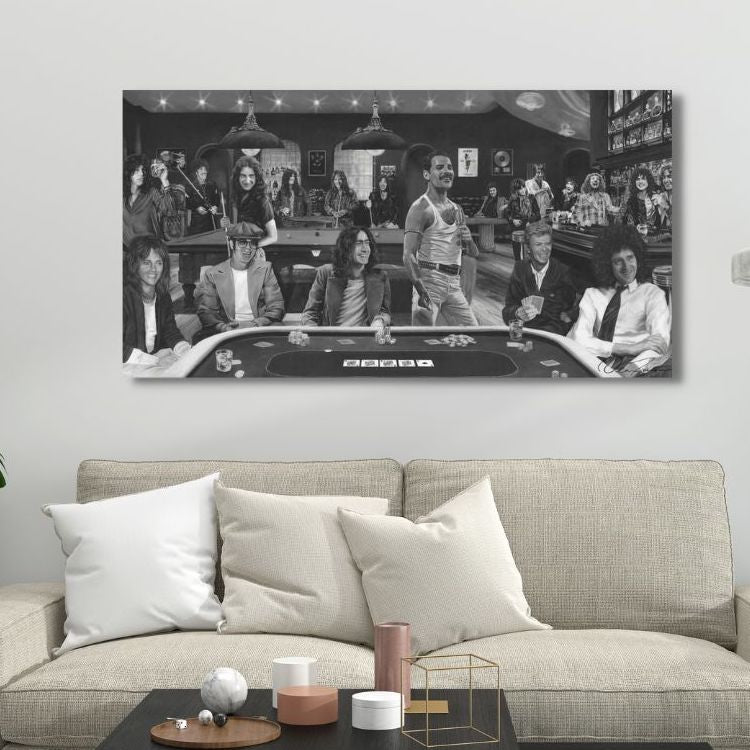

Dean has painted David Gilmour into two of his paintings, and each one puts him in different company.

Hang this painting and someone will always point at a face and ask, “Who’s that?” Dean Turner’s Ultimate Guitarist Reunion is a hand-painted original of 45 guitar greats, 12 months from planning and hand painting to finish. David Gilmour is one of them.

If your car stereo has worn out a West Coast record or two, you’ll know most of this crowd. Dean Turner’s Ultimate Eagles Reunion is a hand-painted original of 24 numbered faces: the Eagles, Fleetwood Mac, Crosby, Stills and Nash, Neil Young and Carole King, with David one of two from Pink Floyd. It was painted over 12 months.
Each one is available as a framed canvas print, made from the original, for the room where your music lives. This is David Gilmour’s story.
No. 9 Who’s Who Ultimate Guitarist Reunion
from Cambridge to the Circus Maximus
He joined Pink Floyd to cover for Syd Barrett, and more than half a century later he opened a tour with six nights at the Circus Maximus in Rome.
 9of 45
In this story 13 sections
Why fans still care
DAVID GILMOUR used to own the Black Strat. In March 2026 it sold at Christie’s for about US$14.55 million, and no guitar had ever made more at auction. He wasn’t even the one selling it.
That’s how much the sound means to people. Count Pink Floyd’s records and his own and he has had ten number 1 albums in Britain.
The Dark Side of the Moon, from 1973, spent 937 weeks on the US Billboard 200. Guinness World Records lists that as the most weeks on the chart for any album.
Early life and training
David Jon Gilmour was born in Cambridge on 6 March 1946. His father, Douglas, was a senior lecturer in zoology at the University of Cambridge, and his mother, Sylvia, was a teacher.
Before Pink Floyd he played in Jokers Wild, one of the most popular bands on the Cambridge pub scene in the 1960s. In January 1967 the band went to Paris for a club residency at Le Bilboquet, and he stayed on until the end of that summer.
In late 1967 or early 1968 (the sources don’t agree on the month) he joined Pink Floyd as a guitarist and singer. He was brought in to cover for Syd Barrett.
Career chapters
- 1967 to 1968Joins Pink Floyd
- 1968Syd Barrett leaves, and the guitar is Gilmour’s
- 1973The Dark Side of the Moon
- 1978First solo album, David Gilmour
- 1979The Wall
- 1985Roger Waters, Who’s Who number 18 in · Ultimate Eagles Reunion (story coming soon) leaves the band
- 1987A Momentary Lapse of Reason, the first Pink Floyd album without Waters, Who’s Who number 18 in · Ultimate Eagles Reunion (story coming soon)
- 1994The Division Bell
- 1996Rock & Roll Hall of Fame with Pink Floyd
- 2003CBE
- 2005Live 8, Pink Floyd’s four members together again
- 2014The Endless River, the last Pink Floyd album
- 2024Luck and Strange, his third solo UK number 1
Joining Pink Floyd and the Syd Barrett years 1968 to 1975
Gilmour and Syd Barrett met as children in Cambridge, and later they played guitar together. In 1965 Barrett co-founded Pink Floyd, while Gilmour kept playing in his own bands.
For a short time in early 1968 Pink Floyd were a five-piece. A photo shoot that January is the only one with both Barrett and Gilmour in it. The five-piece played its first gig on 12 January 1968 and only a handful more. On 26 January the band played without Barrett for the first time, and from then on the guitar was Gilmour’s.
He didn’t walk away from his old friend. When Barrett made his two solo albums in 1970, Gilmour co-produced part of The Madcap Laughs, some of it with Roger Waters, Who’s Who number 18 in · Ultimate Eagles Reunion (story coming soon), and produced Barrett on his own.
Barrett’s shadow stayed over the band. On 5 June 1975, while they were working on Wish You Were Here at Abbey Road, an overweight man with a shaved head and no eyebrows turned up in the studio, and it took them a while to realise it was Syd. In some accounts they were mixing Shine On You Crazy Diamond, a song about him, at the time.
Gilmour has said he has a regret or two about Barrett, who died in 2006. “I regret that I never went up to his house and knocked on the door,” he said.
Dark Side and The Wall 1973 to 1979
The Rock & Roll Hall of Fame counts Pink Floyd among the architects of psychedelic and progressive rock. It puts The Dark Side of the Moon (1973) and The Wall (1979) among the most ambitious and best-selling albums ever made.
In Britain, the band’s number 1 albums run from Atom Heart Mother through Wish You Were Here to The Final Cut, and later The Division Bell, Pulse and The Endless River, and in 2025 the live At Pompeii MCMLXXII.
The push and pull with Roger Waters 1975 to 1985
By the mid-1970s the band were pulling in two directions. Louder describes the Wish You Were Here sessions as a struggle to agree, with Roger Waters, Who’s Who number 18 in · Ultimate Eagles Reunion (story coming soon) intent on a new path and Gilmour and Rick Wright happy with the road they were on.
The Wall brought it to a head. Producer Bob Ezrin recalled that Waters, Who’s Who number 18 in · Ultimate Eagles Reunion (story coming soon) hadn’t planned to use any of Gilmour’s material at first. Gilmour said Ezrin was there partly as a man in the middle between the two of them. “Our arguments were numerous and heated,” Gilmour said.
Comfortably Numb started as Gilmour’s demo. Ezrin fought for it, and Waters, Who’s Who number 18 in · Ultimate Eagles Reunion (story coming soon) wrote the words. Even then they argued. By Ezrin’s account, Gilmour wanted it lean, with just bass, drums and guitar, while Waters, Who’s Who number 18 in · Ultimate Eagles Reunion (story coming soon) sided with Ezrin’s idea of an orchestra. They had a row over which of two backing tracks to use, and in the end used bits of both. Gilmour called songs like it the last embers of their ability to work together: “my music, his words.”
By The Final Cut in 1983, which Uncut calls a Waters, Who’s Who number 18 in · Ultimate Eagles Reunion (story coming soon) solo album in all but name, there wasn’t much partnership left. In December 1985 Waters, Who’s Who number 18 in · Ultimate Eagles Reunion (story coming soon) wrote to the band’s record companies to say he had left.
Rockestra and the first solo records 1978 to 1984
His first solo album, David Gilmour, came out in 1978 and reached number 17 in the UK. On 3 October that year he was at Abbey Road Studio Two. Paul McCartney, Who’s Who number 4 in · Ultimate Beatles Reunion (story coming soon) had called a rock orchestra together for the Wings track Rockestra Theme, and the guests included Pete Townshend, Who’s Who number 8 and John Bonham, Who’s Who number 6 in · Highway to Hell (story coming soon). Eric Clapton, Who’s Who number 3, Jeff Beck, Who’s Who number 15 and Jimmy Page, Who’s Who number 32 were invited too, but didn’t come.
His second solo record, About Face, reached number 21 in 1984.
Pink Floyd after Waters 1986 to 2014
Gilmour didn’t see Waters, Who’s Who number 18 in · Ultimate Eagles Reunion (story coming soon) leaving as the end of Pink Floyd. “We felt we were released,” he told Uncut. In 1986 he and Nick Mason started work on a new record with Ezrin aboard the Astoria, Gilmour’s houseboat studio. Waters, Who’s Who number 18 in · Ultimate Eagles Reunion (story coming soon) went to court to stop them using the Pink Floyd name, arguing the band were “a spent force creatively”.
The case was settled at the end of 1987, at a meeting on the same houseboat. Years later Waters, Who’s Who number 18 in · Ultimate Eagles Reunion (story coming soon) admitted he had got it wrong. “I was wrong! Of course I was,” he told the BBC in 2013.
A Momentary Lapse of Reason came out on 7 September 1987 and reached number 3 in Britain and America, with Gilmour leading the band and Rick Wright back on board for the tour. The tour ran to almost 200 shows. With no sponsors, Gilmour and Mason paid for the production themselves, and Mason put up his 1962 Ferrari 250 GTO as collateral. He still owns it. “David carried most of that tour on his shoulders,” Mason said.
The Division Bell followed in March 1994, and Gilmour had found a new songwriting partner in Polly Samson. It was the band’s biggest seller since The Wall and went to number 1 in Britain and America. Marooned, an instrumental Gilmour wrote with Wright, won a Grammy. The band’s last full concert was at Earl’s Court in London on 29 October 1994.
Twenty years later Gilmour and Mason went back to the Division Bell sessions and built The Endless River from them, as a tribute to Wright. Gilmour said Wright had been “underestimated by the public, by the media and by us at times”. It went to number 1 in Britain in 2014, and Gilmour said he was pretty certain it would be the band’s last. “This is the last thing that’ll be out from us,” he told BBC 6 Music.
McCartney, the Who and the Hall of Fame 1984 to 1999
He kept turning up on McCartney’s, Who’s Who number 4 in · Ultimate Beatles Reunion (story coming soon) records in the 1980s and 1990s. On 14 December 1999 he played in McCartney’s, Who’s Who number 4 in · Ultimate Beatles Reunion (story coming soon) band at the Cavern Club in Liverpool.
Pink Floyd’s live album Pulse (1995) went to number 1 in Britain. In 1996 the band went into the Rock & Roll Hall of Fame, presented by Billy Corgan. The same year he joined the Who at their Hyde Park concert, singing The Dirty Jobs and playing guitar on Love Reign O’er Me.
In November 2003 he was made a CBE for services to music, at Buckingham Palace. He joked that the Queen had probably heard Pink Floyd through her children or grandchildren.
Live 8 2005
On 2 July 2005, at Live 8 in Hyde Park, Gilmour, Roger Waters, Who’s Who number 18 in · Ultimate Eagles Reunion (story coming soon), Nick Mason and Rick Wright played together for the first time since 1981, when they’d last shared a stage at Earl’s Court. They did four songs in about 20 minutes: Breathe, Money, Wish You Were Here and Comfortably Numb.
“The moment was bigger than those bad feelings,” Gilmour said. Afterwards Pink Floyd’s sales jumped by about 1,300 per cent, and he said he’d give his share of that rise to charity.
The moment was bigger than those bad feelings.
On his own terms 2006 to 2026
On an Island went to number 1 in 2006. Two years later, on 15 September 2008, Rick Wright died, aged 65. Gilmour called him “such a lovely, gentle, genuine man”.
On 12 May 2011 he walked on at the O2 Arena during Roger Waters, Who’s Who number 18 in · Ultimate Eagles Reunion (story coming soon)’ The Wall Live and played Comfortably Numb with him. Rattle That Lock (2015) was another UK number 1.
In April 2022 he and Nick Mason put out Hey Hey Rise Up as Pink Floyd, with the Ukrainian singer Andriy Khlyvnyuk, to raise money for humanitarian relief in Ukraine. It was the first new Pink Floyd music since 1994. Gilmour called the Russian invasion “this vile act”.
Luck and Strange came out on 6 September 2024 and became his third solo number 1. The tour opened with six nights at the Circus Maximus in Rome, and the concert film, Live at the Circus Maximus, Rome, reached cinemas on 17 September 2025.
Craft, sound and style
The guitar everyone knows is the Black Strat. Jim Irsay bought it in 2019 for US$3,975,000. In March 2026 his estate sold it at Christie’s for about US$14.55 million, the most ever paid for a guitar at auction.
Listen to the solos in Comfortably Numb or Wish You Were Here and you’ll hear why. He doesn’t play many notes. He makes each one last.
He has his heroes, too. He told Mojo in 2016 that he wished he’d been one of the Beatles.
The Black Strat and the others
The Black Strat is a 1969 Fender Stratocaster he bought in 1970 at Manny’s, on West 48th Street in New York. Christie’s credits it on The Dark Side of the Moon, Wish You Were Here, Animals and The Wall, including Money, Shine On You Crazy Diamond and the Comfortably Numb solo, and on four of his solo albums, from David Gilmour in 1978 to Rattle That Lock in 2015. It was modified so often over the years that it once had an XLR output jack, since taken out. For a long stretch it sat on loan at the Hard Rock Cafe, until he took it back to play Live 8 on 2 July 2005.
It wasn’t the only famous guitar in the house. A white 1954 Stratocaster, serial number 0001, which he got in 1978, played the rhythm parts on Another Brick in the Wall Parts 2 and 3. The solo on Part 2 was a 1955 gold Gibson Les Paul. In the 1980s and 1990s his main electric was a Candy Apple Red 1984 ’57V Strat, the guitar on A Momentary Lapse of Reason and The Division Bell. In the studio his main acoustic was a 1969 Martin D-35 he bought on the streets of New York in 1971, and it’s all over Wish You Were Here.
He told Guitar World in 1993 about a few odd ones. The last Money solo was played on a Lewis guitar “made by some guy in Vancouver”, with “a whole two octaves on the neck”. Dogs was a custom Telecaster through Hiwatt amps and Yamaha rotating-speaker cabinets. By 1993 he was mostly on “modern ’57 reissue Strats with EMG pickups”.
Echoes, fuzz and lap steel
On Meddle in 1971 he was experimenting with a Binson Echorec, and One of These Days grew out of it, then Echoes. For One of These Days he set the vibrato on an H&H amp to roughly the tempo of the delay, and hid the tape splices under cymbal crashes. Money, two years later, was a Fuzz Face and a Binson echo. He thought the amp was a Hiwatt but wasn’t sure, and he recalled using Fender Twin Reverbs a lot in the studio.
His guitar tech Phil Taylor says the Comfortably Numb solos are a Big Muff and a delay, and that Gilmour would rather use a pedal like the Big Muff than a rack unit, because pedals have more character.
He doesn’t play slide with a bottleneck. He plays it on lap steel. One of These Days is a lap steel in open E minor (E, B, E, G, B, E from low to high), and The Great Gig in the Sky is open G with the top string left on E, so he could play major and minor chords on the top three strings. Live, up to 1993, he used two cheap Jensen lap steels fitted with Fender pickups.
Building a solo
On Comfortably Numb he recorded five or six solos, marked the bars he liked with ticks and crosses, then rode the faders to build one solo out of them. The first Money solo was artificially double-tracked. Live, he never plays a solo exactly as it is on the record.
Some of it goes back to A Saucerful of Secrets in 1968, when he laid the guitar on the studio floor and slid the leg of a mic stand along the neck.
He told Rick Beato he wasn’t gifted with enormous speed and just wants to play a nice tune, and he credits Hank Marvin of the Shadows for that. Beato has a name for what happens when fast players turn up on his channel: the “Gilmour Effect”, a flood of comments from fans who’d rather hear Gilmour. Phil Taylor puts the classic sound down to his fingers, his vibrato, his choice of notes and the way he sets his effects. Bob Ezrin says there are no wasted notes.
What other guitarists hear in him
Ask other players about Gilmour and they talk about feel and tone, not speed. He says the same thing himself. “The fingers aren’t very fast but I think I am instantly recognisable,” he said in 2006.
Joe Perry, Who’s Who number 17 is a fan of the first Comfortably Numb solo. “He’s got probably the best Strat tone I can think of,” Perry told Guitar Player in 2024, and he put it down to how little distortion Gilmour uses.
Bob Ezrin, who co-produced The Wall, A Momentary Lapse of Reason and The Division Bell, calls him his favourite guitar player. “He just has a way of massaging sound out of the guitar,” Ezrin said in 2024.
His official site says a Guitarist magazine poll voted him “Best Fender Guitar Player Ever”, ahead of Jimi Hendrix, Who’s Who number 6 and Eric Clapton, Who’s Who number 3.
What other players say
“I think his playing is cinematic.”
“was the perfect guitarist for Floyd”
“the master of melody. He can kill you with two little notes.”
“the way he plays while wandering around the central melody”
Stories people still tell
-
Pompei.
On 6 July 2016, before his concerts at the ancient site, the town of Pompei made him an honorary citizen. “Here in Pompei I feel safe, as if I was at home,” he said. The live album from those shows, Live at Pompeii, reached number 3 in 2017.
-
The Queen.
At his CBE in 2003 he joked that she’d probably heard Pink Floyd through her children or grandchildren.
-
Thanks for buying it.
When Luck and Strange hit number 1 in 2024, he said: “I’d like to thank everyone who’s bought my new album.”
-
The guitar he didn’t sell.
The Black Strat’s record US$14.55 million went to Jim Irsay’s estate, not to Gilmour.
Legacy
The Hall of Fame has Pink Floyd. The Queen made him a CBE. Anglia Ruskin University gave him an honorary doctorate in 2009, and Pompei made him one of its own.
On 22 May 2026 he shared the news that saxophonist Dick Parry had died, aged 83. “My dear friend Dick Parry died this morning,” Gilmour wrote.
In the painting
David Gilmour | Pink Floyd


Ultimate Guitarist Reunion
Number 9 of 45 on the Who’s Who
Number 9 of 45 on the Who’s Who list for Ultimate Guitarist Reunion, published as David Gilmour | Pink Floyd.
Dean painted him in the back row between Pete Townshend, Who’s Who number 8 and Kirk Hammett, Who’s Who number 10. His link with Townshend, Who’s Who number 8 runs through the mid-1980s: Townshend, Who’s Who number 8 wrote lyrics for two songs on About Face in 1984, and Gilmour played in Townshend’s, Who’s Who number 8 Deep End band at Brixton Academy on 1 and 2 November 1985.


Ultimate Eagles Reunion
Number 19 of 24 on the Who’s Who
Number 19 of 24 on the Who’s Who list for Ultimate Eagles Reunion, published as David Gilmour | Pink Floyd.
Dean painted him at the front left of the poker table, with Joe Walsh, Who’s Who number 20 beside him. His Pink Floyd bandmate Roger Waters, Who’s Who number 18 (story coming soon) is in the opposite corner. Waters, Who’s Who number 18 (story coming soon) left the band in 1985, and at Live 8 in Hyde Park on 2 July 2005 the two shared a stage for the first time since 1981.
See David Gilmour among all 45 guitarists in Ultimate Guitarist Reunion.
Who’s Who in the Ultimate Guitarist Reunion
Numbered as on the painting’s key. Pick a name to read their story.
- Story live
- Coming soon
- You’re reading
 Find the numbers on the painting
- 1Albert King
- 2B.B. King
- 3Eric Clapton | Cream/Yardbirds
- 4Stevie Ray Vaughan | Stevie Ray Vaughan & Double Trouble
- 5Billy Gibbons | ZZ TOP
- 6Jimi Hendrix | The Jimi Hendrix Experience/Solo
- 7The Edge | U2
- 8Pete Townshend | The Who
- 9David Gilmour | Pink FloydYou’re reading
- 10Kirk Hammett | Metallica
- 11Peter Frampton | Solo/Humble Pie/The Herd
- 12George Thorogood | George Thorogood & the Destroyers
- 13Mark Knopfler | Dire Straits
- 14Ritchie Blackmore | Deep Purple/Rainbow
- 15Jeff Beck | Solo/Yardbirds
- 16Gary Moore
- 17Joe Perry | Aerosmith
- 18Prince
- 19Ronnie Wood | Rolling Stones
- 20Brian May | Queen
- 21Rory Gallagher | Solo/Taste
- 22Tom Morello | Rage Against the machine /Audioslave
- 23Tony Iommi | Black Sabbath
- 24Carlos Santana
- 25Joe Walsh | Eagles
- 26Jack White | Solo/White Stripes
- 27Zakk Wylde | Ozzy Osbourne/Black Label Society
- 28Randy Rhoads | Ozzy Osbourne
- 29Joe Satriani
- 30Steve Vai
- 31Keith Richards | Rolling Stones
- 32Jimmy Page | Led Zeppelin/Yardbirds
- 33James Hetfield | Metallica
- 34Eddie Van Halen | Van Halen
- 35Angus Young | AC/DC
- 36Chuck Berry
- 37Kurt Cobain | Nirvana
- 38Les Paul
- 39Lenny Kravitz
- 40Bo Diddley
- 41Johnny Winter
- 42Malcolm Young | AC/DC
- 43Slash | Guns N Roses
- 44George Harrison | Beatles/Traveling Wilburys/Solo
- 45Robert Johnson
David Gilmour is also on the Who’s Who in 1 more painting
Ultimate Eagles Reunion24 names · David Gilmour is number 19 of 24
Find the numbers on the painting
- 1Jackson Browne | Eagles (story coming soon)
- 2Tom Petty (story coming soon)
- 3Timothy B. Schmit | Eagles (story coming soon)
- 4Lindsey Buckingham | Fleetwood Mac (story coming soon)
- 5Stevie Nicks | Fleetwood Mac (story coming soon)
- 6Christine McVie | Fleetwood Mac (story coming soon)
- 7John McVie | Fleetwood Mac (story coming soon)
- 8Bernie Leadon | Eagles (story coming soon)
- 9Randy Meisner | Eagles (story coming soon)
- 10Bob Seger (story coming soon)
- 11Carole King (story coming soon)
- 12Don Felder | Eagles (story coming soon)
- 13Graham Nash (story coming soon)
- 14David Crosby (story coming soon)
- 15Stephen Stills (story coming soon)
- 16Linda Ronstadt (story coming soon)
- 17Bruce Springsteen (story coming soon)
- 18Roger Waters | Pink Floyd (story coming soon)
- 19David Gilmour | Pink FloydYou’re reading
- 20Joe Walsh | Eagles
- 21Don Henley | Eagles (story coming soon)
- 22Glenn Frey | Eagles (story coming soon)
- 23Mick Fleetwood | Fleetwood Mac (story coming soon)
- 24Neil Young (story coming soon)
Sources
- Rock & Roll Hall of Fame, Pink Floyd (1996 induction, Billy Corgan, Dark Side and The Wall). rockhall.com
- Wikipedia, David Gilmour (lead only; birth name and joining dates, always paired with another source). en.wikipedia.org
- Official Charts, “David Gilmour celebrates third solo Number 1 album with Luck And Strange” (13 September 2024; solo and Pink Floyd chart peaks). officialcharts.com
- Consequence, “David Gilmour’s Fabled ’Black Strat’ Sells for Record-Breaking $14.55 Million” (13 March 2026). consequence.net
- Anglia Ruskin University, David Gilmour (birth, parents, honorary doctorate). aru.ac.uk
- Ultimate Classic Rock, Dick Parry, Pink Floyd saxophonist, dead (22 May 2026). ultimateclassicrock.com
- The Globe and Mail, “Queen bestows honour on Pink Floyd guitarist” (10 November 2003). theglobeandmail.com
- Ultimate Classic Rock, Pink Floyd Live 8 reunion (2 July 2015). ultimateclassicrock.com
- The Beatles Bible, Paul McCartney live at the Cavern Club (14 December 1999). beatlesbible.com
- Guitar Player, “David Gilmour on The Who, the Beatles and Pink Floyd” (31 August 2026). guitarplayer.com
- The Beatles Bible, Recording: Rockestra Theme (3 October 1978). beatlesbible.com
- Al Jazeera, Pink Floyd releases first song in almost 30 years to help Ukraine (8 April 2022). aljazeera.com
- Sony Music, David Gilmour Joins Roger Waters on The Wall (14 May 2011). sony.mediaroom.com
- Guinness World Records, Most cumulative weeks on US albums chart (one album). guinnessworldrecords.com
- ANSA, David Gilmour made citizen of Pompei (6 July 2016). ansa.it
- Consequence, David Gilmour Circus Maximus concert film (29 July 2025). consequence.net
- UPI, Pink Floyd musician Wright dead at 65 (15 September 2008). upi.com
- Pete Townshend and David Gilmour, About Face (1984) credits, davidgilmour.com (“Love On The Air” and “All Lovers Are Deranged” by Gilmour and Townshend). davidgilmour.com
- Guitar Player, “See Pete Townshend and David Gilmour team up...” (Deep End, Brixton Academy, November 1985). guitarplayer.com
- Deep End Live! (Atco, 1986): recorded at Brixton Academy, 1 and 2 November 1985, with David Gilmour (lead: Wikipedia, “Deep End Live!”). en.wikipedia.org
- BBC News, “Pink Floyd reform for Live 8 show” (2005). news.bbc.co.uk
- Billboard, “Pink Floyd Dazzles At Live 8 Reunion” (July 2005; first time together in 24 years). billboard.com
- NME, “Wish You Were Here” (Live 8, Hyde Park, 2 July 2005). nme.com
- Rolling Stone, “Roger’s leaving the band” (19 November 1987; Waters’s December 1985 letters to EMI and CBS), via Pink Floyd Online. pinkfloydonline.com
- Louder, “Pink Floyd’s Descent Into Madness” (Waters announced his departure in December 1985). loudersound.com
- David Gilmour official site, About: met Syd Barrett as children in Cambridge and later played guitar together; Barrett co-founded Pink Floyd in 1965; Gilmour asked to join as singer and guitarist in 1968, “only for Syd to leave the group five gigs later”; took control in 1985; A Momentary Lapse of Reason with Wright and Mason; Marooned (Wright and Gilmour) won a Grammy; voted “Best Fender Guitar Player Ever” in a Guitarist magazine poll, ahead of Hendrix and Clapton; Gilmour confirmed The Endless River as the band’s final album. davidgilmour.com
- Syd Barrett official site, Syd in Pink Floyd 1965 to 68 (January 1968 “Five Man Floyd” photo shoot, the only one with Syd and David Gilmour). sydbarrett.com
- Syd Barrett official site, Syd’s Recordings (The Madcap Laughs, 3 January 1970: tracks produced by David Gilmour and Roger Waters, and by Syd Barrett and David Gilmour; Barrett, 14 November 1970: produced by David Gilmour). sydbarrett.com
- Louder (Prog), Martin Kielty, “Syd Barrett’s surprise visit to Pink Floyd’s studio” (5 June 2024): Wish You Were Here sessions, Waters on a new path, Gilmour and Wright content; Barrett at Abbey Road on 5 June 1975, shaved head and eyebrows; in some accounts during the Shine On You Crazy Diamond mix; Barrett died in 2006; Gilmour’s regret quote. loudersound.com
- Guitar World, Sylvie Simmons, “Pink Floyd: Goodbye Blue Sky” (The Wall oral history): Ezrin on Waters not planning to use Gilmour’s material and fighting for Comfortably Numb; Gilmour on Ezrin as “a man in the middle”, “Our arguments were numerous and heated”, the two backing tracks and “my music, his words”. guitarworld.com
- Guitar World, “Pink Floyd: Wall of Sound”: Ezrin on Comfortably Numb, which “Dave saw as a more bare-bones track, with just bass, drums and guitar. Roger sided with me.” guitarworld.com
- Uncut, Tom Pinnock, ”’We felt released’: Pink Floyd on life after Roger Waters”: The Final Cut “a Roger Waters solo album in all but name”; Waters’s letter, December 1985; work on the Astoria from early 1986 with Ezrin; settlement aboard the Astoria, 23 December 1987; A Momentary Lapse of Reason released 7 September 1987; almost 200 shows with Wright back; self-funded, Mason’s Ferrari GTO; Mason quote; Polly Samson as songwriting partner; The Division Bell, March 1994, biggest seller since The Wall; last show at Earl’s Court, 29 October 1994; The Endless River from the same sessions. uncut.co.uk
- BBC News, “Roger Waters: ’I was wrong to sue Pink Floyd’” (19 September 2013): sued Gilmour and Mason in 1986, “a spent force creatively”, settled out of court at a meeting on Gilmour’s houseboat. bbc.com
- BBC News, “New Pink Floyd album to be the last says David Gilmour” (October 2014): “This is the last thing that’ll be out from us”; tribute to Rick Wright; “underestimated by the public, by the media and by us at times”. bbc.com
- BBC News, “Pink Floyd heading for first number one in 20 years” (12 November 2014): The Endless River built from The Division Bell sessions; tribute to Wright. bbc.com
- MusicRadar, ”’The fingers aren’t very fast but I think I am instantly recognisable’: David Gilmour classic guitar interview” (2006 interview, republished 3 April 2024). musicradar.com
- Guitar Player, Ken Sharp and others, “Bob Ezrin on David Gilmour’s Comfortably Numb solo” (21 October 2024): Ezrin “David Gilmour is my favorite guitar player” and “He just has a way of massaging sound out of the guitar”; Ezrin co-produced The Wall, A Momentary Lapse of Reason and The Division Bell; Joe Perry, “He’s got probably the best Strat tone I can think of” (Guitar Player, November 2024 issue), “He relies very little on distortion”. guitarplayer.com
- Pink Floyd official archive, Timeline 1968 (five-piece debut at the University of Aston, 12 January 1968; “at least three more occasions”; first gig without Barrett, Southampton University, 26 January 1968). archive.pinkfloyd.com
- Pink Floyd official archive, chronological gig list (1968: 12, 13, 19 and 20 January as a five-piece; 26 January without Barrett). archive.pinkfloyd.com
- Pink Floyd official archive, Timeline 1987 (A Momentary Lapse of Reason released 7 September 1987 in the UK, a day later in the US). archive.pinkfloyd.com
- Official Charts, Pink Floyd, A Momentary Lapse of Reason (UK peak No. 3); The Division Bell (No. 1). officialcharts.com
- Billboard, Pink Floyd chart history, Billboard 200 (A Momentary Lapse of Reason peak No. 3, 1987; The Division Bell No. 1, 1994). billboard.com
- Goodwood Road & Racing, “Up close with Nick Mason’s Ferrari 250 GTO” (Mason bought it in 1978). goodwood.com
- Yahoo Autos, “Meet The Ferrari That Helped Put Pink Floyd On The Map” (Mason told Brian Johnson he put the GTO up as collateral for the 1987 tour). autos.yahoo.com
- Guitar.com, “David Gilmour’s Black Strat becomes most expensive guitar ever”, 20 Jun 2019 (XLR jack, 1954 #0001 and 1955 Les Paul sales). guitar.com
- Premier Guitar (Christie’s press release), “David Gilmour to Auction Off the Black Strat for Charity”, 31 Jan 2019 (Manny’s, albums, Hard Rock Cafe, Live 8, 1954 Strat, Les Paul, Candy Apple Red ’57V, Martin D-35). premierguitar.com
- Guitar World, A. DiPerna, David Gilmour interview, Feb 1993, archived at Pink Floyd and Co. (Lewis guitar, Telecaster on Dogs, Binson, H&H, lap steels, tunings, composite solo, mic stand). pfco.neptunepinkfloyd.co.uk
- Electro-Harmonix, repost of a Guitar World interview with Phil Taylor, 3 Jun 2010 (Big Muff, pedals over racks, touch). ehx.com
- Guitar Player, Phil Weller, David Gilmour on shred and tasteful soloing, 27 Nov 2024 (Rick Beato, Hank Marvin, Gilmour Effect). guitarplayer.com
- Louder (Prog), David West, “The 30 greatest David Gilmour performances”, updated 28 Oct 2024 (Andy Summers). loudersound.com
- Guitar Player, Vinnie DeMasi, Gilmour and The Dark Side of the Moon, 16 Jun 2023 (Scott Page). guitarplayer.com
- Far Out, Jordan Potter, “Mark Knopfler on why David Gilmour is a unique talent”, 18 Jul 2026 (French Guitarist, 2002). faroutmagazine.co.uk
- Official Charts Company, Pink Floyd artist page (seven UK Number 1 albums, including At Pompeii MCMLXXII, 2025). officialcharts.com
Names appear exactly as published on the Who’s Who lists for Ultimate Guitarist Reunion and Ultimate Eagles Reunion.
See the names list for other Ultimate Series artworks
Every painting has its own numbered Who’s Who. Pick a scene and see who’s in it.
 Ultimate Aussie Pub Rock ReunionSee who’s in it
  Ultimate Aussie Reunion - Part 2See who’s in it
  Highway to HellSee who’s in it
  The Ultimate ReunionSee who’s in it
 - Ultimate Eagles ReunionSee who’s in it
 Ultimate Queen ReunionSee who’s in it
  Ultimate Beatles ReunionSee who’s in it
  Ultimate Classic Country ReunionSee who’s in it
  Ultimate Hip Hop ReunionSee who’s in it
  Ultimate Gangster ReunionSee who’s in it
  Ultimate Boxing ReunionSee who’s in it
  Ultimate Fighter ReunionSee who’s in it