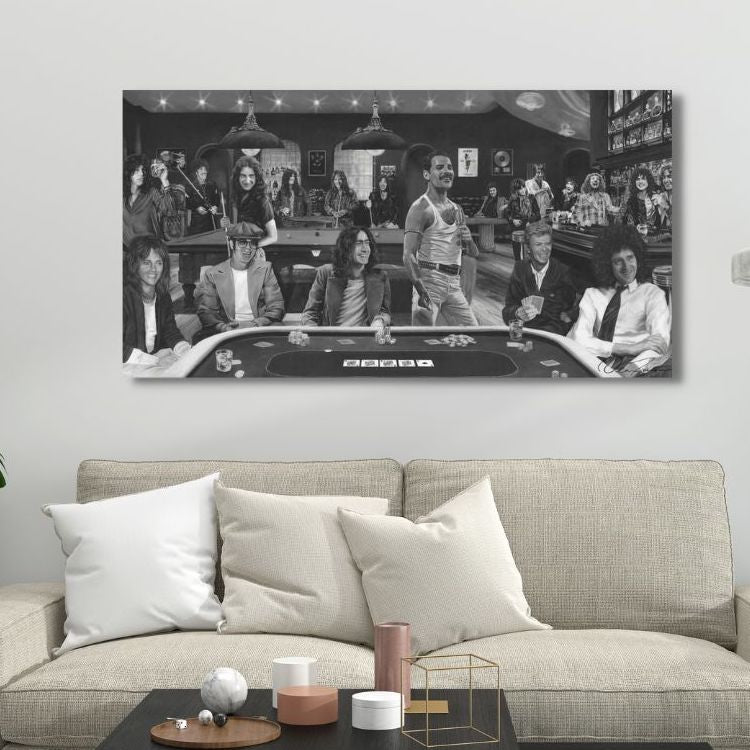


Hang this painting and someone will always point at a face and ask, “Who’s that?” Dean Turner’s Ultimate Guitarist Reunion is a hand-painted original of 45 guitar greats, 12 months from planning and hand painting to finish. This is the story of one of them, Lenny Kravitz. It’s available as a framed canvas print, made from the original, for the room where your music lives.
No. 39 Who’s Who Ultimate Guitarist Reunion
four Grammys in a row for the same award
He once called himself Romeo Blue because his own name didn’t sound rock and roll enough. Then he won the same Grammy four years running under the name he was born with.
 39of 45

In this story 13 sections
Why fans still care
LENNY KRAVITZ won the Grammy for Best Male Rock Vocal Performance four years in a row, from 1999 to 2002, for Fly Away, American Woman, Again and Dig In. NBC and the AP called it a record.
He also wrote, sang and played his way past every box people tried to put him in. “My music wasn’t Black enough, it wasn’t white enough,” he said in 2024. He made his first album on his own, playing nearly everything, on old gear.
Early life
Leonard Albert Kravitz was born in New York City on 26 May 1964. His mother, Roxie Roker, played Helen Willis on The Jeffersons, and his father, Sy Kravitz, was a news producer at NBC who also promoted jazz on the side. Duke Ellington played Happy Birthday to him when he was five.
His first concert, he says, was the Jackson 5 at Madison Square Garden, on a day his father surprised him by collecting him from school. “I used to write in my notebook Lenny Jackson,” he said. His parents bought him his first guitar, a Yamaha acoustic from Manny’s in New York, for his ninth birthday.
The family moved to Los Angeles in the mid-1970s, after his mother was cast in The Jeffersons, and he sang in the California Boys Choir, which he credits with teaching him discipline as a singer. In LA he fell in with the Dogtown skateboard crowd, who were listening to Led Zeppelin, the Who, Queen and Jimi Hendrix, Who’s Who number 6. He set up drums, guitar, bass and amps in his bedroom and taught himself, without telling his parents much about it. In 1979, aged 15, he left home. He worked in a fish market, a clothing store and a shoe store, and washed dishes in a macrobiotic restaurant.
Career chapters
- 1979Leaves home at 15
- 1987Marries Lisa Bonet and starts recording with Henry Hirsch in Hoboken
- 1989Let Love Rule, on Virgin
- 1990Meets Slash, Who’s Who number 43 again at the American Music Awards
- 1991Co-writes Justify My Love, a US number 1 for Madonna, Who’s Who number 11 in · The Ultimate Reunion (story coming soon)
- 1991It Ain’t Over ’til It’s Over reaches US number 2
- 1993Are You Gonna Go My Way, a UK number 1
- 1999The first of four straight Grammys
- 2001Writes the music for Mick Jagger’s, Who’s Who number 19 in · The Ultimate Reunion (story coming soon) God Gave Me Everything
- 2011Ordre des Arts et des Lettres, France
- 2024Hollywood Walk of Fame and Blue Electric Light
Romeo Blue 1980s
As a young musician he called himself Romeo Blue. “I wasn’t comfortable with my name, with Lenny Kravitz,” he said. Friends had called him Romeo, and he added the Blue. “I was thinking about a mesh of Ziggy Stardust and Prince, Who’s Who number 18,” he told Classic Rock. He wore blue contact lenses for the part, the hard kind. “These were bottle caps, man.”
Romeo Blue knocked on every major label’s door. He was offered deals, but always with a catch. “I was offered deals but only if I changed my music,” he told the Los Angeles Times in 1989. The labels wanted him to sound like whatever Black radio was playing, and he turned them down, even while he was sleeping in a car.
Lisa Bonet and the new songs 1987 to 1988
He met the actor Lisa Bonet, then starring in The Cosby Show, and they married in 1987. He says his songwriting changed almost overnight. Before, the songs had been laboured. “All of a sudden, they were being downloaded,” he told NPR’s Fresh Air in 2020.
Bonet was part of the record too. She wrote the lyrics for two of its songs, Rosemary and Fear, and directed the video for Let Love Rule.
Making Let Love Rule 1987 to 1989
The record was made in Hoboken, New Jersey, at Henry Hirsch’s Waterfront studio in an old factory by the river. Kravitz had first gone there with another band. Hirsch, a keyboard player turned engineer, liked the way he played and the two of them got on. Kravitz left the band to do his own thing.
He played almost everything himself: drums, bass, guitar and keyboards. That started as money. “I couldn’t afford to hire musicians,” he told NPR. Hirsch had heard him on every instrument and told him to just do it. Kravitz says Hirsch told him, “It has more character when you play it.” He had also grown up on Prince, Who’s Who number 18, Stevie Wonder and Paul McCartney, Who’s Who number 4 in · Ultimate Beatles Reunion (story coming soon), who made records on their own.
He wanted the sound to be the opposite of 1988. Everyone else was making records that were “very effected, very bombastic, big drums”, he said, so he went for a small, close sound. He told Hirsch he wanted something “carpety”, plush and warm. Hirsch had basic old equipment, including a Trident desk, and they recorded to analogue tape. Kravitz still loves the sound of tape, though he admits that on the old 16-track 3M machines “you go crazy punching and editing all day.”
The guitar sound was simple. Most of it was an Epiphone Sorrento through a tweed Fender Deluxe turned up to 10. “When you turn that amp all the way up, it compresses itself,” he said. A Fender Twin Reverb and a Telecaster covered the clean parts.
He made it all before he had a deal. “I made that record without a record label,” he said, so nobody told him to change it.
Signing to Virgin 1988 to 1989
He talked his way into Virgin’s office in Los Angeles to see the A&R executive Nancy Jeffries late on a Friday afternoon. She gave him 15 minutes. He played the song Let Love Rule from a cassette, and she went and fetched more staff. They passed notes to each other as they listened, and at the end they asked if he wanted a deal. The notes, he said, compared him to John Lennon, Who’s Who number 5 in · The Ultimate Reunion (story coming soon) meeting Prince, Who’s Who number 18.
“They didn’t categorize me,” he told the Los Angeles Times. “They wanted me to do the music I wanted.” He dropped the Romeo Blue name. “I realised I was Lenny Kravitz, and I should deal with it.”
Let Love Rule came out in 1989. As Virgin had warned, it didn’t do much in the US at first, peaking at number 61 on the Billboard 200 in February 1990, and some critics called it retro. It went Gold in the US in 1995. Kravitz says the Black Crowes had it on the desk the whole time they were making Shake Your Money Maker.
He went on the road opening for Tom Petty, Who’s Who number 2 in · Ultimate Eagles Reunion (story coming soon), David Bowie, Who’s Who number 16 in · The Ultimate Reunion (story coming soon), Bob Dylan and the Cult. He says Tom Petty, Who’s Who number 2 in · Ultimate Eagles Reunion (story coming soon) was the first to take him on tour.
Justify My Love and Mama Said 1990 to 1991
He co-wrote Madonna’s, Who’s Who number 11 in · The Ultimate Reunion (story coming soon) Justify My Love with Ingrid Chavez, and it went to number 1 in the US on 5 January 1991.
At the American Music Awards in January 1990 he recognised Slash, Who’s Who number 43 from school. Axl Rose, Who’s Who number 2 in · Highway to Hell (story coming soon) was wearing a Let Love Rule badge on his leather jacket, Kravitz remembers. Slash, Who’s Who number 43 played a one-take solo on Fields of Joy, and the two of them built Always on the Run from a riff Slash, Who’s Who number 43 brought along. Kravitz has said Slash, Who’s Who number 43 came straight from the end of a Guns N’ Roses tour to cut it. Their memories of exactly when and where each part happened don’t quite match.
He and Bonet had separated by then, and Mama Said was the record that came out of it. He says he was going to give It Ain’t Over ’til It’s Over to Smokey Robinson. Instead it went to number 2 in the US, his highest single there.
Are You Gonna Go My Way 1993
The title track came from a jam, as the guitarist Craig Ross tells it. Ross started playing the riff, Kravitz said “Whoa, what’s that?”, and about half an hour later it was cut, with Ross on Kravitz’s 1953 Les Paul Goldtop. With 15 minutes of the session left, Ross added a solo in one take through a little Gibson Skylark amp.
The album came out on 9 March 1993 and went straight in at number 1 in the UK. It reached number 12 in the US, his first top 20 album there, and went 2x Platinum. The title track made number 4 in the UK.
Fly Away and four Grammys 1998 to 2002
5 came out in 1998, and Fly Away from it went to number 1 in the UK. It also won him the first of his four straight Grammys for Best Male Rock Vocal Performance, followed by American Woman, Again and Dig In. Greatest Hits (2000) went 3x Platinum.
He wrote the music for Mick Jagger’s, Who’s Who number 19 in · The Ultimate Reunion (story coming soon) God Gave Me Everything in 2001, with Mick Jagger, Who’s Who number 19 in · The Ultimate Reunion (story coming soon) writing the words.
The Walk of Fame and Blue Electric Light 2020 to 2026
His memoir, Let Love Rule, came out in October 2020 and covers his life up to that first album. In 2024 he was nominated for the Rock & Roll Hall of Fame for the first time, received the 2,774th star on the Hollywood Walk of Fame on 12 March, outside the Capitol Records Tower, and released Blue Electric Light, his 12th studio album, on 24 May.
He voices the villain Bawma in the video game 007 First Light, which came out in May 2026.
Craft, sound and style
A guitar straight into a small amp
His rhythm sound is a guitar plugged into an amp, “with no processing whatsoever”, as he told Guitarist in 2024. He uses a pedal now and then for a lead. His favourite studio amp is a black-panel Fender Deluxe modified by Dumble, alongside a tweed Deluxe, and he turns them to 10. He uses a Marshall now and then, but mostly small amps such as the Fenders and a Gibson Skylark. “They sound the biggest when you record them properly,” he says.
He has been doing it that way since Let Love Rule. Cleaner, hotter pickups and less distortion, he says, move more air in a track.
The Goldtop and the Flying V
His number one studio guitar is a 1953 Les Paul Goldtop conversion with PAF pickups, bought in 1992. Its first album was Are You Gonna Go My Way, and it has been on every album since. The Flying V people link him with is a video guitar. “I’ve never used a V in the studio,” he told Guitar World in 2014.
By 2014 he had about 200 guitars, with vintage Les Pauls, Strats and 335s doing most of the studio work.
Playing every part
He still records most of his own parts, usually drums first, then guitar, then bass. “I don’t have to explain anything to anyone,” he says. He thinks of the whole record as one painting, not a set of instrument parts, and he doesn’t call himself a virtuoso.
Right after Let Love Rule he bought the REDD.37 mixing desk the Beatles had used at Abbey Road. At the time, he says, hardly anyone wanted old gear like that.
Fewer notes
He wants solos simple and melodic, using “the least amount of notes to make the point.” He points to B.B. King, Who’s Who number 2, who in his words could take “one string, one note, one finger” and knock over a mountain. Feel, dynamics and emotion come first for him, ahead of speed.
What other players say
“Lenny’s great, and I’m glad the way that turned out.”
“Lenny is a musical genius.”
Stories people still tell
-
Big brother.
On 21 April 2026, ten years after Prince, Who’s Who number 18 died, Kravitz posted a clip of the two of them playing American Woman together. “This man was a great inspiration and big brother,” he wrote.
-
No effects at all.
Jamming with Prince, Who’s Who number 18 once, he was asked what effect he had on his guitar. “Nothing. It’s a guitar into a Deluxe, turned to 10,” he answered. Prince, Who’s Who number 18 couldn’t believe it.
-
A record for someone else.
He pitched Justify My Love to Madonna, Who’s Who number 11 in · The Ultimate Reunion (story coming soon) as a hit, by his own account, and he was right.
Legacy
Classic Rock credits his first two albums, made on vintage gear, with influencing the Black Crowes and Guns N’ Roses. They also brought him friendships with the musicians he grew up on, from David Bowie, Who’s Who number 16 in · The Ultimate Reunion (story coming soon) to Mick Jagger, Who’s Who number 19 in · The Ultimate Reunion (story coming soon).
“I’m going to continue doing this as long as I can,” he said in 2020. Six years and another album later, he’s kept his word.

on the
Who’s Who
In the painting
Lenny Kravitz
Number 39 of 45 on the Who’s Who list for Ultimate Guitarist Reunion by Dean Turner Art, published as Lenny Kravitz.
Dean painted Slash, Who’s Who number 43, top hat and all, diagonally in front of him with no one in between. The two went to Beverly Hills High at the same time, met again at the 1990 American Music Awards and co-wrote and recorded Always on the Run (1991).
Collectors lean in, argue over faces and pull the names list. If you’re looking for 1990s rock with soul in it, start with Kravitz.
Another name on the same list is part of his story: Prince, Who’s Who number 18, his “big brother”.
See Lenny Kravitz among all 45 guitarists in Ultimate Guitarist Reunion.
Who’s Who in the Ultimate Guitarist Reunion
Numbered as on the painting’s key. Pick a name to read their story.
- Story live
- Coming soon
- You’re reading
 Find the numbers on the painting
- 1Albert King
- 2B.B. King
- 3Eric Clapton | Cream/Yardbirds
- 4Stevie Ray Vaughan | Stevie Ray Vaughan & Double Trouble
- 5Billy Gibbons | ZZ TOP
- 6Jimi Hendrix | The Jimi Hendrix Experience/Solo
- 7The Edge | U2
- 8Pete Townshend | The Who
- 9David Gilmour | Pink Floyd
- 10Kirk Hammett | Metallica
- 11Peter Frampton | Solo/Humble Pie/The Herd
- 12George Thorogood | George Thorogood & the Destroyers
- 13Mark Knopfler | Dire Straits
- 14Ritchie Blackmore | Deep Purple/Rainbow
- 15Jeff Beck | Solo/Yardbirds
- 16Gary Moore
- 17Joe Perry | Aerosmith
- 18Prince
- 19Ronnie Wood | Rolling Stones
- 20Brian May | Queen
- 21Rory Gallagher | Solo/Taste
- 22Tom Morello | Rage Against the machine /Audioslave
- 23Tony Iommi | Black Sabbath
- 24Carlos Santana
- 25Joe Walsh | Eagles
- 26Jack White | Solo/White Stripes
- 27Zakk Wylde | Ozzy Osbourne/Black Label Society
- 28Randy Rhoads | Ozzy Osbourne
- 29Joe Satriani
- 30Steve Vai
- 31Keith Richards | Rolling Stones
- 32Jimmy Page | Led Zeppelin/Yardbirds
- 33James Hetfield | Metallica
- 34Eddie Van Halen | Van Halen
- 35Angus Young | AC/DC
- 36Chuck Berry
- 37Kurt Cobain | Nirvana
- 38Les Paul
- 39Lenny KravitzYou’re reading
- 40Bo Diddley
- 41Johnny Winter
- 42Malcolm Young | AC/DC
- 43Slash | Guns N Roses
- 44George Harrison | Beatles/Traveling Wilburys/Solo
- 45Robert Johnson
Sources
- NBC Bay Area (AP), Lenny Kravitz receives his Hollywood Walk of Fame star (12 Mar 2024). nbcbayarea.com
- Official Charts, Lenny Kravitz. officialcharts.com
- RIAA Gold & Platinum database, Lenny Kravitz. riaa.com
- uDiscover Music, Are You Gonna Go My Way. udiscovermusic.com
- NPR Fresh Air via WLRN, Lenny Kravitz’s memoir Let Love Rule. wlrn.org
- Stereogum, The Number Ones: Madonna’s Justify My Love (29 Oct 2021). stereogum.com
- MOJO, Lenny Kravitz interviewed. mojo4music.com
- AOL (ABC Audio), Lenny Kravitz pays tribute to Prince (21 Apr 2026). aol.com
- Video Games Chronicle, Lenny Kravitz in 007 First Light (12 Dec 2025). videogameschronicle.com
- ET Online, 2024 Rock & Roll Hall of Fame nominees (10 Feb 2024). etonline.com
- Pollstar, France honours Lenny Kravitz (1 Dec 2011). news.pollstar.com
- Guitar World, Lenny Kravitz on his collaboration with Slash. guitarworld.com
- Ultimate Classic Rock, Lenny Kravitz recalls ’fluid’ studio experience with Slash. ultimateclassicrock.com
- People, Lenny Kravitz recalls high school (29 Nov 2023). people.com
- Hollywood Walk of Fame, Lenny Kravitz. walkoffame.com
- IO Interactive, 007 First Light launches globally (27 May 2026). ioi.dk
- Billboard Hot 100, week of 5 January 1991 (Justify My Love at No. 1). billboard.com
- Official Charts, Albums chart, 13 March 1993. officialcharts.com
- NPR Fresh Air via WLRN, Sam Briger, Lenny Kravitz interview (aired 6 Oct 2020, rebroadcast 22 Oct 2021). wlrn.org
- Louder (Classic Rock), Nick Hasted, The story of Lenny Kravitz’s early solo career (Classic Rock issue 202, Sep 2014; online 26 May 2026). loudersound.com
- Los Angeles Times, Dennis Hunt, Rocking beyond the family ties (27 Sep 1989). latimes.com
- Guitar World, Richard Bienstock, Dear Guitar Hero: Lenny Kravitz (12 Dec 2014). guitarworld.com
- Guitar World (Guitarist), Andrew Daly, Lenny Kravitz on Blue Electric Light (21 Jun 2024). guitarworld.com
- Guitar World, Janelle Borg, How Lenny Kravitz and Craig Ross wrote Are You Gonna Go My Way (30 Mar 2025). guitarworld.com
- Mix, Elianne Halbersberg, Flying (almost) solo: in the studio with Lenny Kravitz (1 Nov 2004). mixonline.com
- Tape Op, Dave Amels, Henry Hirsch interview (issue 56). tapeop.com
- Ultimate Classic Rock, Bryan Rolli, Why Slash gave Lenny Kravitz Always on the Run (8 Mar 2022). ultimateclassicrock.com
- Billboard 200, week of 10 February 1990 (Let Love Rule at its No. 61 peak). billboard.com
- Slash with Anthony Bozza, Slash (autobiography, HarperCollins, 2007): he and Kravitz “attended Beverly Hills High at the same time”, Slash in continuation classes. books.google.com
- Esquire, Bria McNeal, Lenny Kravitz on high school with Nic Cage and Slash (29 Nov 2023). esquire.com
Names appear exactly as published on the Who’s Who list for Ultimate Guitarist Reunion.
See the names list for other Ultimate Series artworks
Every painting has its own numbered Who’s Who. Pick a scene and see who’s in it.
 Ultimate Aussie Pub Rock ReunionSee who’s in it
  Ultimate Aussie Reunion - Part 2See who’s in it
  Highway to HellSee who’s in it
  The Ultimate ReunionSee who’s in it
  Ultimate Eagles ReunionSee who’s in it
  Ultimate Queen ReunionSee who’s in it
  Ultimate Beatles ReunionSee who’s in it
  Ultimate Classic Country ReunionSee who’s in it
  Ultimate Hip Hop ReunionSee who’s in it
  Ultimate Gangster ReunionSee who’s in it
  Ultimate Boxing ReunionSee who’s in it
  Ultimate Fighter ReunionSee who’s in it