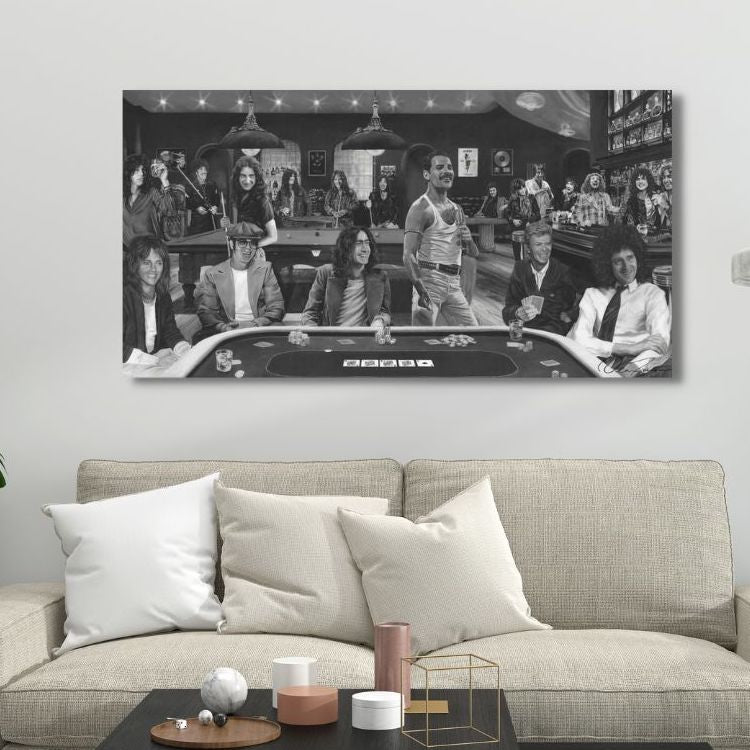


Hang this painting and someone will always point at a face and ask, “Who’s that?” Dean Turner’s Ultimate Guitarist Reunion is a hand-painted original of 45 guitar greats, 12 months from planning and hand painting to finish. This is the story of one of them, Stevie Ray Vaughan. It’s available as a framed canvas print, made from the original, for the room where your music lives.
No. 4 Who’s Who Ultimate Guitarist Reunion
Booed at Montreux, hired by Bowie
In July 1982 a Montreux crowd booed his unsigned Texas trio off on the first night. David Bowie, Who’s Who number 16 in · The Ultimate Reunion (story coming soon) liked what he heard, and by December Vaughan was in New York playing lead guitar on Let’s Dance.
 4of 45

In this story 13 sections
Why fans still care
STEVIE RAY VAUGHAN made four studio albums with Double Trouble, from Texas Flood in 1983 to In Step in 1989. His official site says that was enough to ignite the blues revival of the 1980s, and when the Rock & Roll Hall of Fame took him in, its page called him “the second coming of the blues”.
On his last night, Buddy Guy was on the same bill at Alpine Valley. He said Vaughan’s set was “the most incredible set I’ve ever heard”.
The records are still being played. Pride and Joy had passed 235 million plays on Spotify by October 2026, more than twice any other song of his. Rolling Stone’s 2008 list of the 100 greatest guitar songs has two of his, Little Wing at number 54 and Texas Flood at number 66.
Early life and training
He was born on 3 October 1954 in Oak Cliff, a neighbourhood of Dallas, to Jim and Martha Vaughan. His official biography describes him simply as born and raised in Dallas. His older brother, Jimmie, played guitar too, and the two of them made Family Style together as The Vaughan Brothers. It came out after Stevie died.
Jimmie brought records home too. Stevie told the writer Jas Obrecht in 1989 that the Jimi Hendrix, Who’s Who number 6 record his brother came home with “really knocked my socks off”. Hendrix songs later became centrepieces of his own sets.
In 1972, at 17, Stevie moved to Austin.
Career chapters
- 1954Born in Oak Cliff, Dallas
- 1972Moves to Austin
- 1982Montreux Jazz Festival; Let’s Dance sessions with David Bowie, Who’s Who number 16 in · The Ultimate Reunion (story coming soon)
- 1983Texas Flood
- 1984Couldn’t Stand the Weather
- 1985Soul to Soul
- 1989In Step; tour with Jeff Beck, Who’s Who number 15
- 1990Dies 27 August, East Troy, Wisconsin
- 2015Rock & Roll Hall of Fame
Double Trouble and Montreux 1982
He named his band Double Trouble after an Otis Rush song. In July 1982 the trio played the Montreux Jazz Festival in Switzerland, reportedly the first unsigned act ever booked there.
The first night, the crowd booed them off. The second night went far better. And somewhere in that week, David Bowie, Who’s Who number 16 in · The Ultimate Reunion (story coming soon) heard him and was impressed.
Let’s Dance 1982 to 1983
By December 1982, Bowie, Who’s Who number 16 in · The Ultimate Reunion (story coming soon) and producer Nile Rodgers were finishing Let’s Dance. Vaughan flew to New York to overdub lead guitar, and his official site says he played lead on six of the album’s eight songs. He dedicated his solo on the title track to Albert King, Who’s Who number 1.
He didn’t go on the 1983 tour. KUT in Austin has reported a fee dispute, a dropped opening slot for Double Trouble and a condition about approving publicity, plus his own wish to build his band. His official site says his management pulled him out to support his own record. Either way, Earl Slick got the gig, and Vaughan went home to Texas Flood.
Texas Flood to Soul to Soul 1983 to 1985
Three albums in three years. Texas Flood came out in 1983 and reached number 38 in the US. Pride and Joy is on it. Couldn’t Stand the Weather followed in 1984 and got to number 31, and Soul to Soul reached number 34 in 1985.
None of them was a monster hit at the time. They kept selling, though. Texas Flood and Couldn’t Stand the Weather are both double platinum now, and Soul to Soul is platinum.
Couldn’t Stand the Weather also has his Voodoo Chile (Slight Return), the Hendrix, Who’s Who number 6 song he made his own, which earned a Grammy nomination in 1985. In 1984 he recorded Hendrix’s Little Wing as an instrumental too, though it wasn’t released until after he died.
In Step 1989
He had stopped drinking and taking drugs by then. Writer Michael Corcoran says he gave up both about four years before he died, and his brother Jimmie said the same at the Rock and Roll Hall of Fame in 2015.
In Step won the Grammy for Best Contemporary Blues Recording, and his official site says it went gold just over six months after it came out. The RIAA has since certified it double platinum. “Crossfire”, from that album, spent three weeks at number 1 on Billboard’s Album Rock Tracks chart in the summer of 1989.
The band took 32 amps into the In Step sessions, his amp technician César Díaz said. Díaz also saw him play a borrowed Telecaster-style guitar, an Esquire that belonged to Paul Burlison, on The House Is Rockin’. It was the only time Díaz saw him on one.
That year he also toured with Jeff Beck, Who’s Who number 15. The tour won a Pollstar award for Most Creative Tour Package.
Alpine Valley 1990
On 26 August 1990 he played Alpine Valley in East Troy, Wisconsin, on the bill with Eric Clapton, Who’s Who number 3.
Shortly after midnight, he took a seat on one of the helicopters leaving the venue. According to his spokesman, Charles Comer, he asked for the last seat because he needed to get back. The helicopter hit a ski hill soon after takeoff. All five on board died: Vaughan, Clapton’s, Who’s Who number 3 agent Bobby Brooks, Nigel Browne, Colin Smythe and the pilot, Jeffrey Brown. Stevie Ray Vaughan was 35.
The National Transportation Safety Board put the crash down to the pilot’s planning and decisions, flying at night in fog over rising ground.
More than 1,500 people came to his memorial in Dallas. He’s buried at Laurel Land Memorial Park in the city where he was born.
the most incredible set I’ve ever heard
After 1990
Family Style, the record he made with Jimmie as The Vaughan Brothers, came out after his death and reached number 7. It’s the highest-charting album of his career. The Sky Is Crying followed in 1991, reached number 10 and is double platinum. Between them, those two records brought four more Grammys.
Craft, sound and style
What made people sit up at Montreux was a trio, playing the blues loud, with nobody on stage pretending to be anything but a blues band. The name came from Otis Rush. The dedication on Let’s Dance went to Albert King, Who’s Who number 1. Those two tell you where his ear was.
The Grammy list tells you the rest. He won for “Little Wing” and was nominated for “Voodoo Chile (Slight Return)”, both songs from the Jimi Hendrix, Who’s Who number 6 catalogue. He was nominated for his own instrumental “Rude Mood” and for “Pipeline”, recorded with surf guitarist Dick Dale. He moved between those worlds without any trouble at all.
Number One
His main guitar was a sunburst Fender Stratocaster he called Number One. César Díaz, who looked after his amps, called it a 1959 Strat. When Fender Custom Shop staff examined it, they dated the neck to December 1962, the body to 1963 and the pickups to 1959, so it’s a mix of years.
The neck had a D-shaped profile and a rosewood board flattened by at least two refrets, with wide frets. He ran all five springs in the tremolo and fitted a left-handed tremolo arm. Díaz said he suggested the left-hand arm, after telling him that Hendrix, Who’s Who number 6 had his bar on top. Gold hardware went on around late 1985 or early 1986.
Lenny, and the Gibbons guitars
In the early 1980s he found a 1965 Strat in a pawn shop for US$350 and couldn’t afford it. Friends and his wife, Lenny, bought it for him. The guitar carries her name, and so does his instrumental Lenny, which had about 51 million Spotify plays by October 2026. The sunburst was stripped and stained brown.
Billy Gibbons, Who’s Who number 5 turns up twice in the guitar story. He supplied the maple neck that later replaced Lenny’s rosewood one, and on 29 April 1984 he gave Vaughan a guitar made by James Hamilton: a neck-through body of two-piece maple with an ebony board and pearl inlays.
The rest of the rack
Charley Wirz of Dallas gave him “Ol’ White” in 1984, with Danelectro “lipstick” pickups and a fixed bridge. “Red” was a 1962 Strat painted red, which got a left-handed neck in 1986. “Yellow” had belonged to Vince Martell of Vanilla Fudge. It was stolen in 1987 and never recovered. On the cover of In Step he’s holding a National steel guitar from 1928 or 1929.
Hopkins’s notes add a few more. There was a stock 1961 butterscotch Strat with a pickguard made by René Martinez, and a 1951 Broadcaster handed down from Jimmie, which Stevie later traded for an Epiphone Riviera.
Amps
He played loud, and through a lot of amps at once. In the early 1980s Díaz looked after two 1964 Fender Vibroverbs, each with a single 15 inch speaker, and Díaz says Vaughan felt the Vibroverb was the amp for him. For clean sounds there was a Marshall Club and Country combo, painted black by David Bowie’s, Who’s Who number 16 in · The Ultimate Reunion (story coming soon) crew.
By 1985, Craig Hopkins’s notes list two Fender Super Reverbs, two 150-watt Dumble amps into 4x12 cabinets, and the Vibroverbs, one of them often driving a Fender Vibratone rotating speaker run through a Variac. In the summer of 1990 he was using two Fender reissue Bassmans.
The settings depend on who you ask. Díaz remembered volume 6, treble 5.5 and bass 4, with Vaughan riding the guitar’s own knobs. Hopkins says the volume usually started at 7 to 7.5 and went to 10 for Voodoo Chile. They may be talking about different amps or years. Díaz also recalled running the valves so hard that the amps smoked.
When one of the Dumbles was out, Hopkins says a 200-watt Marshall Major sometimes took its place. The valves were Philips 6L6s and 12AX7s, GE 6550s, and Mesa STR415s and STR387s when he could get them.
Pedals
The pedal list was short. He used Ibanez Tube Screamers, starting with the TS-808, then the TS-9 and TS-10. He had 1960s Vox wahs, sometimes two linked together, a vintage Dallas-Arbiter Fuzz Face that Díaz fitted with germanium transistors, Octavias (a Roger Mayer first, then Tycobrahe), a Uni-Vibe for a while, and a Roland Dimension D now and then in the studio.
Heavy strings, tuned down
He tuned down a half step, to E flat, always. His strings were heavy: GHS Nickel Rockers from .013 to .058, dropping to an .011 on top when his fingers were sore. Díaz remembered the low string as a .052, so it may have changed over the years. The action was high too.
Díaz said he “hit the low strings real hard”, hard enough to strain the amp valves. The heavy strings tore up his fingertips. His guitar tech René Martinez recalled the skin coming off until his fingers bled, and super glue was the fix on the road. On tour with Beck, Who’s Who number 15 in late 1989, Vaughan told Guitar Player he had gone a little lighter for a while because “I’ve got a hole in my finger”, but he planned to go back to the .013.
Some of the touch came from Albert King, Who’s Who number 1. Premier Guitar says Vaughan took up King’s ghost bend, where the bend is silent and you only hear the note coming back down.
What other players say
“I wanted to be Stevie and I still want to be Stevie.”
“He had the whole package. I learned a lot from that”
“It lifted me out of the negative mindset I was in”
“is there anybody better to want to be than Stevie Ray Vaughan?”
Stories people still tell
-
Booed, then hired.
The Montreux crowd booed Double Trouble off on the first night in 1982. One of the people in town that week was David Bowie, Who’s Who number 16 in · The Ultimate Reunion (story coming soon), and a few months later Vaughan was playing lead guitar on Bowie’s, Who’s Who number 16 in · The Ultimate Reunion (story coming soon) Let’s Dance.
-
The Let’s Dance dedication.
His Let’s Dance title-track solo was dedicated to Albert King, Who’s Who number 1. Years earlier, in 1976, he had sat in with King, Who’s Who number 1 at Antone’s in Austin.
-
The drummer who’s still playing.
Chris Layton, Double Trouble’s drummer, was behind the kit for Billy Gibbons, Who’s Who number 5 on his 2026 solo tour.
Legacy
In 2015 the Rock & Roll Hall of Fame inducted Stevie Ray Vaughan & Double Trouble, with Chris Layton, Reese Wynans and Tommy Shannon. John Mayer did the induction.
Texas Governor Ann Richards proclaimed 3 October 1991, what would have been his 37th birthday, Stevie Ray Vaughan Day. The Blues Foundation added him to its Hall of Fame in 2000. In Austin there’s a statue of him, which cost about US$100,000 in materials and foundry work in 1993.
Other players still talk about what he gave them. Mike McCready of Pearl Jam credits a Vaughan show at the Gorge, around 1988 or 1989, with getting him playing again.
Grammy.com lists six wins and 13 nominations. Five of those wins are for his own recordings, and four of them came after he died.

on the
Who’s Who
In the painting
Stevie Ray Vaughan | Stevie Ray Vaughan & Double Trouble
Number 4 of 45 on the Who’s Who list for Ultimate Guitarist Reunion, published as Stevie Ray Vaughan | Stevie Ray Vaughan & Double Trouble.
Dean painted him and Eric Clapton, Who’s Who number 3 next to each other. Vaughan wasn’t normally part of Clapton’s, Who’s Who number 3 tour, but he was added to the Alpine Valley shows on 25 and 26 August 1990. Shortly after midnight on 27 August, the helicopter taking him away from the venue crashed, and three of Clapton’s, Who’s Who number 3 team died with him.
Find Stevie Ray Vaughan among all 45 guitarists in Ultimate Guitarist Reunion.
Who’s Who in the Ultimate Guitarist Reunion
Numbered as on the painting’s key. Pick a name to read their story.
- Story live
- Coming soon
- You’re reading
 Find the numbers on the painting
- 1Albert King
- 2B.B. King
- 3Eric Clapton | Cream/Yardbirds
- 4Stevie Ray Vaughan | Stevie Ray Vaughan & Double TroubleYou’re reading
- 5Billy Gibbons | ZZ TOP
- 6Jimi Hendrix | The Jimi Hendrix Experience/Solo
- 7The Edge | U2
- 8Pete Townshend | The Who
- 9David Gilmour | Pink Floyd
- 10Kirk Hammett | Metallica
- 11Peter Frampton | Solo/Humble Pie/The Herd
- 12George Thorogood | George Thorogood & the Destroyers
- 13Mark Knopfler | Dire Straits
- 14Ritchie Blackmore | Deep Purple/Rainbow
- 15Jeff Beck | Solo/Yardbirds
- 16Gary Moore
- 17Joe Perry | Aerosmith
- 18Prince
- 19Ronnie Wood | Rolling Stones
- 20Brian May | Queen
- 21Rory Gallagher | Solo/Taste
- 22Tom Morello | Rage Against the machine /Audioslave
- 23Tony Iommi | Black Sabbath
- 24Carlos Santana
- 25Joe Walsh | Eagles
- 26Jack White | Solo/White Stripes
- 27Zakk Wylde | Ozzy Osbourne/Black Label Society
- 28Randy Rhoads | Ozzy Osbourne
- 29Joe Satriani
- 30Steve Vai
- 31Keith Richards | Rolling Stones
- 32Jimmy Page | Led Zeppelin/Yardbirds
- 33James Hetfield | Metallica
- 34Eddie Van Halen | Van Halen
- 35Angus Young | AC/DC
- 36Chuck Berry
- 37Kurt Cobain | Nirvana
- 38Les Paul
- 39Lenny Kravitz
- 40Bo Diddley
- 41Johnny Winter
- 42Malcolm Young | AC/DC
- 43Slash | Guns N Roses
- 44George Harrison | Beatles/Traveling Wilburys/Solo
- 45Robert Johnson
Sources
- Rock & Roll Hall of Fame, Stevie Ray Vaughan & Double Trouble. rockhall.com
- UPI Archives, “Guitarist Stevie Ray Vaughan, four others killed” (1990). upi.com
- SRV Official, Biography. srvofficial.com
- Grammy.com, Stevie Ray Vaughan. grammy.com
- SRV Official, Awards and Achievements. srvofficial.com
- RIAA Gold & Platinum, Stevie Ray Vaughan. riaa.com
- RIAA, Texas Flood. riaa.com
- RIAA, Couldn’t Stand the Weather. riaa.com
- RIAA, The Sky Is Crying. riaa.com
- Texas State Historical Association, Handbook of Texas, Vaughan, Stevie Ray. tshaonline.org
- This Day in Aviation (quoting NTSB CHI90MA244). thisdayinaviation.com
- Michael Corcoran, Stevie Ray Vaughan. michaelcorcoran.net
- KUT 90.5, “The Last Dance of David Bowie and Stevie Ray”. kut.org
- Alan Paul, “We all stand on the shoulder of giants” (Antone’s 1976). alanpaul.substack.com
- Ultimate Classic Rock, Billy Gibbons 2026 tour (Chris Layton). ultimateclassicrock.com
- Premier Guitar, “GALLERY: Stevie Ray Vaughan Gear”, data from Craig Hopkins, Stevie Ray Vaughan: Day by Day, Night After Night, 28 Dec 2011 (Number One dating and specs, Lenny, Hamilton, Ol’ White, Red, Yellow, National, amps by year, tubes, pedals, strings, action). premierguitar.com
- Guitar Player, Dave Rubin, “Amp guru Cesar Díaz revealed Stevie Ray Vaughan’s guitar and amp secrets”, updated 8 Feb 2025 (1959 dating, left-hand bar, Vibroverbs, settings, 700 volts, 32 amps, Burlison’s Esquire, “hit the low strings real hard”, .052). guitarplayer.com
- Guitar Player, ”’I’ve Got a Hole in My Finger’: Stevie Ray Vaughan on the Trials and Tribulations of Heavy Strings”, 27 Sep 2022 (Vaughan interview on the late-1989 tour with Jeff Beck, first printed February 1990: “I’ve got a hole in my finger”, back to an .013 later; Martinez, bleeding fingers and super glue, from an interview with Hittin’). guitarplayer.com
- Guitar Player, Phil Weller, “Eric Johnson on the one thing that took Stevie Ray Vaughan’s playing to the next level”, 5 Feb 2025. guitarplayer.com
- Guitar Player, Phil Weller, “Mike McCready on Stevie Ray Vaughan, acid, and the night that made him fall in love with guitar again”, 6 Jun 2025. guitarplayer.com
- Ultimate Classic Rock, Matt Wardlaw, “John Mayer Inducts Stevie Ray Vaughan Into the Rock and Roll Hall of Fame”, 18 Apr 2015. ultimateclassicrock.com
- Stereogum (reproducing Rolling Stone), “100 Greatest Guitar Songs Of All Time”, 30 May 2008 (Little Wing 54, Texas Flood 66). stereogum.com
- kworb.net, Stevie Ray Vaughan Spotify top songs, updated 8 Oct 2026. kworb.net
- RIAA Gold & Platinum, In Step (2x Platinum, 6 Jun 1995). riaa.com
- Jas Obrecht, Talking Guitar, “Stevie Ray Vaughan: Our 1989 Interview” (interview 9 Feb 1989), 19 Aug 2023 (“really knocked my socks off”). jasobrecht.substack.com
- Michael Corcoran, “Stevie Ray Vaughan Oct. 3, 1954 to Aug. 27, 1990”, updated 30 Jan 2023 (gave up drugs and alcohol four years before his death). michaelcorcoran.net
- Premier Guitar, Jeff Jacobson, “Unleashing the Power of the Blues Avengers: B.B., Albert, and Freddie King”, 20 Jan 2024 (Vaughan adopting Albert King’s ghost bend). premierguitar.com
- Billboard, Album Rock Tracks chart, issues of 29 July, 5 August and 12 August 1989 (“Crossfire” No. 1; “3 weeks” at No. 1 on 12 August). worldradiohistory.com
- Official Stevie Ray Vaughan site, Awards and Achievements (“Crossfire”: Billboard Album Rock Tracks, 29 July and 5 August 1989; No. 1 on FMQB Album Report Hot Tracks 100 and AOR Tracks). srvofficial.com
- Guitar World, “Stevie Ray Vaughan’s Epic ’Little Wing’” (recorded 1984 at the Power Station, New York; released on The Sky Is Crying, 1991). guitarworld.com
- Wikipedia, “Stevie Ray Vaughan discography” (studio albums table, citing Billboard and RIAA; accessed 12 Oct 2026). en.wikipedia.org
Names appear exactly as published on the Who’s Who list for Ultimate Guitarist Reunion.
See the names list for other Ultimate Series artworks
Every painting has its own numbered Who’s Who. Pick a scene and see who’s in it.
 Ultimate Aussie Pub Rock ReunionSee who’s in it
  Ultimate Aussie Reunion - Part 2See who’s in it
  Highway to HellSee who’s in it
  The Ultimate ReunionSee who’s in it
  Ultimate Eagles ReunionSee who’s in it
  Ultimate Queen ReunionSee who’s in it
  Ultimate Beatles ReunionSee who’s in it
  Ultimate Classic Country ReunionSee who’s in it
  Ultimate Hip Hop ReunionSee who’s in it
  Ultimate Gangster ReunionSee who’s in it
  Ultimate Boxing ReunionSee who’s in it
  Ultimate Fighter ReunionSee who’s in it