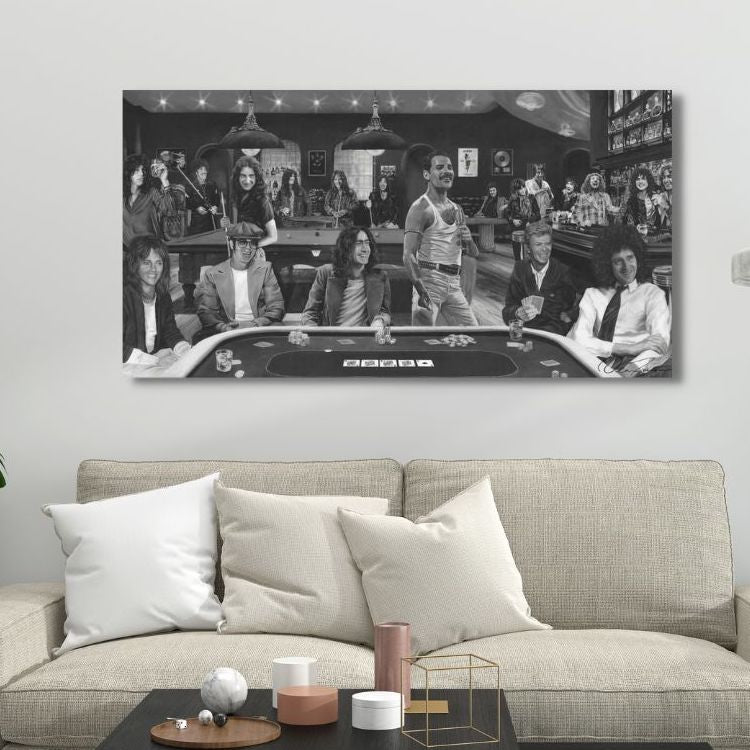


Hang this painting and someone will always point at a face and ask, “Who’s that?” Dean Turner’s Ultimate Guitarist Reunion is a hand-painted original of 45 guitar greats, 12 months from planning and hand painting to finish. This is the story of one of them, Ritchie Blackmore. It’s available as a framed canvas print, made from the original, for the room where your music lives.
No. 14 Who’s Who Ultimate Guitarist Reunion
back on stage with Deep Purple after 33 years
On 12 August 2026, at Jones Beach in New York, Ritchie Blackmore walked on and played Smoke on the Water with Deep Purple for the first time in 33 years. When it ended, Ian Gillan, Who’s Who number 12 in · The Ultimate Reunion (story coming soon) called him “the immortal”.
 14of 45

In this story 13 sections
Why fans still care
RITCHIE BLACKMORE is credited with the opening riff of Smoke on the Water, and the Rock and Roll Hall of Fame says Deep Purple “created a riff everyone knows”.
That’s one riff. Around it sit two UK number 1 albums with Deep Purple, a run of top ten records with Rainbow and, since 1997, a Renaissance folk band with his wife. He’s done all of it on his own terms. He has said the “angriest man in rock” tag comes in handy, because it keeps away people he doesn’t like.
Early life and training
Richard Hugh Blackmore was born in Weston-super-Mare, Somerset, on 14 April 1945. When he was about two the family moved to Heston in Middlesex, and he grew up near Heathrow Airport.
His father bought him his first guitar when he was 11. There was a condition: a year of lessons.
At 15 he was playing in the Outlaws, the house band for the producer Joe Meek. He later played with Screaming Lord Sutch, and in the 1960s he spent time living in Hamburg.
Career chapters
- c.1960Joined the Outlaws, Joe Meek’s house band, aged 15
- 1967Co-founded the group that became Deep Purple, with Jon Lord, Who’s Who number 13 in · The Ultimate Reunion (story coming soon)
- 1968The band took the name Deep Purple
- 1972Machine Head, UK number 1
- 1975Left Deep Purple and formed Rainbow
- 1981Difficult to Cure and I Surrender both peaked at number 3 in the UK
- 1984Rejoined Deep Purple for the Mark II reunion, Perfect Strangers
- 1993Last show with Deep Purple, Helsinki, 15 November
- 1997Blackmore’s Night became his main band
- 2016Rock and Roll Hall of Fame, with Deep Purple
- 2026Guest encore with Deep Purple at Jones Beach, New York
Deep Purple 1967 to 1975
According to the German news agency dpa, Blackmore co-founded the group with organist Jon Lord, Who’s Who number 13 in · The Ultimate Reunion (story coming soon) in 1967. They toured Scandinavia as Roundabout and became Deep Purple in April 1968.
The first line-up, now known as Mark I, had Rod Evans singing, Nick Simper on bass and Ian Paice on drums alongside Blackmore and Jon Lord, Who’s Who number 13 in · The Ultimate Reunion (story coming soon). Blackmore had heard Billy Joe Royal’s Hush and saw what a tougher arrangement could do with it. Deep Purple’s version, from the 1968 debut Shades of Deep Purple, reached number 4 in the US. In 1969 the band replaced Evans and Simper with Ian Gillan, Who’s Who number 12 in · The Ultimate Reunion (story coming soon) and Roger Glover, Who’s Who number 14 in · The Ultimate Reunion (story coming soon).
That line-up, Mark II, with Gillan, Who’s Who number 12 in · The Ultimate Reunion (story coming soon) singing and Glover, Who’s Who number 14 in · The Ultimate Reunion (story coming soon) on bass, made the records guitar fans come back to. Deep Purple in Rock entered the UK chart on 20 June 1970, reached number 4 and stayed on the chart for 68 weeks. Fireball went to number 1 in Britain in 1971. Machine Head entered on 15 April 1972 and spent three weeks at number 1, and that’s the album with Smoke on the Water on it.
Machine Head was meant to be made in a casino. The band hired the Rolling Stones’ mobile studio and went to Montreux, in Switzerland, to record in the Montreux Casino. On 4 December 1971, the night before they were due to start, they went to see Frank Zappa and the Mothers of Invention play there. Someone fired a flare gun into the ceiling and the building burned down. The Montreux Jazz Festival says no casualties were reported. Roger Glover, Who’s Who number 14 in · The Ultimate Reunion (story coming soon) remembers watching the smoke from the bar of their hotel, and waking a couple of mornings later with the words “smoke on the water” in his head.
The festival’s founder, Claude Nobs, found them a sports hall, the Pavillon, and that’s where Blackmore first played the riff on his Stratocaster, by the festival’s account. Drummer Ian Paice says that before it had words it was just “the der-der-der song”. The police shut that session down over the noise, so the band moved into the Grand Hotel, closed for the winter, and used mattresses to soundproof it. Glover, Who’s Who number 14 in · The Ultimate Reunion (story coming soon) suggested Smoke on the Water as the title of a song about the fire, and he and Ian Gillan, Who’s Who number 12 in · The Ultimate Reunion (story coming soon) wrote the words about what had happened to them.
In 1975 he fell out with his bandmates and walked.
Rainbow 1975 to 1984
He started Rainbow straight away. Ritchie Blackmore’s Rainbow entered the UK chart on 13 September 1975 and peaked at number 11.
The first singer was Ronnie James Dio, from Elf, an American band that had opened for Deep Purple. Graham Bonnet took over for Down to Earth and lasted one album. Joe Lynn Turner sang from 1980 until the band stopped in 1984. The line-ups around them changed often, and Glover, Who’s Who number 14 in · The Ultimate Reunion (story coming soon) joined on bass along the way.
The band hit its stride as the decade turned. Down to Earth reached number 6 in 1979, and Since You Been Gone made number 6 as a single. All Night Long got to number 5 in 1980. In February 1981 Difficult to Cure and the single I Surrender both peaked at number 3 in the same week.
At the 1984 Grammys, Rainbow were nominated for Best Rock Instrumental Performance for Anybody There. They didn’t win, but it’s the only Grammy nomination on the band’s record.
Back to Purple, and out again to 1993
In 1984 he put Rainbow on ice and the Mark II line-up got back together. Ian Gillan, Who’s Who number 12 in · The Ultimate Reunion (story coming soon), Roger Glover, Who’s Who number 14 in · The Ultimate Reunion (story coming soon), Jon Lord, Who’s Who number 13 in · The Ultimate Reunion (story coming soon), Paice and Blackmore made Perfect Strangers, their first album together in 11 years. It went top five in the UK and top 20 in the US.
He left again in the middle of the 1993 tour. His last show with them was in Helsinki on 15 November 1993. Joe Satriani, Who’s Who number 29, finished the tour, and Steve Morse took the job for good in 1994.
Blackmore’s Night 1997 to now
From 1997 his main band has been Blackmore’s Night, a Renaissance and folk group he leads with Candice Night, who is also his wife.
Their first album, Shadow of the Moon, came out in 1997.
He doesn’t like travelling and has said he hopes to play only close to home. In April 2025 Candice Night said he’d had a heart attack about 18 months earlier and had been advised not to fly. In November 2025 Blackmore’s Night cancelled four of six US East Coast dates. He said it started with an inner-ear virus and was diagnosed as severe vertigo.
Craft, sound and style
His style mixes hard rock with neo-classical playing, and that’s the sound running through the Deep Purple and Rainbow records.
He made his name on a Gibson ES-335. The Strat came in 1969, when Deep Purple were all living in one house in Acton, London. Eric Clapton’s, Who’s Who number 3 roadie called round with a Strat, Blackmore asked if it was for sale, and the roadie said, “I’ll sell it to you for £60.” “That was my initiation into playing a Strat,” Blackmore told Guitar World in 2024. Within a couple of years, by his own reckoning ’probably around ’71’, the Strat was his main guitar.
He scallops the fingerboards himself, sanding the wood down between the frets so each one sits in a small dip. He liked the feel of a scooped neck on an old classical guitar at 15, and started sanding his own at about 19 or 20. “It’s three days of scalloping with tape over the frets,” he told Guitar Player.
He found a stock Marshall “too mellow and too muted”, so he went to the factory in Bletchley and asked the engineers, among them Ken Bran, for more. They added an extra output stage to a 200-watt Marshall Major and took it to 280 watts. “I basically had the loudest amp ever made by Marshall,” he said.
Framus, Höfner and the 335
His father bought him a Framus acoustic when he was 11, and a Höfner Club 50 followed at about 15 or 16. He bought the Gibson ES-335 second hand at about 17. He believed it was a 1959, while Guitar.com says 1961, with a Bigsby. He names “my 335” on Shades of Deep Purple. When its neck started to bow he went looking for something else, which is how the Strat came in. In 1997 he said he’d moved to Fenders “probably around ’71”, so the change seems to have happened over a couple of years. He built guitars by swapping necks and gluing the new ones in place. Guitar.com lists a 1972 natural ash Strat with a scalloped maple neck for Mark III and early Rainbow, and a 1978 Olympic White Strat.
A Vox sound in a Marshall box
His early amp was a Watkins Dominator. What he wanted was a Vox sound, and by 1968 he’d asked Marshall to copy his Vox AC30. Marshall would fit Vox style insides into a Marshall, so the amp said Marshall on the front. He used a 200 watt Marshall on Shades of Deep Purple, with an English fuzzbox and a Vox wah now and again. The modified Major had four KT88 output valves, and Ken Flegg worked on it along with Ken Bran. He says Marshall kept it quiet and would deny it if he talked. In 1973 he said he ran his amps “Full up”. He also used a Hornby-Skewes treble booster and a tape recorder he’d modified into an echo that boosted the signal too. In the 1990s he moved to Engl amps.
A light touch and a tremolo arm
Early banjo strings went out of tune if he played hard, so he “started playing lighter out of necessity”. He had a year of classical lessons. Guitar.com credits session player Big Jim Sullivan with teaching him to use his little finger, so the accounts differ. He used the tremolo arm for vibrato, and liked the way Hendrix used his. The Highway Star solo is built on a Bach progression. Guitar.com hears the Phrygian dominant scale in the Stargazer solo. Smoke on the Water is played with the fingers, and Hush was done in two takes. Session work at about 17, he said, “makes you more strict”.
On stage
Lars Ulrich, Who’s Who number 13 in · Highway to Hell (story coming soon) saw him in February 1973 and remembers him playing the guitar sideways, upside down and with his boots, which he called “electric narcissism”. When Steve Morse took over in Deep Purple in 1994, he studied tapes of Blackmore and Joe Satriani, Who’s Who number 29 playing the set and combined the two for his first show.
What other players say
“Ritchie is a great creator and originator of the wild electric guitar.”
“What he did with the guitar did not seem feasible.”
“It was just impossible to look away.”
“Pound for pound, he’s one of the best soloists in history”
“Ritchie wasn’t just the guitar player, he was a brilliant innovator”
Stories people still tell
-
The empty seat in Brooklyn.
Deep Purple went into the Rock and Roll Hall of Fame on 8 April 2016 at the Barclays Center, inducted by Lars Ulrich, Who’s Who number 13 in · Highway to Hell (story coming soon) of Metallica. Blackmore is on the plaque, but he didn’t go. In February 2016 he posted on Facebook that the Hall’s president had written to him and the band’s manager, Bruce Payne, had said no. “Therefore Ritchie will not be attending the ceremony,” the post said. Drummer Ian Paice said the band’s current members should come first. On the night his old bandmates gave him shout-outs in their speeches.
-
Gillan, Who’s Who number 12 in · The Ultimate Reunion (story coming soon) and Blackmore.
The falling-out with singer Ian Gillan, Who’s Who number 12 in · The Ultimate Reunion (story coming soon) ran for years. In 2020 Gillan, Who’s Who number 12 in · The Ultimate Reunion (story coming soon) said both of them had been at fault, that they passed messages through other people, and that things were now “quite good”.
Legacy
On 12 August 2026 at Jones Beach in Wantagh, New York, Blackmore came out for the encore and played Smoke on the Water, his first show with Deep Purple in about 33 years. When the song ended, Gillan, Who’s Who number 12 in · The Ultimate Reunion (story coming soon) put an arm round him and called him “the founder member, the great legend, the immortal”.
It was one song, not a reunion, and he said it was his idea. He told Guitar Player he’d gone there to heal old wounds, and found there “weren’t any wounds.” He kept the playing simple, too. “I didn’t play anything too technical,” he said.

on the
Who’s Who
In the painting
Ritchie Blackmore | Deep Purple/Rainbow
Number 14 of 45 on the Who’s Who list for Ultimate Guitarist Reunion by Dean Turner Art, published as Ritchie Blackmore | Deep Purple/Rainbow.
Collectors lean in, argue over faces and pull the names list. If you’re looking for Deep Purple and Rainbow, start with Blackmore.
Two more names on the same list are part of his story: Joe Satriani, Who’s Who number 29, who finished Deep Purple’s 1993 tour after he left, and Eric Clapton, Who’s Who number 3, whose roadie sold him his first Strat.
See Ritchie Blackmore among all 45 guitarists in Ultimate Guitarist Reunion.
Who’s Who in the Ultimate Guitarist Reunion
Numbered as on the painting’s key. Pick a name to read their story.
- Story live
- Coming soon
- You’re reading
 Find the numbers on the painting
- 1Albert King
- 2B.B. King
- 3Eric Clapton | Cream/Yardbirds
- 4Stevie Ray Vaughan | Stevie Ray Vaughan & Double Trouble
- 5Billy Gibbons | ZZ TOP
- 6Jimi Hendrix | The Jimi Hendrix Experience/Solo
- 7The Edge | U2
- 8Pete Townshend | The Who
- 9David Gilmour | Pink Floyd
- 10Kirk Hammett | Metallica
- 11Peter Frampton | Solo/Humble Pie/The Herd
- 12George Thorogood | George Thorogood & the Destroyers
- 13Mark Knopfler | Dire Straits
- 14Ritchie Blackmore | Deep Purple/RainbowYou’re reading
- 15Jeff Beck | Solo/Yardbirds
- 16Gary Moore
- 17Joe Perry | Aerosmith
- 18Prince
- 19Ronnie Wood | Rolling Stones
- 20Brian May | Queen
- 21Rory Gallagher | Solo/Taste
- 22Tom Morello | Rage Against the machine /Audioslave
- 23Tony Iommi | Black Sabbath
- 24Carlos Santana
- 25Joe Walsh | Eagles
- 26Jack White | Solo/White Stripes
- 27Zakk Wylde | Ozzy Osbourne/Black Label Society
- 28Randy Rhoads | Ozzy Osbourne
- 29Joe Satriani
- 30Steve Vai
- 31Keith Richards | Rolling Stones
- 32Jimmy Page | Led Zeppelin/Yardbirds
- 33James Hetfield | Metallica
- 34Eddie Van Halen | Van Halen
- 35Angus Young | AC/DC
- 36Chuck Berry
- 37Kurt Cobain | Nirvana
- 38Les Paul
- 39Lenny Kravitz
- 40Bo Diddley
- 41Johnny Winter
- 42Malcolm Young | AC/DC
- 43Slash | Guns N Roses
- 44George Harrison | Beatles/Traveling Wilburys/Solo
- 45Robert Johnson
Sources
- Rock & Roll Hall of Fame, Deep Purple inductee page. rockhall.com
- Ultimate Classic Rock, “Ritchie Blackmore Reunites With Deep Purple for the First Time in 33 Years” (13 Aug 2026). ultimateclassicrock.com
- Guitar Player, Gary Graff, Ritchie Blackmore on his Deep Purple reunion (15 Aug 2026). guitarplayer.com
- Blabbermouth, Ritchie Blackmore’s heart attack, as told by his wife (3 Apr 2025). blabbermouth.net
- Blabbermouth, Ritchie Blackmore on his vertigo attack (21 Mar 2026). blabbermouth.net
- Blabbermouth (reporting The Guardian), Ian Gillan on the feud (12 Oct 2020). blabbermouth.net
- Best Classic Bands, Blackmore, Purple and the Hall of Fame (19 Feb 2016). bestclassicbands.com
- Official Charts Company, Machine Head. officialcharts.com
- Official Charts Company, Fireball. officialcharts.com
- Official Charts Company, Deep Purple in Rock. officialcharts.com
- Official Charts Company, Ritchie Blackmore’s Rainbow. officialcharts.com
- Official Charts Company, Down to Earth. officialcharts.com
- Official Charts Company, Difficult to Cure. officialcharts.com
- Official Charts Company, Since You Been Gone (listed there as Since You’ve Been Gone). officialcharts.com
- Official Charts Company, All Night Long. officialcharts.com
- Official Charts Company, I Surrender. officialcharts.com
- t-online / dpa, Ritchie Blackmore turns 75 (14 Apr 2020, German). t-online.de
- The Highway Star, Jouni Rosas, the Ritchie Blackmore discobiography. thehighwaystar.com
- Ultimate Classic Rock, Joe Satriani and Deep Purple. ultimateclassicrock.com
- Recording Academy, Rainbow artist page. grammy.com
- Louder (Classic Rock), Rob Hughes, Deep Purple’s Hush: the story behind the song (18 Oct 2025). loudersound.com
- Ultimate Classic Rock, Nick DeRiso, Deep Purple makes an improbable return (Perfect Strangers). ultimateclassicrock.com
- Louder (Classic Rock), Paul Rees, Rainbow’s Down to Earth (27 Dec 2023). loudersound.com
- Rolling Stone, Andy Greene, Joe Lynn Turner on fronting Deep Purple and Rainbow. rollingstone.com
- AllMusic, Blackmore’s Night, Shadow of the Moon. allmusic.com
- Montreux Jazz Festival, “Smoke On The Water 50th Anniversary” (4 Dec 2021: 4 December 1971, Zappa’s concert, no casualties reported, the Rolling Stones’ mobile studio, the Pavillon, the riff on his Stratocaster, the Grand Hotel in Territet, closed in winter, mattresses). montreuxjazzfestival.com
- The Guardian, Dave Simpson, “Deep Purple on Smoke on the Water” (18 Aug 2025: Roger Glover on the flare gun, the hotel bar and the title; Ian Paice on “the der-der-der song”, the police and the mattresses). theguardian.com
- Guitar World, Andrew Daly, Ritchie Blackmore on his Fender Stratocasters (23 Jul 2024: 1969, the Acton house, Clapton’s roadie, £60, the ES-335 before that). guitarworld.com
- Guitar Player, Christopher Scapelliti, Ritchie Blackmore on his Deep Purple era guitar tone (6 Mar 2026: scalloping, the classical guitar at 15, sanding at 19 or 20, Bletchley, Ken Bran, the 200-watt Marshall Major taken to 280 watts). guitarplayer.com
- Guitar World, Janelle Borg, why Ritchie Blackmore’s Marshall stacks were actually Vox (14 Aug 2026; quotes his 2018 Guitar World interview: the 200-watt made into a 280-watt). guitarworld.com
- NPR, Peter Kenyon, “A Swiss Town, A Casino Fire And ’Smoke On The Water’” (8 Mar 2015: the 4 December 1971 fire). npr.org
- Guitar Player, “How Ritchie Blackmore got the world’s loudest Marshall amp”, 3 Feb 2025. guitarplayer.com
- Vintage Guitar, Willie G. Moseley, “Ritchie Blackmore”, Oct 1997. vintageguitar.com
- Guitar Player, Phil Weller, Ritchie Blackmore on his first Stratocaster, 30 Sep 2026. guitarplayer.com
- Guitar Player, Martin K. Webb, Ritchie Blackmore 1973 interview, web 19 Apr 2024. guitarplayer.com
- Guitar Player, Phil Weller, “Brian May on the ’fireball’ guitarist Ritchie Blackmore”, 14 Nov 2025. guitarplayer.com
- Blabbermouth, Steve Morse on combining Blackmore and Satriani, 2 Oct 2020. blabbermouth.net
- deeppurple.com, Lars Ulrich’s Deep Purple Rock Hall induction, 9 Apr 2016. deeppurple.com
- Guitar Player, Christopher Scapelliti, Billy Corgan on Ritchie Blackmore (1995 interview), 19 Aug 2026. guitarplayer.com
- Guitar.com, Michael Leonard, “Guitar legends: Ritchie Blackmore”, 30 Mar 2021. guitar.com
Names appear exactly as published on the Who’s Who list for Ultimate Guitarist Reunion.
See the names list for other Ultimate Series artworks
Every painting has its own numbered Who’s Who. Pick a scene and see who’s in it.
 Ultimate Aussie Pub Rock ReunionSee who’s in it
  Ultimate Aussie Reunion - Part 2See who’s in it
  Highway to HellSee who’s in it
  The Ultimate ReunionSee who’s in it
  Ultimate Eagles ReunionSee who’s in it
  Ultimate Queen ReunionSee who’s in it
  Ultimate Beatles ReunionSee who’s in it
  Ultimate Classic Country ReunionSee who’s in it
  Ultimate Hip Hop ReunionSee who’s in it
  Ultimate Gangster ReunionSee who’s in it
  Ultimate Boxing ReunionSee who’s in it
  Ultimate Fighter ReunionSee who’s in it