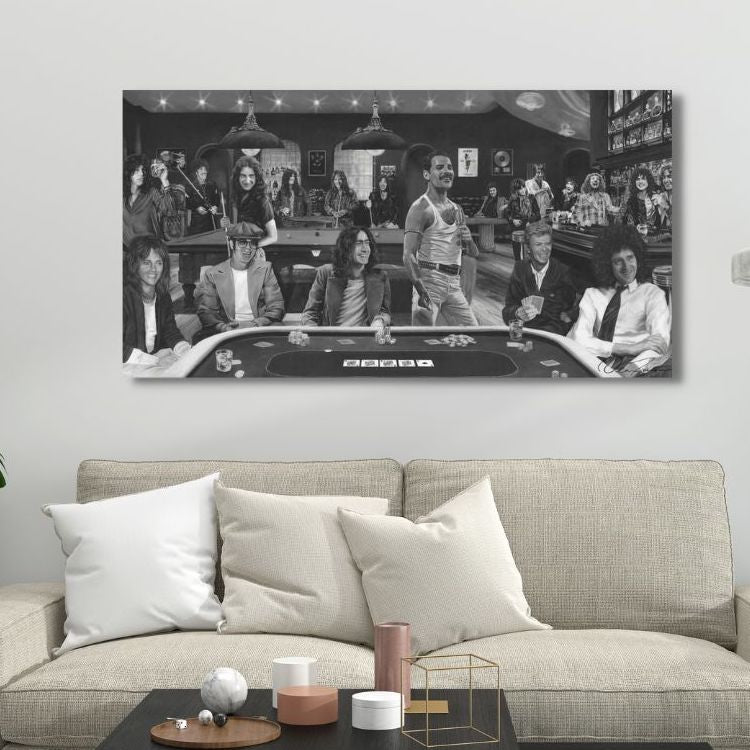


Hang this painting and someone will always point at a face and ask, “Who’s that?” Dean Turner’s Ultimate Guitarist Reunion is a hand-painted original of 45 guitar greats, 12 months from planning and hand painting to finish. This is the story of one of them, Gary Moore. It’s available as a framed canvas print, made from the original, for the room where your music lives.
No. 16 Who’s Who Ultimate Guitarist Reunion
from Belfast to Parisienne Walkways
By the late 1980s he was “really sick of the whole rock metal scene”. His bass player kept telling him to make a blues album, and in 1990 he did.
 16of 45

In this story 13 sections
Why fans still care
GARY MOORE played hard rock with Thin Lizzy and had two UK hit singles with Phil Lynott, Who’s Who number 2 in · Ultimate Queen Reunion (story coming soon). Then, in 1990, he turned round and made a blues record. Still Got the Blues went to number 13 in the UK. The follow-up, After Hours, with B.B. King, Who’s Who number 2, and Albert Collins as guests, got to number 4, his highest album in Britain.
He also owned Peter Green’s 1959 Les Paul, the guitar people call Greeny. Ask a blues player about Moore and that’s often where the talk starts.
Early life and training
Moore was born in Belfast on 4 April 1952. He was left-handed, but he learned on a right-handed guitar. Premier Guitar says he found the instrument at eight, and other accounts say ten.
In the mid-1960s he saw Jimi Hendrix, Who’s Who number 6, and John Mayall’s Bluesbreakers play in Belfast.
At 16 he moved to Dublin to join a blues-rock band called Skid Row. The singer was Phil Lynott, Who’s Who number 2 in · Ultimate Queen Reunion (story coming soon). The band signed to CBS in 1970.
Lynott, Who’s Who number 2 in · Ultimate Queen Reunion (story coming soon) didn’t last long. He was out within months of Moore arriving, and Skid Row carried on as a trio with bassist Brush Shiels and drummer Noel Bridgeman. That line-up made two albums, Skid and 34 Hours.
Career chapters
- Late 1960sMoved to Dublin, aged 16, to join Skid Row
- 1970Skid Row signed to CBS; Peter Green’s Les Paul passed to Moore
- 1973Joined Thin Lizzy, the first of three stints in the 1970s
- 1979Parisienne Walkways, UK number 8; left Thin Lizzy in the middle of a US tour
- 1985Out in the Fields, UK number 5
- 1987Wild Frontier, dedicated to Phil Lynott, Who’s Who number 2 in · Ultimate Queen Reunion (story coming soon)
- 1990Still Got the Blues
- 1992After Hours, UK number 4
- 1994BBM, with Jack Bruce and Ginger Baker
- 1995Blues for Greeny
- 2011Died 6 February, Estepona, Spain, aged 58
Peter Green and Greeny 1970
Peter Green inspired Moore and helped him get started. According to Guitar Player, Green sold Moore his 1959 Les Paul in 1970, though the year is disputed. That guitar, Greeny, became one of the most talked-about Les Pauls in rock.
Moore sold it in 2006. In 2014 it went to Kirk Hammett, Who’s Who number 10, who still plays it with Metallica.
Thin Lizzy 1973 to 1979
In 1973 Moore joined Thin Lizzy, taking over from Eric Bell. Some accounts say early 1974. It was the first of three spells with the band in the 1970s.
After that first spell, he wanted more discipline and found it in Jon Hiseman’s jazz-rock band Colosseum II, making three albums with them. In 1977 he was back in Thin Lizzy for a US tour supporting Queen, standing in for Brian Robertson, who had hurt his hand. He rejoined in 1978 and played on the 1979 album Black Rose. Then, in 1979, he walked out in the middle of another American tour. He set up in Los Angeles and formed G-Force, which made one album, in 1980.
Parisienne Walkways 1979
In 1979 Moore and Lynott, Who’s Who number 2 in · Ultimate Queen Reunion (story coming soon) made Parisienne Walkways, with Lynott, Who’s Who number 2 in · Ultimate Queen Reunion (story coming soon) singing. It reached number 8 in the UK and spent 11 weeks on the chart. For plenty of people it’s the first Gary Moore record they heard.
Out in the Fields 1985
Six years later the two of them were back together for Out in the Fields. It went to number 5 in the UK and spent 10 weeks on the chart.
The song was on Run for Cover, his third hard rock album of the decade after Corridors of Power in 1982 and Victims of the Future in 1983. It was also his last record with Lynott, Who’s Who number 2 in · Ultimate Queen Reunion (story coming soon), who died in January 1986. Moore’s next album, Wild Frontier, came out in 1987, with a nod to Irish traditional music, and he dedicated it to his friend. “I see the whole album as a tribute to Phil,” he told Guitar World. After the War followed in 1989.
Still Got the Blues 1990
Bassist Bob Daisley kept at Moore to make a blues album. In a 2003 interview, published by Guitar Player in 2026, Moore said they’d both laughed when Daisley first suggested it, but that Daisley was right. He was tired of the rock scene anyway. “I was getting really sick of the whole rock metal scene,” he said.
Still Got the Blues came out on Virgin on 26 March 1990 and reached number 13 in the UK.
After Hours 1992
The next blues record, After Hours, had B.B. King, Who’s Who number 2 and Albert Collins as guests. It went to number 4, the highest any of his albums reached in Britain.
BBM and Blues for Greeny 1994 to 1995
In 1994 he formed BBM with Jack Bruce and Ginger Baker, both from Cream, with Moore in the guitar role. They made one album, Around the Next Dream.
A year later came Blues for Greeny, his tribute to Peter Green, the man whose guitar he owned.
Craft, sound and style
Moore was a rock guitarist who kept coming back to the blues. The players he saw as a teenager in Belfast, Hendrix, Who’s Who number 6 and the Bluesbreakers, played blues-rock, and Peter Green was his model.
On After Hours he stood next to B.B. King, Who’s Who number 2 and Albert Collins. On Blues for Greeny he played Green’s songs on Green’s old guitar.
Other players took bits of him home. Kirk Hammett, Who’s Who number 10, who now owns Greeny, told Rolling Stone in February 2011 that the opening lick of his Master of Puppets solo is “a variation of a lick that Gary Moore played a lot”. Blabbermouth carried the same words on 9 February 2011.
Greeny and Stripe
Guitar Player describes Greeny as the “out-of-phase” 1959 Les Paul that became his main guitar for years. He played it with Thin Lizzy and on Parisienne Walkways. By 2007 he was calling it “a big old battle axe”, and he told Vintage Guitar he’d sold it, mainly for money after an insurance claim fell through.
The Les Paul on Still Got the Blues was another 1959 Standard, one he’d owned since 1989, with its original pickups. Bonhams, which sold his collection in 2025 and calls the guitar “Stripe”, says it was his most-recorded guitar, and links it to After the War, Oh Pretty Woman and Walking by Myself as well.
The red Strat
In about 1981 he found a 1960 Fender Stratocaster, Fiesta Red but faded, at Jon King Sounds in Kingston. He was shopping with Greg Lake, who passed on it because of the scratches. Late in 1982 he told Tony Bacon it was the best Strat he’d ever played. A Strat, he said, has a “definite physical punch”, and he wanted a “clangy” sound with an edge.
Bonhams says you can hear it on Corridors of Power in 1982, the intro to End of the World especially, then Too Tired and Moving On in 1990, and Montreux that year. In September 2004 he played Red House on it at Fender’s 50th anniversary concert. It got bigger Dunlop 6100 frets after he bought it, and his former tech Graham Lilley says Seymour Duncan rewound the neck pickup in 1998. It sold at Bonhams on 20 November 2025 for £254,400.
The later records
For Close As You Get in 2007 he used a 1968 Telecaster tuned to open E and dropped to D for slide, a mid-1960s Gibson ES-335 he thought was a ’64, a 1960s Burns Artist for the whammy parts on Hard Times, and an Ozark resonator in open G. He recorded it to 24-track tape, not Pro Tools.
The amps on that record were a 1960s Vox AC30, a Fender Vibroverb reissue, and an Orange Tiny Terror into a hand-wired Marshall 2x12. A year later, on Bad for You Baby, he went to a Fender Dual Showman head, the kind of amp Peter Green used, into a Marshall 4x12. That record also has a red Gibson Firebird he bought in Finland, and a German-built solidbody with Bare Knuckle pickups wired “kind of out of phase” for a Peter Green feel.
Marshalls on stage
For about ten years from around 1996, Marshall DSL heads were his main live amps. In 2008 he moved to two hand-wired Marshall 1959HW heads, which he said had more presence and a rawer sound, with a DigiTech reverb pedal because the amps had none. The pedals were simple: a T-Rex Moller with a clean boost on one side and overdrive on the other, which he used live on Oh Pretty Woman, and a Roger Mayer Stone Fuzz on the opening track of Bad for You Baby.
Strings, picks and phrasing
In 2007 his strings were .009 to .048, down from .010 to .052. He used Gibson extra heavy picks, and before that grey Hercos for years, all through Thin Lizzy.
Albert King, Who’s Who number 1 once told him, “Gary, play every other lick.” Moore told Vintage Guitar that it changed how he thought about phrasing. After Still Got the Blues, he worried that playing quietly would sound like “faking it”, so he kept more of his rock sound in the blues. He described the goal as “a modern, less high-gain version” of the natural sound Eric Clapton, Who’s Who number 3 had in the 1960s.
In 2013 Gibson made a Gary Moore Les Paul Standard in lemonburst, with BurstBucker Pro pickups and the neck pickup mounted reversed, for that out-of-phase sound.
What other players say
“Gary Moore is definitely in my list of top five guitar influences”
“But … live … he was a demon.”
“I probably ripped off Gary Moore more than any other guitar player.”
“Gary opened the door for me and a lot of other blues-rock guitarists.”
“The most powerful, genuine authentic blues-rock guitarist of his day.”
“Gary Moore was the best.”
“he was a great player and a great guy”
Stories people still tell
-
The left-handed kid.
He learned on a right-handed guitar and never switched.
-
Lynott, Who’s Who number 2 in · Ultimate Queen Reunion (story coming soon), again and again.
Skid Row, Thin Lizzy, Parisienne Walkways and Out in the Fields. In August 2005 Moore played a one-off concert in Dublin in honour of Lynott, Who’s Who number 2 in · Ultimate Queen Reunion (story coming soon), filmed for a DVD released in 2006.
6 February 2011
Gary Moore died on 6 February 2011 at a hotel in Estepona, on the south coast of Spain. He was 58. A post-mortem found that he had probably died of a heart attack.
Legacy
Belfast hasn’t forgotten him. In January 2025 a Belfast City Council committee approved a check of sites in the Cathedral Quarter for a privately funded statue, proposed by Councillor Brian Smyth for the Wild Frontier Memorial Project. The statue itself hasn’t been approved, but the idea is on the table.

on the
Who’s Who
In the painting
Gary Moore
Number 16 of 45 on the Who’s Who list for Ultimate Guitarist Reunion by Dean Turner Art, published as Gary Moore.
Collectors lean in, argue over faces and pull the names list. If you’re looking for the blues side of Thin Lizzy, start with Moore.
More names on the same list turn up in his story: B.B. King, Who’s Who number 2, a guest on After Hours, Jimi Hendrix, Who’s Who number 6, whom he saw play in Belfast as a teenager, Kirk Hammett, Who’s Who number 10, who owns Greeny and built a Master of Puppets lick on one of his, and Brian May, Who’s Who number 20, who toured with him in Thin Lizzy’s days.
See Gary Moore among all 45 guitarists in Ultimate Guitarist Reunion.
Who’s Who in the Ultimate Guitarist Reunion
Numbered as on the painting’s key. Pick a name to read their story.
- Story live
- Coming soon
- You’re reading
 Find the numbers on the painting
- 1Albert King
- 2B.B. King
- 3Eric Clapton | Cream/Yardbirds
- 4Stevie Ray Vaughan | Stevie Ray Vaughan & Double Trouble
- 5Billy Gibbons | ZZ TOP
- 6Jimi Hendrix | The Jimi Hendrix Experience/Solo
- 7The Edge | U2
- 8Pete Townshend | The Who
- 9David Gilmour | Pink Floyd
- 10Kirk Hammett | Metallica
- 11Peter Frampton | Solo/Humble Pie/The Herd
- 12George Thorogood | George Thorogood & the Destroyers
- 13Mark Knopfler | Dire Straits
- 14Ritchie Blackmore | Deep Purple/Rainbow
- 15Jeff Beck | Solo/Yardbirds
- 16Gary MooreYou’re reading
- 17Joe Perry | Aerosmith
- 18Prince
- 19Ronnie Wood | Rolling Stones
- 20Brian May | Queen
- 21Rory Gallagher | Solo/Taste
- 22Tom Morello | Rage Against the machine /Audioslave
- 23Tony Iommi | Black Sabbath
- 24Carlos Santana
- 25Joe Walsh | Eagles
- 26Jack White | Solo/White Stripes
- 27Zakk Wylde | Ozzy Osbourne/Black Label Society
- 28Randy Rhoads | Ozzy Osbourne
- 29Joe Satriani
- 30Steve Vai
- 31Keith Richards | Rolling Stones
- 32Jimmy Page | Led Zeppelin/Yardbirds
- 33James Hetfield | Metallica
- 34Eddie Van Halen | Van Halen
- 35Angus Young | AC/DC
- 36Chuck Berry
- 37Kurt Cobain | Nirvana
- 38Les Paul
- 39Lenny Kravitz
- 40Bo Diddley
- 41Johnny Winter
- 42Malcolm Young | AC/DC
- 43Slash | Guns N Roses
- 44George Harrison | Beatles/Traveling Wilburys/Solo
- 45Robert Johnson
Sources
- Premier Guitar, “Irish Blues-Rocker Gary Moore: 1952 to 2011” (7 Feb 2011). premierguitar.com
- Gary Moore official website, biography. gary-moore.com
- Guitar Player, Joe Matera, Gary Moore on how Bob Daisley steered him toward the blues (20 May 2026). guitarplayer.com
- Clash Magazine, Gary Moore “died of heart attack” (9 Feb 2011). clashmusic.com
- Blabbermouth, Belfast statue committee report (17 Jan 2025). blabbermouth.net
- Guitar Player, the Les Paul lineage of Peter Green, Gary Moore and Kirk Hammett (14 Apr 2022). guitarplayer.com
- Official Charts Company, Gary Moore. officialcharts.com
- The Guardian, Gary Moore obituary (7 Feb 2011). theguardian.com
- Louder (Classic Rock), Harry Shapiro, Gary Moore: leaving Thin Lizzy and the story of G-Force (18 Oct 2022). loudersound.com
- Guitar World, Gary Moore’s tribute album to Phil Lynott, Wild Frontier (Sep 1987 interview, republished 6 Feb 2025). guitarworld.com
- AllMusic, Skid Row (Gary Moore, Brush Shiels, Noel Bridgeman) and Skid. allmusic.com
- Guitar World, how Kirk Hammett ended up buying Greeny. guitarworld.com
- Guitar World, Henry Yates, Scott Gorham on his guitar partnership with Gary Moore (8 Jul 2025: 1977 US tour supporting Queen, Moore in for the injured Brian Robertson). guitarworld.com
- Louder (Classic Rock), Harry Doherty, Thin Lizzy on the road across America and Europe (15 Jun 2025: Moore back in place of Robertson for the 1977 American tour with Queen). loudersound.com
- Rolling Stone, Andy Greene, “Metallica’s Kirk Hammett Remembers Thin Lizzy’s Gary Moore” (9 Feb 2011). rollingstone.com
- brianmay.com, Brian’s Soapbox, “Surely not … Gary Moore has died” (6 Feb 2011). brianmay.com
- Guitar Player, Gary Moore rig interview (Feb 2009 issue), published 6 Feb 2023 (Greeny out of phase, Bad for You Baby rig, DSLs, 1959HW, pedals, Clapton sound, “faking it”). guitarplayer.com
- Bonhams, “The Gary Moore Collection: The Final Encore” (sale 32366), 20 Nov 2025 (Stripe). bonhams.com
- Bonhams, Lot 37, Gary Moore 1960 Fender Stratocaster, 20 Nov 2025 (records, frets, rewind, £254,400). bonhams.com
- Bonhams, Tony Bacon, “Gary Moore: ’The Strat Era’” (undated, c. late 2025): Jon King Sounds, Greg Lake, 1982 interview. bonhams.shorthandstories.com
- Vintage Guitar, Lisa Sharken, “Gary Moore”, September 2007 (Greeny sold, Stripe since 1989, Close As You Get guitars and amps, strings, picks, Albert King). vintageguitar.com
- Premier Guitar, “Gibson Announces Gary Moore Les Paul Standard”, 24 Apr 2013. premierguitar.com
- Blabbermouth, “Gary Moore: Official Biography by Harry Shapiro Due in September”, 4 Aug 2022 (Campbell, Bonamassa, Bruce, Hammett). blabbermouth.net
- Blabbermouth, “Glenn Hughes Says Gary Moore Was ’The Best’ Guitarist He Ever Played With”, 2 Oct 2023. blabbermouth.net
- Hot Press, “Tributes to Gary Moore”, 7 Feb 2011. hotpress.com
- Blabbermouth, “Metallica’s Kirk Hammett Remembers Gary Moore”, 9 Feb 2011 (excerpt of Rolling Stone / Andy Greene). blabbermouth.net
Names appear exactly as published on the Who’s Who list for Ultimate Guitarist Reunion.
See the names list for other Ultimate Series artworks
Every painting has its own numbered Who’s Who. Pick a scene and see who’s in it.
 Ultimate Aussie Pub Rock ReunionSee who’s in it
  Ultimate Aussie Reunion - Part 2See who’s in it
  Highway to HellSee who’s in it
  The Ultimate ReunionSee who’s in it
  Ultimate Eagles ReunionSee who’s in it
  Ultimate Queen ReunionSee who’s in it
  Ultimate Beatles ReunionSee who’s in it
  Ultimate Classic Country ReunionSee who’s in it
  Ultimate Hip Hop ReunionSee who’s in it
  Ultimate Gangster ReunionSee who’s in it
  Ultimate Boxing ReunionSee who’s in it
  Ultimate Fighter ReunionSee who’s in it