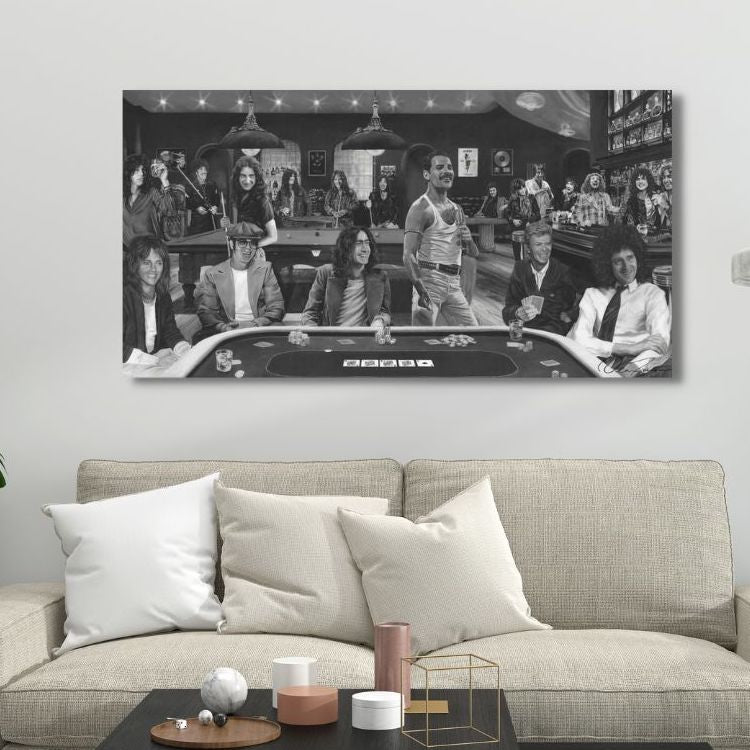


Hang this painting and someone will always point at a face and ask, “Who’s that?” Dean Turner’s Ultimate Boxing Reunion is a hand-painted original of 39 boxing greats, painted over six months. This is the story of one of them, Roberto Durán. It’s available as a framed canvas print, made from the original, for your favourite place.
No. 13 Who’s Who Ultimate Boxing Reunion
from a Panama debut at 16 to world titles in four weight classes
He made his professional debut in Panama in 1968, aged 16. He won his first world title at Madison Square Garden in 1972, and he fought for the last time in Denver in 2001, aged 50. In between he won world titles in four weight classes, and fought Sugar Ray Leonard three times.
 13of 39

In this story 14 sections
Why fans still care
ROBERTO DURÁN won world titles in four weight classes and fought across five decades. He had 119 professional fights, won 103 of them and stopped 70 opponents. People still call him Manos de Piedra, Hands of Stone.
Ask a fight fan about him and you will hear about two nights in 1980, five months apart. In June he beat Sugar Ray Leonard, Who’s Who number 16 over 15 rounds in Montreal. In November, in New Orleans, he turned away in round 8 and the fight was stopped. Then the same fan will tell you about the night in 1989 when he won a fourth title at 37.
Early life
He was born Roberto Durán on 16 June 1951. The International Boxing Hall of Fame says he was born in El Chorrillo, a neighbourhood of Panama City, though some sources say Guararé.
He turned professional on 23 February 1968, aged 16. The name “Manos de Piedra” was given to him by the Panamanian broadcaster Alfonso Castillo. In English it became Hands of Stone.
The early fights
In September 1971, aged 20, he fought at Madison Square Garden for the first time and beat Benny Huertas. Nine months later he was back at the Garden for a world title.
Career chapters
- 1968Turns professional in Panama, aged 16
- 1971Fights at Madison Square Garden for the first time
- 1972Stops Ken Buchanan in round 13 to win the WBA lightweight title
- 1972Loses for the first time, to Esteban De Jesús
- 1980Beats Sugar Ray Leonard, Who’s Who number 16 in Montreal for the WBC welterweight title
- 1980Turns away in round 8 of the rematch in New Orleans, and the fight is stopped
- 1983Stops Davey Moore in round 8 to win the WBA light middleweight title
- 1983Loses a unanimous decision to Marvin Hagler, Who’s Who number 5 over 15 rounds
- 1984Stopped by Thomas Hearns, Who’s Who number 27 in round 2
- 1989Beats Iran Barkley to win the WBC middleweight title, a fourth weight class
- 1989Loses to Leonard for the third time
- 1994Loses to Vinny Pazienza, Who’s Who number 15 (story coming soon) after knocking him down
- 2001Fights for the last time, aged 50, against Héctor Camacho
- 2007Inducted into the International Boxing Hall of Fame
Buchanan 26 June 1972
On 26 June 1972, at Madison Square Garden, he fought the champion Ken Buchanan for the WBA lightweight title. He was 21. He knocked Buchanan down early in round 1. Going into round 13, the referee, Johnny LoBianco, had it 8 to 3 with one round even, the judge Recht had it 9 to 2 with one even, and the judge Gordon had it 9 to 3 with one even, all for Durán.
After the bell ended round 13 the two kept punching, Buchanan went down holding his groin and could not continue, and Durán was given the win by TKO. It was a controversial finish. LoBianco said the punch was in the abdomen, not any lower. Buchanan’s trainer Gil Clancy said it was a knee, and Durán said, “It was a right-hand punch, right here.” He went on to make 12 lightweight title defences.
De Jesús 17 November 1972
Five months later, in a non title fight at Madison Square Garden, he lost a unanimous decision over ten rounds to Esteban De Jesús. De Jesús knocked him down in round 1, and it was his first loss. He beat De Jesús in the rematch in Panama City in 1974, and again on 21 January 1978 at Caesars Palace in Las Vegas, with a TKO in round 12 that unified the WBA and WBC lightweight titles.
Leonard I, the first fight 20 June 1980
On 20 June 1980 he fought Sugar Ray Leonard, Who’s Who number 16 at the Olympic Stadium in Montreal for the WBC welterweight title. Carlos Padilla was the referee. Durán won a unanimous decision over 15 rounds, with the judges Baldeyrou at 146 to 144, Gibbs at 145 to 144 and Poletti at 148 to 147.
Poletti’s total was first announced as 147 to 147, which made it look like a majority decision. About an hour later the WBC’s Bob Lee found an addition error, and the score was corrected to 148 to 147. Leonard said later, “I’ve never been hurt so much in my career.”
Leonard II, “No Más” 25 November 1980
The rematch was on 25 November 1980 at the Superdome in New Orleans. Durán had been celebrating after Montreal and had to lose a lot of weight in about a month. By round 7 Leonard was taunting him, with a bolo feint followed by a stiff jab. In round 8, with 16 seconds left, Durán turned away and raised a hand. The referee, Octavio Meyran, waved the fight on, then stopped it at 2:44. The Louisiana commission later fined Durán $7,500 for an “unsatisfactory performance”.
What he said, and why, is still argued over. The words themselves are disputed. The explanations come from different people, and this post gives no verdict. They are set out under “No Más” in the stories below.
After the fight Arcel and Brown left his team. Durán told the press, “I am retired from boxing right now.”
Moore 16 June 1983
Panama turned on him after New Orleans. In his own words, “I didn’t even leave my house.” He was welcomed back after he stopped Davey Moore in round 8 at Madison Square Garden on 16 June 1983, his 32nd birthday, to win the WBA light middleweight title. Before the fight Moore had dismissed him: “Duran was a great lightweight, a good welterweight and a mediocre junior middleweight.”
Don King, Who’s Who number 18 (story coming soon) had promoted the New Orleans rematch, and dropped him after the loss to Kirkland Laing on 4 September 1982. He then signed with the promoter Bob Arum.
Hagler 10 November 1983
On 10 November 1983 he fought the undisputed middleweight champion Marvin Hagler, Who’s Who number 5 at Caesars Palace. In the middle rounds Hagler switched stance, and Durán lost a unanimous decision over 15 rounds. The cards read 144 to 142, 144 to 143 and 146 to 145 for Hagler. Durán led on two of them after 13 rounds, and Hagler won rounds 14 and 15.
Hagler said afterwards, “I felt I beat him but he’s a very gutsy warrior.” Durán said of Hagler, “He didn’t teach me anything.”
Hearns 15 June 1984
On 15 June 1984 he fought Thomas Hearns, Who’s Who number 27 at Caesars Palace for the WBC light middleweight title. Hearns knocked him down twice in round 1 and once more in round 2. Carlos Padilla stopped it at 1:07 of round 2. UPI reported it was the first time another fighter had stopped him. Durán lost his WBA belt because he fought Hearns instead of the mandatory challenger.
Barkley 24 February 1989
On 24 February 1989, at the Convention Hall in Atlantic City, he fought Iran Barkley for the WBC middleweight title. He was 37. Barkley went down in round 11. It was a split decision over 12 rounds, with Ferrari at 118 to 112 and Kaczmarek at 116 to 112 for Durán, and Brown at 116 to 113 for Barkley. It won him a fourth world title in a fourth weight class, and it was named The Ring Fight of the Year for 1989.
He weighed 156 and a quarter pounds for the fight. Afterwards he said, “I am like a bottle of wine. The older I get, the better I get.”
Leonard III 7 December 1989
On 7 December 1989 he fought Sugar Ray Leonard, Who’s Who number 16 for the third time, at The Mirage in Las Vegas, for the WBC super middleweight title. Leonard won a unanimous decision over 12 rounds, 120 to 110, 119 to 109 and 116 to 111.
The long tail 1994 to 2001
On 25 June 1994 he fought Vinny Pazienza, Who’s Who number 15 (story coming soon) at the MGM Grand in Las Vegas for the vacant IBC super middleweight title. He was 43. He knocked Pazienza down with a right hand (the AP put it in round 5, the Los Angeles Times in round 6), and lost a unanimous decision over 12 rounds. The cards read 117 to 113, 117 to 112 and 117 to 112. He said afterwards, through an interpreter, “I didn’t lose the fight.” Pazienza beat him again on 14 January 1995 in Atlantic City.
Héctor Camacho beat him on 22 June 1996 in Atlantic City, for the vacant IBC middleweight title. On 28 August 1998, aged 47, he was stopped in round 3 by William Joppy at the Las Vegas Hilton, in a WBA middleweight title fight, and said, “I am finished.” He fought on. In June 2000, aged 49, he won a unanimous decision over Pat Lawlor in Panama City for a fringe super middleweight title.
His last fight was against Camacho again, on 14 July 2001 at the Pepsi Center in Denver. He was 50. Camacho won a unanimous decision, 114 to 112, 118 to 108 and 118 to 108. Camacho said afterwards, “I was fighting a great legend.”
The crash and retirement 2001 and 2002
In early October 2001 he was injured in a car crash in Buenos Aires. In January 2002 he announced his retirement. “I can’t return to fight anymore,” he said.
Style, technique and the corner
How he fought
Different people describe him differently, and the quotes below do most of the work. His trainer Freddie Brown said, “When he hits ya, he hurts ya,” and compared him to Rocky Marciano, Who’s Who number 22 (story coming soon). Ken Buchanan, who lost his title to him, called him a scrapper. Hagler, who switched stance in the middle rounds and won their fight, still called him a very gutsy warrior.
His own line about age came after Barkley. At 37 he said he was like a bottle of wine.
The corner
Carlos Eleta managed him. Ray Arcel, a Hall of Fame trainer, and Freddie Brown trained him, and by May 1980 they had worked with him for the past eight years, which puts the start at about 1972. Arcel was 81 that year and Brown was 71. Both left after New Orleans.
Training
For the first Leonard fight in 1980 he trained at Gleason’s Gym in New York, then at Grossinger’s in the Catskills. Crowds paid a dollar to watch him spar, and Kevin Rooney was among his sparring partners. He skipped rope. He arrived at camp at about 159 pounds, after ballooning to about 170 between lightweight defences, and Brown cut his New York workouts because the crowds got in the way.
For the 2001 fight in Denver he walked in wearing a velvet purple robe with gold trim.
What others say
“I’ve never been hurt so much in my career.”
“You’ll pull through champ. You’re the best.”
“I felt I beat him but he’s a very gutsy warrior.”
“He was a scrapper.”
“Duran was a great lightweight, a good welterweight and a mediocre junior middleweight.”
“...because he was known as a great fighter.”
“Oh, Roberto Duran. Number one, yeah.”
“He’s like a Marciano.”
“When he hits ya, he hurts ya.”
Stories people still tell
-
No Más.
The facts are plain. In round 8 in New Orleans, with 16 seconds left, Durán turned away and raised a hand. What lay behind it is disputed, and so are the words. These are the explanations people have given, with their names.
- Durán, in his 2016 autobiography: “I felt sick from when I started training and stayed that way until the fight. I spent almost every day in the sauna and went two days without eating. I was too weak and could not feel my legs.” He also wrote, “I never said ’no mas.’ I just turned my back and motioned to the referee that I didn’t want to continue... all I said was ’no sigo.’ I couldn’t go on.”
- Leonard says he never heard “no más” either. His plan was to rematch Durán while he was out of shape.
- His manager Carlos Eleta told reporters, “Stomach cramps? Maybe that’s true, maybe it’s not. But Duran didn’t quit because of stomach cramps. He quit because he was embarrassed.” Eleta said Durán cried afterwards and said, “I’m ashamed of myself.”
- In the locker room the explanation was stomach cramps from a big meal after the weigh in. The WBC president José Sulaiman said it was an injured right shoulder.
- Freddie Brown said, “He just quit. I been with the guy nine years and I can’t answer it.”
- Ray Arcel, aged 81, wept. In his biography he said, “The whole situation was more than I could take.”
- His son Robin Durán said, “It’s very hard for a fighter to speak with a mouthpiece on. He just waved his hand.”
-
The Buchanan finish.
A blow after the bell in round 13 that Buchanan’s corner called a knee or low, a referee who ruled it was to the abdomen, and Durán ahead on all three cards. Buchanan said later that he made the mistake of going toe to toe with him. Durán, in an interview reported by Seconds Out in April 2025, named Buchanan as his toughest opponent, because “he had to travel, it was 15 rounds, and it was his first world title fight”, in the words of his translator.
-
Four Kings.
Durán, Leonard, Hagler and Hearns are the four names people group together from the 1980s. Durán fought all three of the others. In The Ring’s Best I Faced series he named Leonard, and said, “It takes a lot to come back from defeat and Leonard did it.”
-
Three fights with Leonard.
Montreal in June 1980 went to Durán. New Orleans in November 1980 and Las Vegas in 1989 went to Leonard.
-
Hands of Stone.
The 2016 film Hands of Stone was written and directed by Jonathan Jakubowicz. Édgar Ramírez plays Durán, Robert De Niro plays Arcel and Usher plays Leonard. It premiered at Cannes on 16 May 2016 and opened in the United States on 26 August 2016. Reviews were mixed.
Legacy
He won world titles in four weight classes, made 12 lightweight title defences, and fought from 1968 to 2001. He was inducted into the International Boxing Hall of Fame in 2007. The Hall of Fame record has him at 103 wins and 16 losses from 119 fights, with 70 knockouts.
Sugar Ray Leonard, Who’s Who number 16, who fought him three times, sent him a video message when he had COVID-19: “You’ll pull through champ. You’re the best.” Mike Tyson, Who’s Who number 34, asked which fighters inspired him to box, said, “Oh, Roberto Duran. Number one, yeah.”

on the
Who’s Who
In the painting
Roberto Durán
Number 13 of 39 on the Who’s Who list for Ultimate Boxing Reunion by Dean Turner Art, published as Roberto Durán.
Collectors lean in, argue over faces and pull the names list. Durán’s story runs through a lot of this painting: he fought Sugar Ray Leonard, Who’s Who number 16 three times, lost to Marvin Hagler, Who’s Who number 5 and Thomas Hearns, Who’s Who number 27, and lost twice to Vinny Pazienza, Who’s Who number 15 (story coming soon). Don King, Who’s Who number 18 (story coming soon) promoted the New Orleans rematch, and Mike Tyson, Who’s Who number 34 names him among the fighters who inspired him to box. His trainer Freddie Brown said he was like a Marciano, and Rocky Marciano, Who’s Who number 22 (story coming soon) is in the painting too.
If you can name every face in this one, there’s a fair chance someone taught you them, maybe a dad who stayed up for the fights.
See Roberto Durán among all 39 faces in Ultimate Boxing Reunion, a framed canvas print made from Dean’s hand-painted original.
Who’s Who in the Ultimate Boxing Reunion
Numbered as on the painting’s key. Pick a name to read their story.
- Story live
- Coming soon
- You’re reading
 Find the numbers on the painting
- 1Manny Pacquiao
- 2Kostya Tszyu
- 3Tim Tszyu
- 4Roy Jones Jr (story coming soon)
- 5Marvin Hagler
- 6Félix Trinidad (story coming soon)
- 7Johnny Famechon
- 8Canelo Álvarez (story coming soon)
- 9Bernard Hopkins (story coming soon)
- 10Oscar De La Hoya (story coming soon)
- 11Danny Green (story coming soon)
- 12Jeff Fenech
- 13Roberto DuránYou’re reading
- 14Floyd Mayweather Jr
- 15Vinny Pazienza (story coming soon)
- 16Sugar Ray Leonard
- 17Tyson Fury (story coming soon)
- 18Don King (story coming soon)
- 19Larry Holmes (story coming soon)
- 20Sonny Liston (story coming soon)
- 21Joe Louis (story coming soon)
- 22Rocky Marciano (story coming soon)
- 23Joe Bugner (story coming soon)
- 24Jack Johnson (story coming soon)
- 25Tommy Morrison (story coming soon)
- 26Ken Norton (story coming soon)
- 27Thomas Hearns
- 28Ryan Garcia (story coming soon)
- 29Lennox Lewis
- 30Leon Spinks (story coming soon)
- 31Evander Holyfield (story coming soon)
- 32Joe Frazier
- 33Muhammad Ali
- 34Mike Tyson
- 35George Foreman
- 36Cus D’Amato (story coming soon)
- 37Lionel Rose
- 38Jack Dempsey (story coming soon)
- 39Archie Moore (story coming soon)
Sources
- International Boxing Hall of Fame, Roberto Durán (inductee page): 119 bouts, 103 wins, 16 losses, 70 KOs, four divisions, five decades, 12 lightweight defences, El Chorrillo, debut 23 Feb 1968, inducted 2007. ibhof.com
- The New York Times (27 Jun 1972): Durán v Buchanan, 26 Jun 1972, TKO 13. nytimes.com
- The Washington Post (25 May 1980, Vic Ziegel): the 1980 training camp, Arcel and Brown for the past eight years, Huertas, Freddie Brown quotes. washingtonpost.com
- The Washington Post (22 Jun 1980): Leonard I, cards and the scoring correction. washingtonpost.com
- Bleacher Report (25 Nov 2015), The Men and the Myths: Leonard II, 2:44, Meyran, Eleta, Sulaiman, Brown, Robin Durán. bleacherreport.com
- ESPN Classic, Sugar Ray Leonard profile: Leonard II. espn.com
- Inside the Games (27 Nov 2020): Durán’s 2016 autobiography, Leonard quotes, Arum, Panama’s reaction, Castillo and the nickname. insidethegames.biz
- BoxingScene (Groves), 25 years later: Duran v Moore remembered (17 Jun 2008): Moore, Laing, Arum. boxingscene.com
- UPI (11 Nov 1983), Hagler shows skills, Durán shows heart: cards, Hagler and Durán quotes. upi.com
- The Washington Post (16 Jun 1984), Hearns knocks down Durán three times: Hearns fight. washingtonpost.com
- UPI (21 Jun 1984): first time another fighter had stopped him. upi.com
- Los Angeles Times (25 Feb 1989): Barkley, cards, “bottle of wine”. latimes.com
- UPI (25 Feb 1989): Barkley, weight. upi.com
- Los Angeles Times (8 Dec 1989): Leonard III. latimes.com
- The Washington Post, AP (25 Jun 1994): Pazienza I. https://www.washingtonpost.com/archive/sports/1994/06/26/pazienza-earns-decision-in-12-rounds-vs-duran/3fd4e1bc-199c-492a-819f-15bad0ee8ec0/ Also Los Angeles Times (Tim Kawakami, 26 Jun 1994), Pazienza I, Durán’s remark through an interpreter. latimes.com
- Deseret News, AP (29 Aug 1998): Joppy, “I am finished”. deseret.com
- ESPN, AP (14 Jul 2001): Camacho II, cards, the 2001 robe. a.espncdn.com
- BBC Sport (26 Jan 2002): retirement announced. newsimg.bbc.co.uk
- BoxingScene (18 Dec 2014): Hearns quote. boxingscene.com
- talkSPORT (4 May 2024): Tyson quote. talksport.com
- BBC Sport (1 Apr 2023): Buchanan quote (the same words appear in the BBC’s 2015 interview, https://www.bbc.com/sport/scotland/32474375). bbc.com
- Seconds Out (22 Apr 2025 and 16 Apr 2025): Durán on Buchanan (https://www.secondsout.com/news/roberto-duran-on-his-toughest-fight/) and on Leonard, Best I Faced. secondsout.com
- Variety (16 May 2016): Hands of Stone, Cannes premiere (used for the credits only, not for facts about Durán). variety.com
Names appear exactly as published on the Who’s Who list for Ultimate Boxing Reunion.
See the names list for other Ultimate Series artworks
Every painting has its own numbered Who’s Who. Pick a scene and see who’s in it.
 Ultimate Aussie Pub Rock ReunionSee who’s in it
  Ultimate Aussie Reunion - Part 2See who’s in it
  Ultimate Guitarist ReunionSee who’s in it
  Highway to HellSee who’s in it
  The Ultimate ReunionSee who’s in it
  Ultimate Eagles ReunionSee who’s in it
  Ultimate Queen ReunionSee who’s in it
  Ultimate Beatles ReunionSee who’s in it
  Ultimate Classic Country ReunionSee who’s in it
  Ultimate Hip Hop ReunionSee who’s in it
  Ultimate Gangster ReunionSee who’s in it
  Ultimate Fighter ReunionSee who’s in it