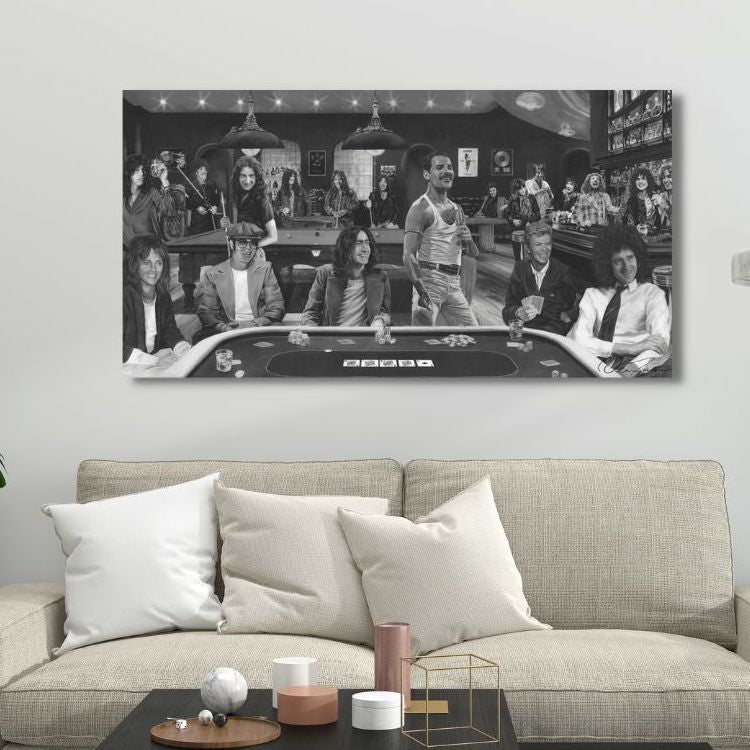


Hang this painting and someone will always point at a face and ask, “Who’s that?” Dean Turner’s Ultimate Boxing Reunion is a hand-painted original of 39 boxing greats, painted over six months. This is the story of one of them, Archie Moore. It’s available as a framed canvas print, made from the original, for your favourite place.
No. 39 Who’s Who Ultimate Boxing Reunion
the Old Mongoose who waited 16 years for a title shot
Archie Moore waited about 16 years for a title shot, won the world light heavyweight title for an $800 purse in 1952, and never lost it in the ring. He still holds boxing’s record for career knockouts.
 39of 39

In this story 14 sections
Why fans still care
ARCHIE MOORE is often called the greatest light heavyweight of all time. He fought for close to three decades, against everyone from Joey Maxim to a young Cassius Clay, and he still holds the record for career knockouts.
He waited about 16 years for his title shot, and once he had the belt, nobody took it off him in the ring.
Early life
He was born Archibald Lee Wright. His mother gave his birth date as 13 December 1913, and he gave 13 December 1916; the 1920 census lists him as a three-year-old in St Louis, which supports his version. Benoit, Mississippi is the usual birthplace, though he also named Collinsville, Illinois. He grew up in St Louis with his uncle and aunt, Cleveland and Willie Moore, and took their surname. As a teenager he spent 22 months in the Missouri reformatory at Boonville.
He decided at 15 that he would fight. His first hero was Kid Chocolate. He built his strength by walking on his hands and chinning a bar 255 times, worked on his jab in front of a mirror holding his aunt’s flatirons, and boxed at a Civilian Conservation Corps camp at Poplar Bluff, Missouri.
The long road
The WBA dates his professional debut to 3 September 1935, a second-round knockout of Billy Simms at Poplar Bluff, at welterweight. From the late 1930s he lived in San Diego, and by 1955 he had fought “from Tasmania to Toledo”. Ezzard Charles beat him three times, and he won four of his five fights with Harold Johnson. Like many top Black contenders of the 1940s he struggled for big fights and fair pay, and in 1950 he fought only twice, hustling pool to get by. By 1952 Jack “Doc” Kearns, who had once managed Jack Dempsey, Who’s Who number 38, was his co-manager.
Career chapters
- 1935First recorded professional win, at Poplar Bluff
- 1952Beats Joey Maxim for the world light heavyweight title
- 1954Settles his rivalry with Harold Johnson
- 1955Challenges Rocky Marciano, Who’s Who number 22 for the heavyweight title
- 1956Loses to Floyd Patterson for the vacant heavyweight title
- 1958Gets up from three knockdowns to stop Yvon Durelle
- 1960 to 1962Stripped of his title by the boxing bodies
- 1962Stopped by Cassius Clay
Maxim 1952
On 17 December 1952 in St Louis he beat Joey Maxim on a unanimous decision over 15 rounds and became world light heavyweight champion. Sherdog reports that his purse came to only $800. He beat Maxim twice more in title defences, in Ogden in June 1953 and Miami in January 1954.
The champion 1953 to 1962
His defences took him to Harold Johnson, stopped in round 14 in August 1954 to settle their five-fight rivalry, Bobo Olson in 1955, Yolande Pompey in London in 1956, Tony Anthony in 1957, Yvon Durelle twice and Giulio Rinaldi at Madison Square Garden in 1961. That made nine defences in all. He moved up to heavyweight twice. Floyd Patterson knocked him out in round 5 for the vacant title at Chicago Stadium on 30 November 1956.
Marciano 1955
On 21 September 1955 at Yankee Stadium, before 61,574, he challenged Rocky Marciano, Who’s Who number 22 for the heavyweight title. He dropped the unbeaten champion in round 2 with a counter right. The referee Harry Kessler gave Marciano an eight-count that is widely reported to have been wrongly applied, and reports differ on how quickly Marciano rose. Marciano put Moore down twice in round 6 and again in round 8, and finished it in round 9. It was Marciano’s last fight.
Durelle 1958
On 10 December 1958 at the Montreal Forum, Yvon Durelle knocked him down three times in round 1 and again later in the fight. Moore came back, dropped Durelle in round 7 and round 10, and knocked him out in round 11. The Fight City calls it “generally regarded as one of the greatest fights of all time”. He was Fighter of the Year for 1958, and he beat Durelle again in three rounds in August 1959.
The last years 1960 to 1963
The NBA withdrew its recognition in October 1960, and the New York commission and the European Boxing Union followed in February 1962. Sherdog gives his reign as nine years and 52 days, the longest at light heavyweight. He lost to Rinaldi in Rome in 1960 and drew with Willie Pastrano in 1962. On 15 November 1962 at the Los Angeles Sports Arena he fought Cassius Clay, the future Muhammad Ali, Who’s Who number 33, who had trained briefly at Moore’s camp in 1960. Clay predicted round 4 and stopped him in round 4. His last fight is reported in 1963.
After boxing
He ran his “Salt Mine” training camp about 30 miles northeast of San Diego, near Ramona, and founded the youth programme Any Boy Can. President Reagan appointed him to help develop HUD’s Project Build. He made his acting debut as Jim in MGM’s The Adventures of Huckleberry Finn in 1960, and stood for the California Assembly the same year. He was in the corner of George Foreman, Who’s Who number 35 against Joe Frazier, Who’s Who number 32, and again when Foreman regained the heavyweight title at 45. He died in a San Diego hospice on 9 December 1998.
Style, technique and the corner
How he fought
He told Sports Illustrated in 1955 that defence was the first thing he learned, with punching added about a year later. He stood left foot forward in a slight crouch, called his left foot “the key to balance”, carried his hands low and brought the jab up with force. He blocked, caught and rolled punches off his shoulders, and against heavyweights he used a cross-arm guard that he later taught to Foreman.
Signature punches
Hooking off the jab and the left cross were his trademarks, and he used the uppercut as a defensive weapon when trapped on the ropes. He called his method “escapology”, building an “escape bridge” into every punch so he could never be caught off balance. He numbered his combinations; the finish that beat Olson was “4-6-9”, and not even his trainer knew the system. He taped his own hands and sparred without headgear.
The corner
His trainers included Cheerful Norman in 1955, then Hiawatha Grey and Dick Saddler. Between fights he weighed between 190 and 215 pounds and cut back to the 175-pound limit for title fights.
What others say
“In my view he was the greatest light heavyweight in the history of boxing and one of the greatest boxers in any division”
“He became greater and greater the older he got.”
“I have fought smart men before, but never anyone as smart as that fellow.”
“Archie is a smart old guy”
“Archie stands as a tower for all athletes, saying, ’If you want it, leave your excuses behind and come get it.’”
“These guys don’t grow old. They just get better as they go.”
“He’s the Einstein of boxing.”
“I just couldn’t seem to get a clean shot at him.”
Stories people still tell
-
The best jab.
“I had the best jab in the business, Joe Louis notwithstanding,” he told The New Yorker in 1961.
-
Mixing in punches.
He talked to opponents during fights. When Tony Anthony’s manager complained in 1957, Moore said, “Please remind Mr. Braca that I mixed a few punches into the conversation.”
-
Kessler woke him up.
Moore later said the referee’s count helped Marciano in 1955, because Kessler “woke him up”.
Legacy
He went into the International Boxing Hall of Fame in 1990. In 1999 the AP named him the greatest light heavyweight of the century, and in 2002 The Ring ranked him 14th among the 80 best fighters of the previous 80 years. In 2025 a bill was introduced in Congress to name the post office in Ramona after him.

on the
Who’s Who
In the painting
Archie Moore
Number 39 of 39 on the Who’s Who list for Ultimate Boxing Reunion by Dean Turner Art, published as Archie Moore.
Collectors lean in, argue over faces and pull the names list. Moore touches more faces here than most: he fought Rocky Marciano, Who’s Who number 22 and Muhammad Ali, Who’s Who number 33, and later worked the corner of George Foreman, Who’s Who number 35.
If you can name every face in this one, there’s a fair chance someone taught you them, maybe a dad who stayed up for the fights.
See Archie Moore among all 39 faces in Ultimate Boxing Reunion, a collector piece made from Dean’s hand-painted original.
Who’s Who in the Ultimate Boxing Reunion
Numbered as on the painting’s key. Pick a name to read their story.
- Story live
- Coming soon
- You’re reading
 Find the numbers on the painting
- 1Manny Pacquiao
- 2Kostya Tszyu
- 3Tim Tszyu
- 4Roy Jones Jr
- 5Marvin Hagler
- 6Félix Trinidad
- 7Johnny Famechon
- 8Canelo Álvarez
- 9Bernard Hopkins
- 10Oscar De La Hoya
- 11Danny Green
- 12Jeff Fenech
- 13Roberto Durán
- 14Floyd Mayweather Jr
- 15Vinny Pazienza
- 16Sugar Ray Leonard
- 17Tyson Fury
- 18Don King
- 19Larry Holmes
- 20Sonny Liston
- 21Joe Louis
- 22Rocky Marciano
- 23Joe Bugner
- 24Jack Johnson
- 25Tommy Morrison
- 26Ken Norton
- 27Thomas Hearns
- 28Ryan Garcia
- 29Lennox Lewis
- 30Leon Spinks
- 31Evander Holyfield
- 32Joe Frazier
- 33Muhammad Ali
- 34Mike Tyson
- 35George Foreman
- 36Cus D’Amato
- 37Lionel Rose
- 38Jack Dempsey
- 39Archie MooreYou’re reading
Sources
- The New Yorker profile (11 Nov 1961), reprinted by Deadspin (14 Jan 2015): reformatory, Kid Chocolate, 255 chin-ups, flatirons, CCC camp, Johnson 4-1, 16 years, Salt Mine, Clay at the camp, Assembly 1960, trainers, weight, quotes. deadspin.com
- WBA, Jesús Cova (15 Feb 2024), Archie Moore: King of the knockout: debut, BoxRec record, IBHOF 1990, AP 1999, Ring 2002. wbaboxing.com
- The Fight City, Michael Carbert (10 Dec 2025), Moore vs Durelle I. thefightcity.com
- Encyclopedia.com, Archie Moore: birth name, raised by the Moores, Fighter of the Year 1958. encyclopedia.com
- VICE, Jack Slack (20 Jan 2016), George Foreman: Student of the Greats: cross guard, Frazier corner, 1994 corner. vice.com
- Sherdog, Bernard Fernandez (16 Dec 2015), December will always be Archie Moore’s month: $800, Kearns, Kessler, reign, Clay prediction, Torres quotes. sherdog.com
- John Nogowski (8 May 2024), Archie Moore remembers Rocky: “woke him up”. johnnogowski.substack.com
- Sports Illustrated, Ezra Bowen (19 Sep 1955), reprinted in IBRO Journal 143: stance, defence, jab, escapology, 4-6-9, Charles, Tasmania to Toledo. ibroresearch.com
- ESPN Stats and Information, Malik Smith (21 Sep 2015), Marciano’s last fight. espn.com
- Boxing News (9 Dec 2016), On This Day: Archie Moore dies: 1920 census, 1950, defences, stripping, Rinaldi, Pastrano, death. boxingnewsonline.net
- ESPN, Ron Flatter, Moore packed a lethal punch: birth dates, Maxim, Marciano, Pompey, Patterson, Durelle, Rinaldi, Clay, Durelle quote. espn.com
- AFI Catalog, The Adventures of Huckleberry Finn (1960). catalog.afi.com
- GovInfo, H.R. 4982 (119th Congress, 15 Aug 2025). govinfo.gov
- CBS News (Dec 1998), Boxer Archie Moore dead: San Diego hospice. cbsnews.com
- Office of Rep. Darrell Issa (19 Aug 2025), bill honouring Archie Moore: Ramona, The Mongoose, Project Build. issa.house.gov
- iVB Boxing, Thomas Hauser, Archie Moore Revisited: Clay camp, purse, Foreman, Maxim, Anthony and Marciano quotes. ivb.co
Names appear exactly as published on the Who’s Who list for Ultimate Boxing Reunion.
See the names list for other Ultimate Series artworks
Every painting has its own numbered Who’s Who. Pick a scene and see who’s in it.
 Ultimate Aussie Pub Rock ReunionSee who’s in it
 Ultimate Aussie Reunion - Part 2See who’s in it
 Ultimate Guitarist ReunionSee who’s in it
 Highway to HellSee who’s in it
 The Ultimate ReunionSee who’s in it
 Ultimate Eagles ReunionSee who’s in it
 Ultimate Queen ReunionSee who’s in it
 Ultimate Beatles ReunionSee who’s in it
 Ultimate Classic Country ReunionSee who’s in it
 Ultimate Hip Hop ReunionSee who’s in it
 Ultimate Gangster ReunionSee who’s in it
 Ultimate Fighter ReunionSee who’s in it