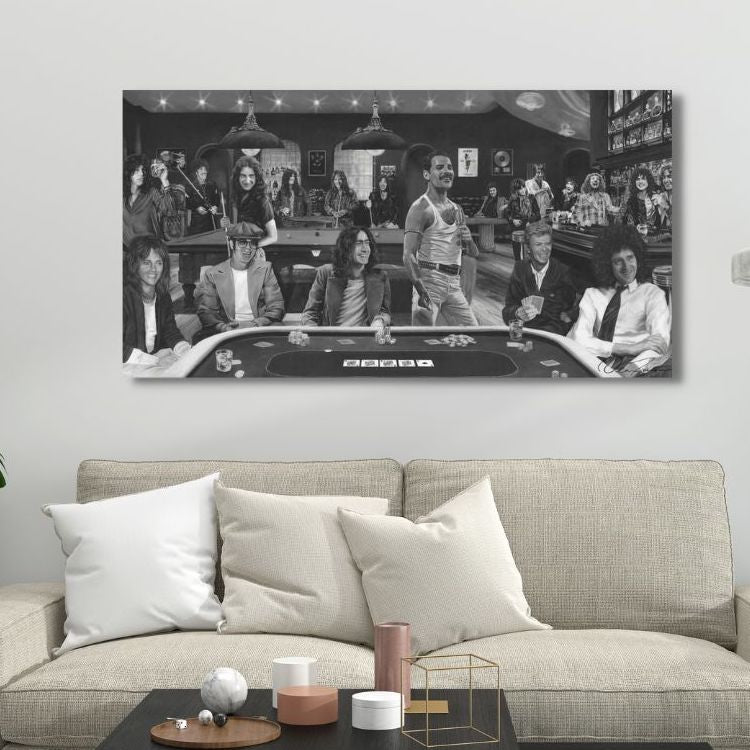


Hang this painting and someone will always point at a face and ask, “Who’s that?” Dean Turner’s Ultimate Boxing Reunion is a hand-painted original of 39 boxing greats, painted over six months. This is the story of one of them, Johnny Famechon. It’s available as a framed canvas print, made from the original, for your favourite place.
No. 7 Who’s Who Ultimate Boxing Reunion
a 6 to 1 underdog from a Melbourne gym who came home featherweight champion of the world
He never had an amateur fight. He learned everything in a Melbourne gym under Festival Hall, and at 23 he went to London as a 6 to 1 underdog and came home featherweight champion of the world.
 7of 39

In this story 14 sections
Why fans still care
JOHNNY FAMECHON was Australia’s third world boxing champion, and he won it by not getting hit. On 21 January 1969 at the Royal Albert Hall he outpointed José Legrá, a champion unbeaten in 54 fights, using a fast jab and constant movement he had learned in a Melbourne gym.
Australian boxing people still use his name as the benchmark for defence. Jeff Fenech, Who’s Who number 12 put it simply: “He was beautiful to watch, just so skilful.”
If you grew up hearing about Australian world champions, Fammo is one of the first names you’d have heard.
Early life
He was born Jean-Pierre Famechon in Paris on 28 March 1945, into a boxing family. His father had been a French lightweight champion, and an uncle was French and European featherweight champion.
In 1950, when he was five, the family emigrated to Australia and settled in Melbourne.
The gym under Festival Hall
He never boxed as an amateur. His trainer, Ambrose Palmer, refused to train amateurs, so he learned the trade in Palmer’s gym underneath Festival Hall in West Melbourne and turned professional at 16.
Palmer’s way of working became known as the Method. The left jab was the main weapon, thrown fast, with constant movement to the side. The right hand stayed open and glued to the chin as the last line of defence, and was thrown rarely. Famechon summed up the gym work as “speed and more speed.”
Palmer trained him for his whole career.
Career chapters
- 1950Family moves from Paris to Melbourne
- 1961Professional debut at Festival Hall, 9 June, aged 16
- 1964Victorian and Australian featherweight champion
- 1965Loses to Gilberto Biondi, his last defeat for more than four years
- 1967Commonwealth champion, TKO 11 over John O’Brien at Festival Hall
- 1968Stops Billy McGrandle in round 12 to keep the Commonwealth title
- 1969WBC world champion, beating José Legrá in London; first defence against Fighting Harada in Sydney
- 1970Knocks out Harada in Tokyo; King of Moomba; loses to Vicente Saldívar in Rome, his last fight
- 1985Sport Australia Hall of Fame
- 1991Hit by a car while jogging
- 2018Bronze statue unveiled in Ballam Park, Frankston, 21 January
- 2022Order of Australia; dies in Melbourne, aged 77
Festival Hall years 1961 to 1968
His debut at Festival Hall on 9 June 1961 was a three round draw. In 1964 he won the Victorian and Australian featherweight titles, and the Sport Australia Hall of Fame says he defended the national title three times.
On 29 October 1965 Gilberto Biondi beat him on points over 12 rounds. He didn’t lose again until 1970.
On 24 November 1967, back at Festival Hall, he stopped John O’Brien in round 11 to win the Commonwealth featherweight title. In 1968 he kept it by stopping Billy McGrandle in round 12.
José Legrá at the Royal Albert Hall 21 January 1969
Legrá, the Cuban-born world champion (he was based in Spain), came in with more than 100 fights behind him and unbeaten in 54. Famechon went in a 6 to 1 underdog.
Early on Legrá clowned. Famechon worked off the jab and kept moving, which kept the champion off balance. Legrá tired, and in the last round he charged, and Famechon picked off his punches. The referee, George Smith, was the only judge, and he gave it to Famechon over 15 rounds. ABC News calls him the undisputed featherweight champion from that night.
Fighting Harada in Sydney 28 July 1969
His first defence was against Fighting Harada at Sydney Stadium. The guest referee and sole judge was Willie Pep. Pep first announced a draw, then corrected his card in Famechon’s favour.
The rematch in Tokyo 6 January 1970
Six months later he went to Harada’s home city for the rematch, at the Metropolitan Gym. Harada put him down in round 10, with Famechon ahead on the cards. He got up, kept boxing, and knocked Harada out at 1:09 of round 14. The referee was Nick Pope.
Saldívar in Rome 9 May 1970
His third defence was against Vicente Saldívar, the Mexican southpaw, in Rome. Saldívar was the aggressor. Famechon slipped to the canvas in the 11th and twice in the 14th, and in the 13th he was counted, which cost him two points under the rules of the fight. The three judges scored it 71 to 68, 71 to 68 and 73 to 70 for Saldívar. Ambrose Palmer was in his corner, with his British manager Denny Mancini as second.
“I’m sure I won,” he told The Age, and he rated Harada the tougher opponent. Saldívar’s view of him: “He was difficult to hit because he moved very intelligently.”
He never fought again. He was 25, and on retiring he said he had simply had enough.
After boxing
In 1970 he was crowned King of Moomba in Melbourne. In 1985 he joined the Sport Australia Hall of Fame.
In 1991 he was hit by a car while jogging near Warwick Farm racecourse in Sydney. He had a stroke and a brain injury, and spent ten days in a coma. From 1993 the Goju karate expert Ragnar Purje worked with him on movement based therapy, and the Sport Australia Hall of Fame says his rehabilitation returned him to near full health. His wife, Glenys, was by his side. “I’m not going to be like this forever,” he said on ABC Radio National in 2016.
He was inducted into the World Boxing Hall of Fame in 1997 and the Australian National Boxing Hall of Fame in 2003. On 21 January 2018 a bronze statue of him was unveiled in Ballam Park, Frankston. Statue committee member Gary Luscombe told MaxBoxing it began at the unveiling of Lionel Rose’s, Who’s Who number 37 statue in 2010, when Rose said he wanted one “for my mate Fammo.”
In 2022 he was made a Member of the Order of Australia for significant service to boxing at the elite level. Johnny Famechon died in Melbourne on 4 August 2022, aged 77.
Style, technique and the corner
How he fought
He was a defensive counter puncher, famous for being hard to hit. The British Vintage Boxing profile of him is titled “The Artful Dodger.” ABC News described quick movement, smart boxing and solid defence.
The punches
The fast left jab did most of the work, with constant lateral movement behind it. Against Legrá it kept the champion off balance for 15 rounds. The right hand stayed at his chin. He ducked low to get under punches, and built the strength for it with leg raises and rotations with his feet held in a frame.
The corner: Ambrose Palmer
Ambrose Palmer trained him from the first day to the last, in the gym under Festival Hall in West Melbourne. He was still in the corner for the last fight, in Rome.
Weight
He was a featherweight for his whole career.
What others say
“He was difficult to hit because he moved very intelligently.”
“Fammo was Floyd Mayweather before there was a Floyd.”
“He was beautiful to watch, just so skilful.”
“He was the epitome of hit and not get hit”
“the way that Fammo danced around the ring”
“He repeatedly landed straight lefts on the Mexican.”
Stories people still tell
-
Pep’s scorecard.
In Sydney in 1969 the guest referee, and the only judge, was Willie Pep. He called a draw, then corrected his own card and gave the fight to Famechon.
-
Fammo’s statue.
The bronze in Ballam Park, Frankston, started, MaxBoxing says, when Lionel Rose, Who’s Who number 37, a fellow Australian world champion of the same era, asked for a statue for his mate Fammo.
Legacy
Barry Michael, a former world champion, says the Legrá win inspired a generation of fighters, himself included. In 2022 the trainer Johnny Lewis compared the defensive skill of Harry Garside to “the way that Fammo danced around the ring”, and called it the greatest compliment he could pay.
Jeff Fenech, Who’s Who number 12 said he was proudest to be named alongside Famechon and Lionel Rose, Who’s Who number 37, and he compared him to Floyd Mayweather Jr, Who’s Who number 14: “Fammo was Floyd Mayweather before there was a Floyd.”

on the
Who’s Who
In the painting
Johnny Famechon
Number 7 of 39 on the Who’s Who list for Ultimate Boxing Reunion by Dean Turner Art, published as Johnny Famechon.
Dean painted him between Félix Trinidad, Who’s Who number 6 (story coming soon) and Canelo Álvarez, Who’s Who number 8 (story coming soon).
Collectors lean in, argue over faces and pull the names list. Johnny Famechon shares this painting with Lionel Rose, Who’s Who number 37, his mate and fellow Australian world champion, whose wish started the Frankston statue, and with Jeff Fenech, Who’s Who number 12, who counted being named alongside the two of them as his proudest honour.
Fenech’s comparison puts one more face here into his story: Floyd Mayweather Jr, Who’s Who number 14.
For a lot of Australian fans, Fammo may well be the name a father or grandfather taught them first.
See Johnny Famechon among all 39 faces in Ultimate Boxing Reunion, a framed canvas print made from Dean’s hand-painted original.
Who’s Who in the Ultimate Boxing Reunion
Numbered as on the painting’s key. Pick a name to read their story.
- Story live
- Coming soon
- You’re reading
 Find the numbers on the painting
- 1Manny Pacquiao (story coming soon)
- 2Kostya Tszyu
- 3Tim Tszyu
- 4Roy Jones Jr (story coming soon)
- 5Marvin Hagler
- 6Félix Trinidad (story coming soon)
- 7Johnny FamechonYou’re reading
- 8Canelo Álvarez (story coming soon)
- 9Bernard Hopkins (story coming soon)
- 10Oscar De La Hoya (story coming soon)
- 11Danny Green (story coming soon)
- 12Jeff Fenech
- 13Roberto Durán
- 14Floyd Mayweather Jr
- 15Vinny Pazienza (story coming soon)
- 16Sugar Ray Leonard
- 17Tyson Fury (story coming soon)
- 18Don King (story coming soon)
- 19Larry Holmes (story coming soon)
- 20Sonny Liston (story coming soon)
- 21Joe Louis (story coming soon)
- 22Rocky Marciano (story coming soon)
- 23Joe Bugner (story coming soon)
- 24Jack Johnson (story coming soon)
- 25Tommy Morrison (story coming soon)
- 26Ken Norton (story coming soon)
- 27Thomas Hearns
- 28Ryan Garcia (story coming soon)
- 29Lennox Lewis
- 30Leon Spinks (story coming soon)
- 31Evander Holyfield (story coming soon)
- 32Joe Frazier
- 33Muhammad Ali
- 34Mike Tyson
- 35George Foreman
- 36Cus D’Amato (story coming soon)
- 37Lionel Rose
- 38Jack Dempsey (story coming soon)
- 39Archie Moore (story coming soon)
Sources
- Sport Australia Hall of Fame, John Famechon. sahof.org.au
- ABC News, Former world featherweight boxing legend Johnny Famechon dies, aged 77 (4 Aug 2022). abc.net.au
- Sydney Morning Herald, Fenech pays tribute to Famechon (4 Aug 2022). smh.com.au
- Fox Sports Australia, ’Floyd Mayweather before there was a Floyd’ (4 Aug 2022). foxsports.com.au
- SMH / The Age, From the Archives, 1970: Johnny Famechon loses title defence in Rome (first published 11 May 1970). smh.com.au
- Mornington Peninsula News, Boxing legend championed (22 Jan 2018). mpnews.com.au
- Inside Sport, The Method. insidesport.com.au
- MaxBoxing, Johnny Famechon to be honored with statue (19 Jan 2018). maxboxing.com
- World Boxing Council, A day like today, Johnny Famechon defended his WBC title (6 Jan 2021). wbcboxing.com
- Australian Dictionary of Biography, Palmer, Ambrose Harold. adb.anu.edu.au
- ABC Radio National, All in the Mind: Johnny Famechon, a boxer’s story (10 Feb 2016). abc.net.au
- British Vintage Boxing, Johnny Famechon: The Artful Dodger (4 Aug 2022). britishvintageboxing.com
- British Vintage Boxing, Fighting Harada (29 Aug 2023). britishvintageboxing.com
- Boxing News, Johnny Famechon, 1945 to 2022 (24 Aug 2022). boxingnewsonline.net
- Australian National Boxing Federation, Vale Johnny Famechon (Aug 2022). anbf.org.au
- Wikipedia, Johnny Famechon (record table only, cross-checked). en.wikipedia.org
Names appear exactly as published on the Who’s Who list for Ultimate Boxing Reunion.
See the names list for other Ultimate Series artworks
Every painting has its own numbered Who’s Who. Pick a scene and see who’s in it.
 Ultimate Aussie Pub Rock ReunionSee who’s in it
  Ultimate Aussie Reunion - Part 2See who’s in it
  Ultimate Guitarist ReunionSee who’s in it
  Highway to HellSee who’s in it
  The Ultimate ReunionSee who’s in it
  Ultimate Eagles ReunionSee who’s in it
  Ultimate Queen ReunionSee who’s in it
  Ultimate Beatles ReunionSee who’s in it
  Ultimate Classic Country ReunionSee who’s in it
  Ultimate Hip Hop ReunionSee who’s in it
  Ultimate Gangster ReunionSee who’s in it
  Ultimate Fighter ReunionSee who’s in it