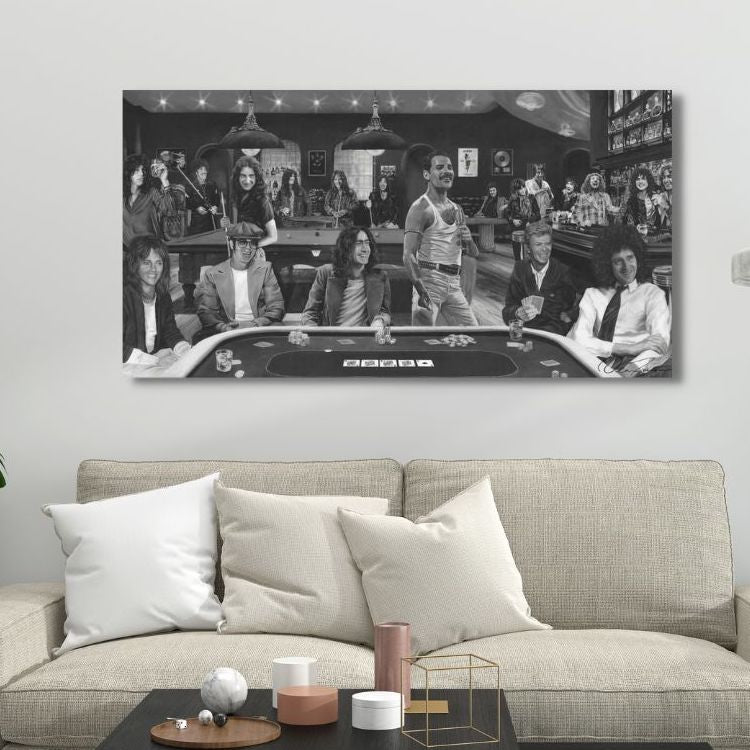


Hang this painting and someone will always point at a face and ask, “Who’s that?” Dean Turner’s Ultimate Boxing Reunion is a hand-painted original of 39 boxing greats, painted over six months. This is the story of one of them, Lionel Rose. It’s available as a framed canvas print, made from the original, for your favourite place.
No. 37 Who’s Who Ultimate Boxing Reunion
Harada, Australian of the Year and 42 wins from 53 fights
He was born at Jackson’s Track, near Warragul in Victoria, and lived in a one-room tin hut until he was ten. On Tuesday 27 February 1968, aged 19, he beat Fighting Harada over 15 rounds in Tokyo to become world bantamweight champion. He was named Australian of the Year for 1968, the first Aboriginal person to receive the honour, and he finished with 42 wins, 11 losses and 12 knockouts from 53 fights.
 37of 39

In this story 14 sections
Why fans still care
LIONEL ROSE was 19 when he won the world bantamweight title in Tokyo. He was the first Aboriginal person to win a world title in any sport, and only the second Australian to win a world boxing title, after Jimmy Carruthers in 1952.
Back home, a crowd of more than 100,000 by most counts turned out to welcome him in Melbourne, and by the end of the year he was Australian of the Year.
Early life
Lionel Edmund Rose was born on 21 June 1948 at Jackson’s Track, near Warragul. His father was Gunditjmara and a tent-show boxer, and Lionel was the eldest of nine children. The family lived in a one-room tin hut until he was ten, when they moved to Drouin with help from the Aboriginal Welfare Board. His first job was at a sawmill, and later he worked as a welder in Drouin.
His idol was the Aboriginal lightweight champion George Bracken. In 1963 he won the Australian amateur flyweight title at 15. He won his first major fight at Melbourne’s Festival Hall the day after his father died. In 1964 he was runner-up to Bill Booth at bantamweight, which cost him a place at the Tokyo Olympics.
The early fights
Frank Oakes of Warragul trained him from about the age of 15, set up a gym for him and introduced him to Jack Rennie in Melbourne. Rennie became his trainer and manager, and from 1964 Rose lived with Rennie, his wife Shirley and their sons Mark and John. He trained in the backyard gym at Marco Polo Street, Essendon. Shirley Rennie negotiated his endorsements and tutored him.
He made his professional debut on 9 September 1964 in Warragul, against Magris. He won the Australian bantamweight title in October 1966, and he was Australian champion when the 1967 referendum was held. On 11 December 1967 he knocked out Gattellari in round 13 at Sydney Stadium to keep the Australian title.
Career chapters
- 1963Wins the Australian amateur flyweight title at 15
- 1964Turns professional and moves in with Jack Rennie’s family
- 1966Wins the Australian bantamweight title
- 1968Beats Fighting Harada in Tokyo to win the world bantamweight title, then beats Takao Sakurai and Chucho Castillo
- 1968Named Australian of the Year and appointed MBE
- 1969Beats Alan Rudkin in March, then loses the title to Ruben Olivares in August
- 1971Loses to Yoshiaki Numata in Hiroshima and retires
- 1975Comes back with a points win over Uchida in Kuala Lumpur
- 1976Stopped by Rafael Limon in August and by Maurice Apeang in December, his last fight
Fighting Harada 27 February 1968
On Tuesday 27 February 1968 he fought Masahiko “Fighting” Harada at the Nippon Budokan in Tokyo, for the world bantamweight title. The Sydney Morning Herald report of the fight is datelined “Tokyo, Tuesday”. The No. 1 contender, Pimentel, had demanded a bigger share of the purse, and Rose took the fight as a substitute. He was 19.
Rose trained in a snow-covered hotel garden in Tokyo and smoked a pipe while he did it. After round 3 he told Rennie that Harada could not hit hard enough to hurt him. He fought with a bruised right knuckle, and Rennie said the referee kept telling Rose to fight more because he was fighting on the retreat. The Herald said that in round 9 it appeared more as though Harada had slipped, but the referee counted. The cards were Toyama 72 to 71, Tezaki 72 to 69 and Morita 70 to 70, which would make it a majority decision on the Herald’s figures. Later accounts, including the ABC, call it unanimous, so the sources differ. It was also the first time an all-Japanese set of officials had controlled a world title fight.
When the decision was read, Rennie and Rose fell to the canvas in the ring. Fans had flown to Tokyo on special flights to be there. Rose said afterwards, “I’m the happiest person in the world at the moment.”
The homecoming
Rose came home to a ticker-tape parade in Melbourne. The ABC and the Sydney Morning Herald put the crowd at more than 100,000 outside the Melbourne Town Hall, and other accounts say 250,000. Traffic stopped in Swanston Street. Rose later said he asked the air hostess whether the Beatles were up the front of the plane, and on the Town Hall balcony he said, “I didn’t think so many people cared.”
Takao Sakurai 2 July 1968
He made his first defence on 2 July 1968 at the Budokan, against Takao Sakurai, an Olympic champion. Sakurai dropped him early, and Rose won a 15 round decision.
Chucho Castillo 6 December 1968
On 6 December 1968 he defended against Chucho Castillo at the Forum in Inglewood, California. Rose was down in round 10 and won a narrow split decision. A riot broke out afterwards. Earlier in 1968 Rennie had watched Castillo from ringside and rated him the best bantamweight he had seen, outside of Rose.
Alan Rudkin March 1969
In March 1969 he beat Alan Rudkin over 15 rounds at Kooyong in Melbourne. It was his third defence of the title.
Ruben Olivares 22 August 1969
On 22 August 1969 he lost the title to Ruben Olivares at the Forum in Inglewood, knocked out in round 5. His purse was $100,000.
Numata, the comeback and the end 1971 to 1976
By then he had filled out and was fighting as a lightweight. He fought Jeff White for the Australian title in Brisbane, then lost a controversial points decision to Yoshiaki Numata in Hiroshima for the world junior lightweight title. He retired in 1971. He came back on 1 July 1975 with a points win over Uchida in Kuala Lumpur, then lost to Rafael Limon in Inglewood on 28 August 1976 and was stopped in round 2 by Maurice Apeang in Noumea on 17 December 1976. He retired for good after that.
Style, technique and the corner
How he fought
The Sport Australia Hall of Fame calls him a sharp left hand, fine counter-puncher. The Fight Site says he was “arguably the best jabber in the history of the division” and had a “sneaky right hand counter”. The Herald reported that the referee told him to fight more because he was boxing on the retreat. He smoked a pipe while training in Japan.
Training
Frank Oakes trained him in Warragul and introduced him to Jack Rennie. Rennie trained and managed him from Melbourne, and he lived with the Rennies from 1964. Rose married Jenny Oakes, Frank’s daughter, in 1970, and they had a son, Michael.
The corner
Jack Rennie handled his fights and his business, and Shirley Rennie negotiated his endorsements and tutored him at home.
What others say
“he was one of my idols”
“He just had phenomenal hand-eye coordination, had phenomenal speed, power”
“I believe he is the best Australian fighter to have come out of these shores”
“Lionel was not only a great fighter but a wonderful human being”
“he showed just how far an Aboriginal could go”
“An absolute boxing legend.”
“Castillo is the best bantamweight I’ve seen - outside of Rose.”
“He gave us all something to fight for and something to live for.”
Stories people still tell
-
Elvis.
In December 1968 he met Elvis Presley at MGM Studios, after fighting in California. Rose said, “I was in awe of him, but he said he was in awe of me.”
-
A speech.
When he accepted his Australian of the Year award he said, “One hundred and eighty-two years ago one of my mob would have been a dead cert for this.”
-
South Africa.
He declined a fight in South Africa in 1970. Frank Quill of the WBC ratings committee said that, to his knowledge, Rose was the first sportsman to refuse to go there because of apartheid.
Legacy
He won 42 of 53 fights, 12 by knockout, and held the world bantamweight title from February 1968 to August 1969. He was named Australian of the Year and appointed MBE in 1968. He was inducted into the Sport Australia Hall of Fame on 10 December 1985, the World Boxing Hall of Fame in 1995, and the Victorian Aboriginal Honour Roll in 2011. A stamp carrying his gloves was issued, and he was a patron of the Victorian Aboriginal Health Service. He also recorded two hit singles, “I Thank You” and “Please Remember Me”, and “I Thank You” reached No. 2 on the Kent Music Report.
Lionel Rose died on 8 May 2011 at his home in Warragul, aged 62.

on the
Who’s Who
In the painting
Lionel Rose
Number 37 of 39 on the Who’s Who list for Ultimate Boxing Reunion by Dean Turner Art, published as Lionel Rose.
Collectors lean in, argue over faces and pull the names list. Rose sits in the foreground with a pipe in his mouth, and he did smoke one while training in Japan. His close friend Jeff Fenech, Who’s Who number 12 is in the painting too.
If you can name every face in this one, there’s a fair chance someone taught you them, maybe a dad who stayed up for the fights.
See Lionel Rose among all 39 faces in Ultimate Boxing Reunion, a framed canvas print made from Dean’s hand-painted original.
Who’s Who in the Ultimate Boxing Reunion
Numbered as on the painting’s key. Pick a name to read their story.
- Story live
- Coming soon
- You’re reading
 Find the numbers on the painting
- 1Manny Pacquiao
- 2Kostya Tszyu
- 3Tim Tszyu
- 4Roy Jones Jr (story coming soon)
- 5Marvin Hagler
- 6Félix Trinidad (story coming soon)
- 7Johnny Famechon
- 8Canelo Álvarez (story coming soon)
- 9Bernard Hopkins (story coming soon)
- 10Oscar De La Hoya (story coming soon)
- 11Danny Green (story coming soon)
- 12Jeff Fenech
- 13Roberto Durán
- 14Floyd Mayweather Jr
- 15Vinny Pazienza (story coming soon)
- 16Sugar Ray Leonard
- 17Tyson Fury (story coming soon)
- 18Don King (story coming soon)
- 19Larry Holmes (story coming soon)
- 20Sonny Liston (story coming soon)
- 21Joe Louis (story coming soon)
- 22Rocky Marciano (story coming soon)
- 23Joe Bugner (story coming soon)
- 24Jack Johnson (story coming soon)
- 25Tommy Morrison (story coming soon)
- 26Ken Norton (story coming soon)
- 27Thomas Hearns
- 28Ryan Garcia (story coming soon)
- 29Lennox Lewis
- 30Leon Spinks (story coming soon)
- 31Evander Holyfield (story coming soon)
- 32Joe Frazier
- 33Muhammad Ali
- 34Mike Tyson
- 35George Foreman
- 36Cus D’Amato (story coming soon)
- 37Lionel RoseYou’re reading
- 38Jack Dempsey (story coming soon)
- 39Archie Moore (story coming soon)
Sources
- Sport Australia Hall of Fame, Lionel Rose: debut, amateur titles, career summary, Numata, comeback, Apeang, honours, Hall of Fame 1985 and World Boxing Hall of Fame 1995, style. sahof.org.au
- Australian of the Year, Lionel Rose MBE: 1968 award, eldest of nine children, father’s death before the Festival Hall fight, the “dead cert” quote. australianoftheyear.org.au
- Victorian Government, First Peoples State Relations, Lionel Rose MBE: Gunditjmara father, Drouin, welder, Rennie, 1967 referendum, Beatles assumption, honour roll, stamp, patron. firstpeoplesrelations.vic.gov.au
- Indigenous Australia (ANU), Lionel Edmund Rose: early life, tin hut, Rennie household, from his 1969 autobiography. ia.anu.edu.au
- ABC News, 9 May 2011, reactions to Rose’s death: record, Warragul home, three defences, Mundine and Vocale quotes, parade crowd. Not used for the “I Thank You” chart position. abc.net.au
- SBS News, 9 May 2011: Fenech, Barry Michael and Geale quotes, Quill on South Africa, 12 knockouts. sbs.com.au
- The Sydney Morning Herald, 8 May 2011, “Warrior of the ring dies at 62”: Fenech and Geale quotes, Quill, Warragul home, 53 fights and 42 wins, parade of more than 100,000, “I didn’t think so many people cared”. smh.com.au
- The Sydney Morning Herald, 28 Feb 1968, Harada report datelined “Tokyo, Tuesday”: cards, round 9, all-Japanese officials, Rose’s quote and Rennie exchange. smh.com.au
- The Fight Site, “The All-Time Great Bantamweights: No 10: Lionel Rose”: Sakurai, Castillo, Pimentel, style quotes, Rennie quote. thefight-site.com
- ABC News (Mitchell), Rose profile: Rennie household, retirement in May 1971, parade of more than 100,000. Not used for the date of the Harada fight or the father’s name. abc.net.au
- TIME, “Prizefighting: Up from the Outback”, 8 March 1968: Pimentel demanded a bigger share of the pot, Rose a substitute challenger. time.com
- The Sydney Morning Herald, 15 May 2011, “Lionel Rose in black and white”: tickertape parade 100,000, training in a snow-covered Tokyo hotel garden, Elvis at MGM Studios in December 1968. smh.com.au
- Australian Geographic, “Vale Lionel Rose”, 10 May 2011: Beatles remark, Marco Polo St gym, 1970 South Africa refusal. australiangeographic.com.au
- Bang a Gong, “I Thank You: Lionel Rose” (Kent Music Report): entered chart 22 Dec 1969, peaked No. 2. bangagong.com.au
- National Film and Sound Archive, commentary on Lionel Rose’s world title fight: broadcast live on Tuesday 27 February 1968. nfsa.gov.au
Names appear exactly as published on the Who’s Who list for Ultimate Boxing Reunion.
See the names list for other Ultimate Series artworks
Every painting has its own numbered Who’s Who. Pick a scene and see who’s in it.
 Ultimate Aussie Pub Rock ReunionSee who’s in it
  Ultimate Aussie Reunion - Part 2See who’s in it
  Ultimate Guitarist ReunionSee who’s in it
  Highway to HellSee who’s in it
  The Ultimate ReunionSee who’s in it
  Ultimate Eagles ReunionSee who’s in it
  Ultimate Queen ReunionSee who’s in it
  Ultimate Beatles ReunionSee who’s in it
  Ultimate Classic Country ReunionSee who’s in it
  Ultimate Hip Hop ReunionSee who’s in it
  Ultimate Gangster ReunionSee who’s in it
  Ultimate Fighter ReunionSee who’s in it