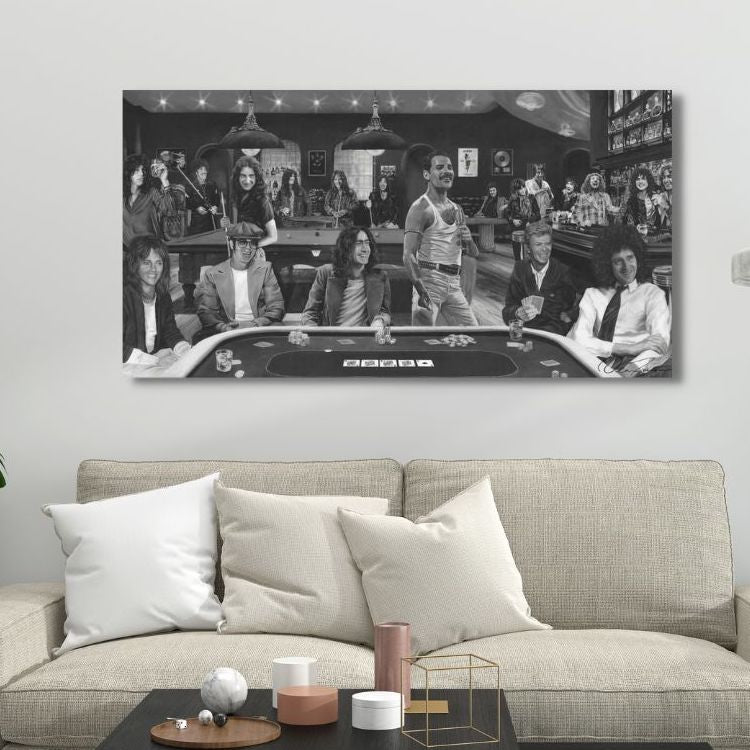


Hang this painting and someone will always point at a face and ask, “Who’s that?” Dean Turner’s Ultimate Boxing Reunion is a hand-painted original of 39 boxing greats, painted over six months. This is the story of one of them, Muhammad Ali. It’s available as a framed canvas print, made from the original, for your favourite place.
No. 33 Who’s Who Ultimate Boxing Reunion
Liston, Frazier, Foreman and the rounds people still talk about
At 12 he reported his stolen bike, and a Louisville policeman told him to learn to box. By 1971 he’d beaten Liston, been banned, come back, and was about to meet Frazier.
 33of 39

In this story 13 sections
Why fans still care
MUHAMMAD ALI won the world heavyweight title from Sonny Liston, George Foreman and Leon Spinks, and nobody before him had won it three times. He did it between 1964 and 1978, with three and a half years in the middle when he wasn’t allowed to fight at all.
When President George W. Bush gave him the Presidential Medal of Freedom in 2005, he named the lightning jabs and the Ali shuffle, and said fans and boxers would try to copy the style, but “certain things defy imitation.” Bush also passed on one of Ali’s own lines: “It’s not bragging if you can back it up.”
If you grew up arguing about who’d win, Ali is the name you’d have argued for, and probably against.
Early life
He was born Cassius Marcellus Clay Jr. in Louisville, Kentucky, on 17 January 1942, to Cassius Marcellus Clay Sr. and Odessa O’Grady Clay.
At 12 someone stole his bicycle. He reported it to a police officer, Joe E. Martin, and Martin suggested he take up boxing. He had his first amateur bout in 1954.
As an amateur he won six Kentucky Golden Gloves titles, two national Golden Gloves titles and a national AAU title, with about 100 amateur wins. In 1960 he went to the Rome Olympics as a light heavyweight and came home with the gold medal.
Career chapters
- 1954First amateur bout, aged 12, under Joe E. Martin in Louisville
- 1960Olympic light heavyweight gold, Rome; professional debut, 29 October
- 1963Floored by Henry Cooper at Wembley, wins in round 5
- 1964Wins the world heavyweight title from Sonny Liston; named Muhammad Ali on 6 March
- 1965Knocks out Liston in round 1 of the rematch, Lewiston, Maine
- 1967Refuses induction into the army; title and licence taken away
- 1970Comes back against Jerry Quarry in Atlanta
- 1971Loses to Joe Frazier at Madison Square Garden, his first professional defeat
- 1974Knocks out George Foreman in Kinshasa to win the title back
- 1975Beats Frazier in Manila
- 1978Loses the title to Leon Spinks, then wins it back, the first three-time heavyweight champion
- 1980Loses to Larry Holmes
- 1981Last fight, against Trevor Berbick, and retires
- 1984Diagnosed with Parkinson’s disease
- 1996Lights the flame at the Atlanta Olympics
- 2005Presidential Medal of Freedom
The rise 1960 to 1964
Angelo Dundee took him on as a professional in 1960 and trained him for the rest of his career. He won his debut over six rounds in Louisville on 29 October 1960, and by the end of 1963 he was 19 and 0, with 15 knockouts.
One of those wins came in Los Angeles on 15 November 1962, a fourth-round stoppage of the veteran Archie Moore, Who’s Who number 39 (story coming soon), who Dean also painted into Ultimate Boxing Reunion.
Henry Cooper at Wembley 18 June 1963
The fight at Wembley Stadium nearly went wrong. In round 4 Henry Cooper’s left hook put Clay on the canvas. What happened in the corner afterwards has never been settled: Dundee has been accused of buying his man time with smelling salts and a torn glove, and it remains an allegation.
In round 5 Clay’s right hand opened a bad cut under Cooper’s eye, and the referee stopped it.
The title from Liston 25 February 1964
He went into Convention Hall in Miami Beach a 7 to 1 underdog against Sonny Liston, Who’s Who number 20 (story coming soon). He moved, slipped and landed flurries early. In round 5 he said he couldn’t see, a claim that is still disputed. Liston’s camp said their man had hurt his left shoulder early and by round 6 couldn’t raise the arm.
Liston’s manager, Jack Nilon, stopped it before the seventh. The press reported a seventh-round stoppage; some record books have it as retired after six. Clay’s verdict, as The Harvard Crimson printed it: “I am the greatest, greatest, greatest.”
On 6 March 1964, Elijah Muhammad gave him the name Muhammad Ali. He had joined the Nation of Islam in the early 1960s.
The rematch in Lewiston 25 May 1965
The second Liston, Who’s Who number 20 (story coming soon) fight, in Lewiston, Maine, lasted one round. The referee was Jersey Joe Walcott. The official time was announced as one minute, though many put it at 1:45. The punch became known as the “phantom punch.”
The years out 1967 to 1970
On 28 April 1967 he refused induction into the US Army on religious grounds. He was arrested, his title was taken away and his boxing licence suspended. He was sentenced to five years in prison and a US$10,000 fine, and stayed free while he appealed. In 1971 the US Supreme Court reversed the conviction.
He was out of the ring for about three and a half years. He came back on 26 October 1970 in Atlanta and stopped Jerry Quarry in round 3.
The Fight of the Century 8 March 1971
Ali and Joe Frazier, Who’s Who number 32 met at Madison Square Garden as two unbeaten heavyweights, each, by ESPN Classic’s account, on a record US$2.5 million purse. It went the full 15 rounds. In the 15th, Frazier dropped Ali with a wide left hook, and he won a unanimous decision. It was Ali’s first professional defeat.
Frazier gave him something back afterwards: “That man can sure take some punches.”
Bugner, Norton and Frazier again 1973 to 1974
Earlier in 1973 he outpointed Joe Bugner, Who’s Who number 23 (story coming soon) over 12 rounds in Las Vegas. That March Ken Norton, Who’s Who number 26 (story coming soon) beat him and broke his jaw. When Bush honoured him in 2005, he recalled Ali fighting on for more than ten rounds with the broken jaw. Ali won the rematch later that year. In January 1974 he beat Frazier over 12 rounds at Madison Square Garden. He met Bugner, Who’s Who number 23 (story coming soon) again in Kuala Lumpur in 1975, and beat Norton, Who’s Who number 26 (story coming soon) a third time at Yankee Stadium in 1976.
The Rumble in the Jungle 30 October 1974
The champion was George Foreman, Who’s Who number 35, a 3 to 1 favourite, and the fight was at the 20th of May Stadium in Kinshasa, Zaire. Ali had logged 302 miles of running and 241 rounds of sparring at Deer Lake to get ready.
He opened by leading with right hands and raised a lump under Foreman’s right eye. But Foreman kept coming.
Round 5 is the one to slow down. For about two minutes Ali stood on the ropes, covered up, arms and gloves over his face, and let Foreman throw heavy shots into his arms. Then he came off them and staggered Foreman with rights and lefts. Boxing News saw him grab Foreman and pull him off balance whenever he charged. The Ring says using the ropes was Dundee’s plan.
In rounds 6 and 7 Foreman’s power faded, though The Ring’s reporter still had him ahead four rounds to three. In round 8 a right rocked him, then lefts and rights, then a last right. Referee Zack Clayton, the first Black referee of a world heavyweight title fight, counted him out at 2:58.
Ali had his title back. “Allah was in the ring tonight, not Ali,” he told The Ring.
The Thrilla in Manila 1 October 1975
The third Frazier fight was at the Philippine Coliseum in Quezon City, in front of about 28,000 people, with Carlos Padilla refereeing. The momentum swung back and forth for 14 rounds. At the end of the 14th Ali led on all three cards, 8 to 5 to 1, 8 to 2 to 4 and 9 to 3 to 2.
Frazier wanted to go on. His trainer, Eddie Futch, stopped it before round 15. Ali called the fight “the closest thing to dying I know.”
Spinks, Holmes and the last fights 1978 to 1981
After Kinshasa he defended the title ten times. Then on 15 February 1978 he lost it to Leon Spinks, Who’s Who number 30 (story coming soon). Seven months later he beat Spinks, Who’s Who number 30 (story coming soon) over 15 rounds and became the first man to win the heavyweight title three times.
On 2 October 1980 he fought Larry Holmes, Who’s Who number 19 (story coming soon), who had been his sparring partner, and his corner pulled him out after round 10. Holmes, Who’s Who number 19 (story coming soon) said years later that the fight “still bothers” him, and that he told Ali in the ring that he loved him. Ali lost to Trevor Berbick in December 1981 and retired.
After boxing 1984 to 2016
He was diagnosed with Parkinson’s disease in 1984. In 1996 he lit the flame at the Atlanta Olympics. The Muhammad Ali Center opened in Louisville in 2005, and that November he received the Presidential Medal of Freedom.
Muhammad Ali died in Scottsdale, Arizona, on 3 June 2016, aged 74. His funeral in Louisville on 10 June was open to the public, and his pallbearers included Mike Tyson, Who’s Who number 34 and Lennox Lewis, Who’s Who number 29.
Style, technique and the corner
How he fought
The writer Bert Sugar said Ali held his hands too low and moved perhaps too much, and that his speed and footwork covered the gaps. Another writer pictured him floating just out of range with his hands at his sides. A 1969 Sports Illustrated measurement, as later reported, had his jab covering 16.5 inches in four hundredths of a second.
Eddie Futch, who trained Frazier, said Ali would show opponents their mistakes and “beat you with them.”
The punches
The jab and the Ali shuffle are the two things Bush named in 2005. The right hand is the one to watch in Kinshasa: he led with it in round 1 against Foreman and finished the fight with it in round 8.
On the ropes
The ropes in Kinshasa were a tactic, not a corner he was trapped in. Boxing News described him covering up with his arms and gloves, letting Foreman punch himself out, then grabbing him when he charged. The Ring credits the plan to Dundee.
The corner: Martin and Dundee
Joe E. Martin, the Louisville policeman, was his first coach, at the Columbia Gym, from 1954 until he turned professional in 1960. From then on his trainer was Angelo Dundee, for the whole of his professional career, from 1960 to 1981. In the 1960s he trained at the Fifth Street Gym in Miami Beach.
Deer Lake
In 1972 he started building his own camp at Deer Lake, Pennsylvania, which he called Fighter’s Heaven. He trained there for Floyd Patterson, Norton, Frazier in the rematch, Foreman, the Spinks, Who’s Who number 30 (story coming soon) rematch and Holmes, Who’s Who number 19 (story coming soon). The days started with early runs and chopping trees. Larry Holmes, Who’s Who number 19 (story coming soon) and Rodney Bobick were among his sparring partners.
His father painted the names of great fighters on boulders around the camp. Among them were Rocky Marciano, Who’s Who number 22 (story coming soon), Jack Johnson, Who’s Who number 24 (story coming soon) and Jack Dempsey, Who’s Who number 38 (story coming soon), all three now in the same painting as Ali.
Weight
He won Olympic gold as a light heavyweight in 1960 and fought every professional fight as a heavyweight.
What others say
“an enormous inspiration to me, not only in my boxing career”
“he taught me everything I knew”
“I emulated Muhammad Ali and Sugar Ray Robinson”
“Not a day went by entering the gym that I didn’t think of you.”
“That man can sure take some punches”
“...Frazier & Foreman we were 1 guy. A part of me slipped away”
Stories people still tell
-
The stolen bike.
The whole career started at a police station in Louisville, with a 12-year-old reporting his bicycle stolen and Joe E. Martin telling him to learn to box.
-
Three of them in one breath.
When Ali died, George Foreman wrote that he, Ali and Frazier had been one guy, and that a part of him had slipped away.
Legacy
The fighters who came after him said it themselves. Sugar Ray Leonard, Who’s Who number 16 told Arsenio Hall in 1989 that he modelled himself on Ali and Sugar Ray Robinson. Larry Holmes, Who’s Who number 19 (story coming soon), his sparring partner for four years, said Ali taught him everything he knew. Lennox Lewis, Who’s Who number 29 called him an inspiration in boxing and in life, and Floyd Mayweather Jr, Who’s Who number 14 wrote that he thought of Ali every time he walked into the gym. On the day Ali died, Mike Tyson, Who’s Who number 34 wrote that God had come for his champion.
The New York State Senate remembered him as a “three-time World heavyweight boxing champion, role model and humanitarian.”

on the
Who’s Who
In the painting
Muhammad Ali
Number 33 of 39 on the Who’s Who list for Ultimate Boxing Reunion by Dean Turner Art, published as Muhammad Ali.
Dean painted him between Joe Frazier and Mike Tyson, Who’s Who number 34.
Collectors lean in, argue over faces and pull the names list. Ali’s story runs through a lot of this painting: he fought Sonny Liston, Who’s Who number 20 (story coming soon), Joe Frazier, George Foreman, Ken Norton, Who’s Who number 26 (story coming soon), Leon Spinks, Who’s Who number 30 (story coming soon), Larry Holmes, Who’s Who number 19 (story coming soon), Joe Bugner, Who’s Who number 23 (story coming soon) and Archie Moore, Who’s Who number 39 (story coming soon).
Three more names here were painted on the boulders at his Deer Lake camp: Rocky Marciano, Who’s Who number 22 (story coming soon), Jack Johnson, Who’s Who number 24 (story coming soon) and Jack Dempsey, Who’s Who number 38 (story coming soon).
If you can name every face in this one, there’s a fair chance someone taught you them, maybe a dad who stayed up for the fights.
See Muhammad Ali among all 39 faces in Ultimate Boxing Reunion, a framed canvas print made from Dean’s hand-painted original.
Who’s Who in the Ultimate Boxing Reunion
Numbered as on the painting’s key. Pick a name to read their story.
- Story live
- Coming soon
- You’re reading
 Find the numbers on the painting
- 1Manny Pacquiao (story coming soon)
- 2Kostya Tszyu
- 3Tim Tszyu
- 4Roy Jones Jr (story coming soon)
- 5Marvin Hagler
- 6Félix Trinidad (story coming soon)
- 7Johnny Famechon
- 8Canelo Álvarez (story coming soon)
- 9Bernard Hopkins (story coming soon)
- 10Oscar De La Hoya (story coming soon)
- 11Danny Green (story coming soon)
- 12Jeff Fenech
- 13Roberto Durán
- 14Floyd Mayweather Jr
- 15Vinny Pazienza (story coming soon)
- 16Sugar Ray Leonard
- 17Tyson Fury (story coming soon)
- 18Don King (story coming soon)
- 19Larry Holmes (story coming soon)
- 20Sonny Liston (story coming soon)
- 21Joe Louis (story coming soon)
- 22Rocky Marciano (story coming soon)
- 23Joe Bugner (story coming soon)
- 24Jack Johnson (story coming soon)
- 25Tommy Morrison (story coming soon)
- 26Ken Norton (story coming soon)
- 27Thomas Hearns
- 28Ryan Garcia (story coming soon)
- 29Lennox Lewis
- 30Leon Spinks (story coming soon)
- 31Evander Holyfield (story coming soon)
- 32Joe Frazier
- 33Muhammad AliYou’re reading
- 34Mike Tyson
- 35George Foreman
- 36Cus D’Amato (story coming soon)
- 37Lionel Rose
- 38Jack Dempsey (story coming soon)
- 39Archie Moore (story coming soon)
Sources
- The White House (George W. Bush archives), President Honors Recipients of the Presidential Medal of Freedom (9 Nov 2005). georgewbush-whitehouse.archives.gov
- New York State Senate, Resolution J6223 (adopted 7 Jun 2016). nysenate.gov
- HISTORY.com Editors, Muhammad Ali. history.com
- Cornell LII, Clay v. United States, 403 U.S. 698 (1971). law.cornell.edu
- Boxing News, original Rumble in the Jungle ringside report (1 Nov 1974). boxingnewsonline.net
- The Ring, Muhammad Ali outfought, outwitted and outlasted George Foreman in a classic upset. ringmagazine.com
- PhilBoxing, Thrilla in Manila: 30th anniversary (2005). philboxing.com
- The Harvard Crimson, “The Greatest” stops Sonny Liston in seven (26 Feb 1964). thecrimson.com
- ESPN, Muhammad Ali and Sonny Liston II (2015). espn.com
- ESPN Classic, Smokin’ Joe had vicious left hook (19 Nov 2003). espn.com
- Wembley Stadium, Henry Cooper v Cassius Clay 50th anniversary (18 Jun 2013). wembleystadium.com
- Gulf News (The Telegraph), Unorthodox style and speed made Ali peerless (2016). gulfnews.com
- Pennsylvania Heritage Magazine, Fighter’s Heaven: Muhammad Ali’s training camp. paheritage.wpengine.com
- Sky Sports, Lennox Lewis humbled to be a pallbearer (8 Jun 2016). skysports.com
- Sherdog, Larry Holmes remembers Muhammad Ali (11 Jun 2016). sherdog.com
- Andscape, Ali on Arsenio. andscape.com
- PBS NewsHour, Tributes pour in as world mourns Muhammad Ali (4 Jun 2016). pbs.org
- ESPN, The planning of Muhammad Ali’s funeral. espn.com
- Wikipedia, Muhammad Ali (record table only, cross-checked). en.wikipedia.org
Names appear exactly as published on the Who’s Who list for Ultimate Boxing Reunion.
See the names list for other Ultimate Series artworks
Every painting has its own numbered Who’s Who. Pick a scene and see who’s in it.
 Ultimate Aussie Pub Rock ReunionSee who’s in it
  Ultimate Aussie Reunion - Part 2See who’s in it
  Ultimate Guitarist ReunionSee who’s in it
  Highway to HellSee who’s in it
  The Ultimate ReunionSee who’s in it
  Ultimate Eagles ReunionSee who’s in it
  Ultimate Queen ReunionSee who’s in it
  Ultimate Beatles ReunionSee who’s in it
  Ultimate Classic Country ReunionSee who’s in it
  Ultimate Hip Hop ReunionSee who’s in it
  Ultimate Gangster ReunionSee who’s in it
  Ultimate Fighter ReunionSee who’s in it