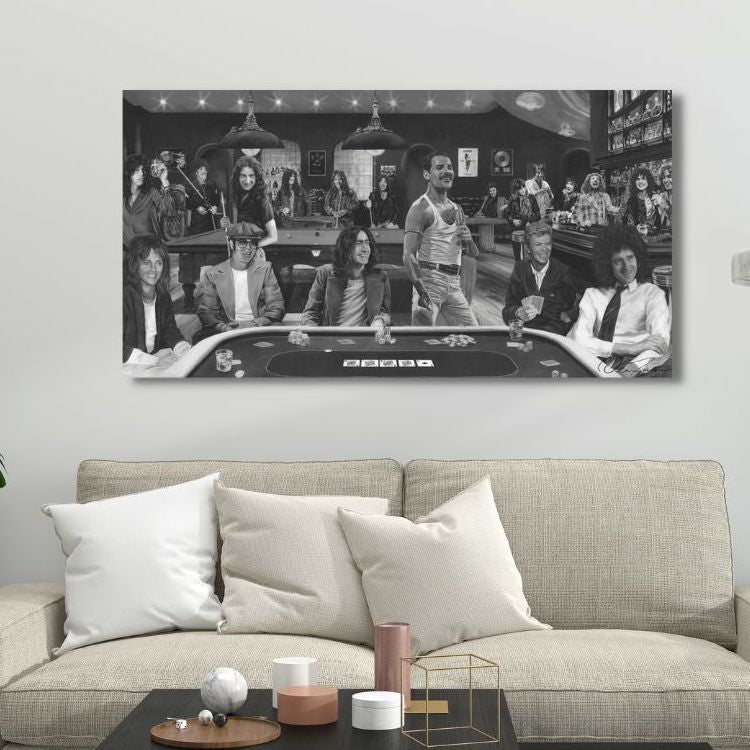


Hang this painting and someone will always point at a face and ask, “Who’s that?” Dean Turner’s Ultimate Boxing Reunion is a hand-painted original of 39 boxing greats, painted over six months. This is the story of one of them, Jack Dempsey. It’s available as a framed canvas print, made from the original, for your favourite place.
No. 38 Who’s Who Ultimate Boxing Reunion
the Manassa Mauler and boxing’s first million-dollar gate
Jack Dempsey knocked Jess Willard down seven times in one round to win the heavyweight title in 1919, then headlined boxing’s first million-dollar gate. When he finally lost it, he told his wife, “Honey, I forgot to duck.”
 38of 39

In this story 14 sections
Why fans still care
JACK DEMPSEY was one of the biggest sports stars of the 1920s, the Golden Age of Sport. He won the heavyweight title in a single brutal afternoon, drew the first million-dollar gate, and is still remembered for one of the most argued-over counts in boxing history.
He held the title for seven years, and he grew even more popular after he lost it.
Early life
He was born William Harrison Dempsey on 24 June 1895 in Manassa, Colorado, one of a large family born to Hyrum and Celia Dempsey. In 1911, at 16, he left home for good and rode railroad cars from job to job. He fought in local clubs under the name “Kid Blackie”. How he came to be called Jack is told two ways: one account says he took it from the earlier middleweight “Nonpareil” Jack Dempsey, another that his brother Bernie boxed as Jack Dempsey and William stood in for him in a Denver fight.
The early years
He turned professional in 1914, fighting in Colorado, Utah and Nevada. In February 1917 Fireman Jim Flynn put him down four times in round 1 and Bernie threw in the towel, the only time he was ever stopped. Later in 1917 he met the manager Jack “Doc” Kearns in a San Francisco bar, and the knockouts started to come quickly. On 27 July 1918 at Harrison, New Jersey, he knocked out Fred Fulton in round 1, officially in 23 seconds.
Career chapters
- 1914Turns professional in the mining towns of the West
- 1917Stopped by Fireman Jim Flynn, then teams up with Jack “Doc” Kearns
- 1919Beats Jess Willard for the world heavyweight title
- 1921Knocks out Georges Carpentier before the first million-dollar gate
- 1923Knocks out Luis Ángel Firpo in round 2
- 1926Loses the title to Gene Tunney
- 1927Loses the Long Count rematch with Tunney
- 1928Announces his retirement
Willard 1919
On 4 July 1919 in Toledo he challenged the champion Jess Willard. He knocked Willard down seven times in round 1, and Willard did not come out for round 4.
The champion 1919 to 1926
He defended the title five times: Billy Miske, Bill Brennan, Georges Carpentier, Tommy Gibbons and Luis Ángel Firpo. Carpentier, at Boyle’s Thirty Acres in Jersey City on 2 July 1921, drew a crowd of between about 80,000 and 90,000 and a gate of about $1.79 million, boxing’s first million-dollar gate. Dempsey knocked him out in round 4. Against Gibbons in Shelby, Montana, on 4 July 1923, he won on points over 15 rounds.
Firpo 1923
On 14 September 1923 at the Polo Grounds he fought Luis Ángel Firpo of Argentina. Dempsey put Firpo down seven times in round 1, but was himself knocked through the ropes and climbed back inside the count. He floored Firpo twice more in round 2 and finished it 57 seconds into the round.
Tunney and the Long Count 1926 to 1927
On 23 September 1926 in Philadelphia, before about 120,000 people in the rain, Gene Tunney outpointed him over 10 rounds and took the title. In July 1927 he knocked out Jack Sharkey in round 7 at Yankee Stadium to earn a rematch. On 22 September 1927 at Soldier Field in Chicago, before just over 104,000 and a gate of $2,658,660, Tunney outboxed him for most of the fight, but Dempsey dropped him in round 7. He did not go straight to a neutral corner, the referee Dave Barry waited until he did before starting the count, and Tunney was down for an estimated 13 to 18 seconds before he rose. Tunney went on to win the decision. It was Dempsey’s last fight, and he announced his retirement in March 1928.
After boxing
He lost about $3 million in the 1929 crash. In the early 1930s he toured in exhibitions, and in 1935 he opened Jack Dempsey’s restaurant in New York. In the Second World War he served in the US Coast Guard as director of its physical fitness programme, with the rank of commander, until November 1945. In 1950 he published a boxing manual, Championship Fighting. He died at home in New York on 31 May 1983, aged 87.
Style, technique and the corner
How he fought
In Championship Fighting he named the full crouch, used by “bobbers and weavers”, as his favourite stance, and said it served him well against bigger men. The book sets out four ways of putting body weight behind a punch, the falling step, leg spring, shoulder whirl and upward surge, and a “power line” running from the shoulder to the knuckle of the little finger. It was a left hook that dropped Tunney in round 7 in 1927, and a left hook to the chin that finished Sharkey.
The corner
Jack “Doc” Kearns managed him from 1917 through his championship years. In his book he credits the trainer Jimmy DeForest, who prepared him for Willard at a camp on Maumee Bay, on Lake Erie.
What others say
“That all really didn’t start until Dempsey.”
“Dempsey stormed over to me ... and decked me.”
“the mystery has always been how Dempsey contrived to hit me”
“Jack might have nailed the most perfect boxer that ever blocked or side-stepped a punch, he was that swift and accurate a hitter.”
“He was one of the greatest fighters who ever lived and one of the hardest punching heavyweights.”
“Jack Dempsey was perhaps the man who sculpted the golden age of sports.”
“In defeat, he gained more stature.”
“Jack Dempsey was a champion who never lost his title in the hearts of the American people.”
Stories people still tell
-
I forgot to duck.
After losing the title to Tunney in 1926, he told his wife, the actress Estelle Taylor, “Honey, I forgot to duck.”
-
The neutral corner.
He was known for standing over opponents as they got up, and PBS ties the rule that sends a fighter to a neutral corner after a knockdown to that habit.
-
The draft case.
He was accused of avoiding service in the First World War, and in 1920 a San Francisco jury acquitted him.
-
Harry Wills.
He never fought the Black contender Harry Wills, and accounts of why still differ.
Legacy
He went into the Ring Boxing Hall of Fame in 1954 and the International Boxing Hall of Fame’s first class in 1990, and the US Postal Service put him on a 32-cent stamp in 1998. Max Schmeling said a film of the Carpentier fight started his own boxing career. He also served as honorary chairman of a fund for Joe Louis, Who’s Who number 21.

on the
Who’s Who
In the painting
Jack Dempsey
Number 38 of 39 on the Who’s Who list for Ultimate Boxing Reunion by Dean Turner Art, published as Jack Dempsey.
Collectors lean in, argue over faces and pull the names list. Dempsey is the oldest story here, and his manager Doc Kearns turns up again decades later as co-manager of Archie Moore, Who’s Who number 39.
If you can name every face in this one, there’s a fair chance someone taught you them, maybe a grandfather who still talked about the Long Count.
See Jack Dempsey among all 39 faces in Ultimate Boxing Reunion, a collector piece made from Dean’s hand-painted original.
Who’s Who in the Ultimate Boxing Reunion
Numbered as on the painting’s key. Pick a name to read their story.
- Story live
- Coming soon
- You’re reading
 Find the numbers on the painting
- 1Manny Pacquiao
- 2Kostya Tszyu
- 3Tim Tszyu
- 4Roy Jones Jr
- 5Marvin Hagler
- 6Félix Trinidad
- 7Johnny Famechon
- 8Canelo Álvarez
- 9Bernard Hopkins
- 10Oscar De La Hoya
- 11Danny Green
- 12Jeff Fenech
- 13Roberto Durán
- 14Floyd Mayweather Jr
- 15Vinny Pazienza
- 16Sugar Ray Leonard
- 17Tyson Fury
- 18Don King
- 19Larry Holmes
- 20Sonny Liston
- 21Joe Louis
- 22Rocky Marciano
- 23Joe Bugner
- 24Jack Johnson
- 25Tommy Morrison
- 26Ken Norton
- 27Thomas Hearns
- 28Ryan Garcia
- 29Lennox Lewis
- 30Leon Spinks
- 31Evander Holyfield
- 32Joe Frazier
- 33Muhammad Ali
- 34Mike Tyson
- 35George Foreman
- 36Cus D’Amato
- 37Lionel Rose
- 38Jack DempseyYou’re reading
- 39Archie Moore
Sources
- PBS American Experience, Jack Dempsey (1895 to 1983): Kid Blackie, Willard, Carpentier crowd, 25 first-round knockouts, neutral corner, “forgot to duck”, Coast Guard, Schmeling quotes, Joe Louis fund, Wills. pbs.org
- ESPN Classic, Dempsey, Jack: birth, Flynn, Willard, five defences, Carpentier gate, Firpo, Tunney I, restaurant 1935, death. espn.com
- ESPN SportsCentury, Larry Schwartz, Defeats didn’t dampen Dempsey: Ring record, 1929 crash, Estelle Taylor, Povich quote, natural causes. m.espn.com
- Boxing News, Bob Mee (23 Jun 2018), On This Day: Jack Dempsey: Flynn and Bernie, Kearns, Miske, Gibbons, Tunney I crowd, retirement 1928. boxingnewsonline.net
- Deseret News (31 May 2024), Remembering Jack Dempsey: Kid Blackie, 1998 stamp. deseret.com
- World Boxing Association, Boxing History: The Long Count: about 14 seconds, Barry, “forgot to duck”. wbaboxing.com
- Yahoo Sports, Ben Fowlkes (20 Mar 2025), The Long Count: crowd, Tunney quote. sports.yahoo.com
- The American Presidency Project, Ronald Reagan (1 Jun 1983), Statement on the Death of Jack Dempsey. presidency.ucsb.edu
- encyclopedia.com, Dempsey, William Harrison (“Jack”): birth order, parents, leaving home, death. encyclopedia.com
- EBSCO Research Starters, Jack Dempsey: 1911, Bernie name account, Fulton, Coast Guard, Ring Hall of Fame 1954. ebsco.com
- New World Encyclopedia, Jack Dempsey: Nonpareil name account, draft trial, Sharkey, IBHOF 1990. newworldencyclopedia.org
- Quillette (27 Sep 2019), Cancel culture, Roaring Twenties style: 1920 draft trial and acquittal. quillette.com
- boxingonly.net, Jack Dempsey vs Fred Fulton, 27 July 1918. boxingonly.net
- Roldboxing Substack, Career Capsule: The Manassa Mauler: Brennan, Sharkey date, IBHOF 1990. roldboxing.substack.com
- SABR, Boxing at the Big Ballpark in the Bronx: Sharkey at Yankee Stadium. sabr.org
- Jack Dempsey, Championship Fighting (1950), full text on archive.org: full crouch, falling step, power line, DeForest, Maumee Bay camp. archive.org
- UPI Archives, Logan Hobson (31 May 1983), A great one is gone: Arcel and Sugar quotes. upi.com
Names appear exactly as published on the Who’s Who list for Ultimate Boxing Reunion.
See the names list for other Ultimate Series artworks
Every painting has its own numbered Who’s Who. Pick a scene and see who’s in it.
 Ultimate Aussie Pub Rock ReunionSee who’s in it
 Ultimate Aussie Reunion - Part 2See who’s in it
 Ultimate Guitarist ReunionSee who’s in it
 Highway to HellSee who’s in it
 The Ultimate ReunionSee who’s in it
 Ultimate Eagles ReunionSee who’s in it
 Ultimate Queen ReunionSee who’s in it
 Ultimate Beatles ReunionSee who’s in it
 Ultimate Classic Country ReunionSee who’s in it
 Ultimate Hip Hop ReunionSee who’s in it
 Ultimate Gangster ReunionSee who’s in it
 Ultimate Fighter ReunionSee who’s in it