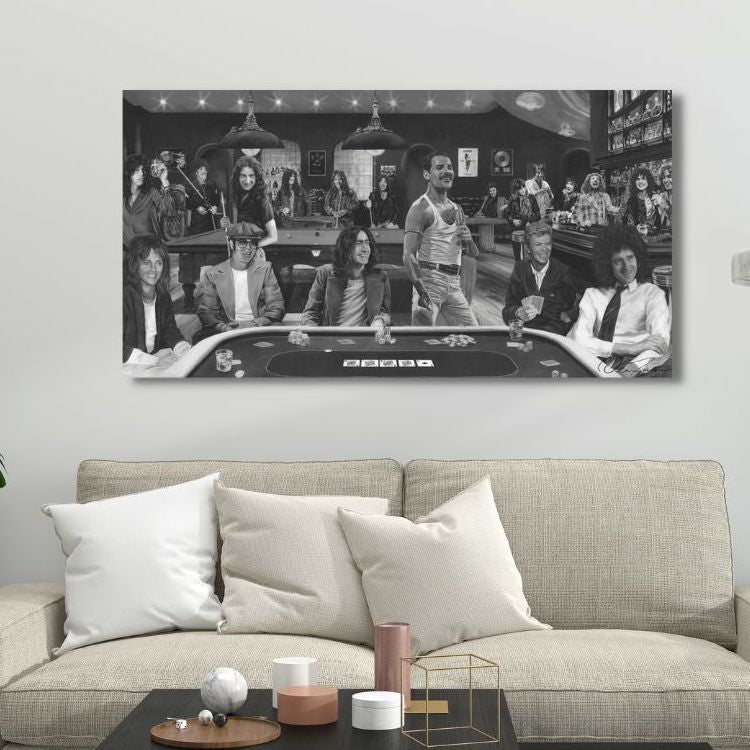


Hang this painting and someone will always point at a face and ask, “Who’s that?” Dean Turner’s Ultimate Boxing Reunion is a hand-painted original of 39 boxing greats, painted over six months. This is the story of one of them, Jack Johnson. It’s available as a framed canvas print, made from the original, for your favourite place.
No. 24 Who’s Who Ultimate Boxing Reunion
the Galveston Giant and the first Black heavyweight champion
Jack Johnson became the first Black world heavyweight champion in Sydney on 26 December 1908, when police stopped his fight with Tommy Burns in round 14. Eighteen months later in Reno he beat James J. Jeffries in the fight billed as the “Fight of the Century”.
 24of 39

In this story 14 sections
Why fans still care
JACK JOHNSON was the first Black man to hold the world heavyweight title, and he won it in Sydney. He was one of the best counterpunchers the ring has seen, according to ESPN, and he held the title for more than six years while promoters searched for a white challenger who could beat him.
Australians have a particular reason to remember him. About 20,000 people packed the stadium at Rushcutters Bay for the Burns fight, it was filmed, and the footage can still be watched.
Early life
He was born John Arthur Johnson on 31 March 1878 in Galveston, Texas. His father, Henry, was a school janitor and his mother, Tiny, a laundress, and he was the third of their nine children. He left school after fifth grade to work on the docks. A Dallas carriage shop owner, Walter Lewis, introduced him to boxing, and he earned $25 for lasting four rounds with Bob Thompson in 1895, money he later called “the hardest earned money of my life”.
The early fights
He turned professional in 1897. In the spring of 1899 in Springfield, Illinois, he was the last man standing in a “battle royal” and won $1.50. On 25 February 1901 in Galveston, Joe Choynski knocked him out in round 3, and both men were jailed for 23 days. In jail Choynski coached him. He moved to California in 1901, and on 3 February 1903 at Hazard’s Pavilion in Los Angeles he beat “Denver” Ed Martin over 20 rounds for the Coloured Heavyweight Championship of the World.
Career chapters
- 1897Turns professional
- 1901Knocked out by Joe Choynski, who coaches him in jail
- 1903Wins the Coloured heavyweight title from “Denver” Ed Martin
- 1907Knocks out former champion Bob Fitzsimmons
- 1908Beats Tommy Burns in Sydney for the world heavyweight title
- 1909Knocks out Stanley Ketchel in round 12
- 1910Beats James J. Jeffries in Reno
- 1913Convicted under the Mann Act and leaves the country
- 1915Loses the title to Jess Willard in Havana
- 1920Returns to the United States and serves his sentence
- 2018Posthumous presidential pardon
The colour line 1903 to 1908
As Coloured champion he beat Sam McVey, Joe Jeannette and Sam Langford, but in 1904 the world champion James J. Jeffries refused to fight him. He knocked out former champion Bob Fitzsimmons in round 2 in July 1907 (PBS gives the year as 1906). The world champion Tommy Burns agreed to meet him only after the promoter Hugh McIntosh guaranteed Burns $30,000.
Tommy Burns, Sydney 1908
On 26 December 1908 at Sydney Stadium, Rushcutters Bay, about 20,000 people watched inside, and Boxing News reports about 30,000 more outside. Burns gave away 24 lb and 7 in, and Johnson invited him to hit as hard as he could and barely flinched. Police entered the ring in round 14, and McIntosh, who was also the referee, stopped the fight. Jack London wrote that there was no fight.
Stanley Ketchel 1909
On 16 October 1909 at Colma, California, the middleweight champion Stanley Ketchel knocked him down in round 12. He got up and knocked Ketchel out in the same round with a right to the jaw. The fight was filmed, and the AFI catalogue lists it as an exhibition.
James J. Jeffries, Reno 1910
Promoter Tex Rickard moved the fight from San Francisco to Reno after California’s governor cancelled it. On 4 July 1910, before about 22,000 people, he began with a few cautious punches and then took control. In round 15 he knocked Jeffries down repeatedly and the fight was halted. ESPN puts his earnings at $117,000. Riots followed across the country, and at least 20 people died.
Mann Act case and exile 1912 to 1921
In 1912 he opened the Café de Champion in Chicago. He was convicted under the Mann Act in 1913 by an all-white jury and sentenced on 4 June 1913 to a year and a day. He left the country later that month and spent about seven years abroad. On 5 April 1915 in Havana he lost the title to Jess Willard by knockout in round 26. He surrendered at Tijuana on 20 July 1920, served his sentence at Leavenworth, Kansas, and was released on 9 July 1921.
Later years 1921 to 1946
In 1922 he was granted a US patent for a wrench. His last sanctioned bouts were knockout losses to Bearcat Wright and Bill Hartwell in Kansas in 1928. He died on 10 June 1946 after a car crash near Franklinton, North Carolina, aged 68, and he is buried at Graceland Cemetery in Chicago.
Style, technique and the corner
How he fought
ESPN calls him one of the best and most powerful counterpunchers in ring history. The WBA describes defensive boxing at distance. Choynski’s advice in the Galveston jail, as PBS tells it, was that a man who could move like him should never have to take a punch.
Against Burns he invited his opponent to hit him and barely flinched. Against Willard he was well ahead until about round 20, then tired.
The corner
No head trainer is documented in the sources. The Texas Sports Hall of Fame says he picked up technique helping the welterweight Joe Walcott train in Boston. Hugh McIntosh promoted and refereed the Burns fight, and Tex Rickard promoted the Jeffries fight.
What others say
“I could never have whipped Johnson at my best.”
“I couldn’t have reached him in 1,000 years.”
“a man who can move like you should never have to take a punch”
“Everything we do in this sport is in honor of the legacy that he left behind.”
“we’re still fighting that same fight that Johnson fought a century ago”
“Jack Johnson! It’s about time.”
“Burns was a toy in his hands.”
“Justice has been done! Keep punching.”
Stories people still tell
-
The battle royal.
As a young man in Springfield, Illinois, he was the last man standing and won $1.50.
-
The wrench.
He patented a wrench in 1922. It was not the monkey wrench, whatever the story says.
-
The Willard rumour.
A story still goes round that he threw the Willard fight. It is reported only as a rumour, and nothing confirms it.
Legacy
He went into the Boxing Hall of Fame as a charter member in 1954, the Texas Sports Hall of Fame in 1971 and the International Boxing Hall of Fame in its first class in 1990. On 24 May 2018 he received a posthumous presidential pardon in the Oval Office, requested by his great-great-niece Linda Haywood, with Lennox Lewis, Who’s Who number 29 at the ceremony. ABC reports that Muhammad Ali, Who’s Who number 33 called him an inspiration.

on the
Who’s Who
In the painting
Jack Johnson
Number 24 of 39 on the Who’s Who list for Ultimate Boxing Reunion by Dean Turner Art, published as Jack Johnson.
Collectors lean in, argue over faces and pull the names list. Johnson is the oldest story in this painting, and it reaches across it: Lennox Lewis, Who’s Who number 29 stood at his pardon, George Foreman, Who’s Who number 35 welcomed it, and the managers of Joe Louis, Who’s Who number 21 shaped Louis’s public image against his.
If you can name every face in this one, there’s a fair chance someone taught you them, maybe a dad who stayed up for the fights.
See Jack Johnson among all 39 faces in Ultimate Boxing Reunion, a collector piece made from Dean’s hand-painted original.
Who’s Who in the Ultimate Boxing Reunion
Numbered as on the painting’s key. Pick a name to read their story.
- Story live
- Coming soon
- You’re reading
 Find the numbers on the painting
- 1Manny Pacquiao
- 2Kostya Tszyu
- 3Tim Tszyu
- 4Roy Jones Jr
- 5Marvin Hagler
- 6Félix Trinidad
- 7Johnny Famechon
- 8Canelo Álvarez
- 9Bernard Hopkins
- 10Oscar De La Hoya
- 11Danny Green
- 12Jeff Fenech
- 13Roberto Durán
- 14Floyd Mayweather Jr
- 15Vinny Pazienza
- 16Sugar Ray Leonard
- 17Tyson Fury
- 18Don King
- 19Larry Holmes
- 20Sonny Liston
- 21Joe Louis
- 22Rocky Marciano
- 23Joe Bugner
- 24Jack JohnsonYou’re reading
- 25Tommy Morrison
- 26Ken Norton
- 27Thomas Hearns
- 28Ryan Garcia
- 29Lennox Lewis
- 30Leon Spinks
- 31Evander Holyfield
- 32Joe Frazier
- 33Muhammad Ali
- 34Mike Tyson
- 35George Foreman
- 36Cus D’Amato
- 37Lionel Rose
- 38Jack Dempsey
- 39Archie Moore
Sources
- PBS (Ken Burns), Johnson’s Early Life: birth, parents, nine children, Walter Lewis, Bob Thompson, $25 quote. pbs.org
- PBS (Ken Burns), Jack Johnson’s Rise: battle royal, Choynski, jail, Jack Jeffries, Ed Martin, Hazard’s Pavilion, McVey, Jeannette, Langford, Jeffries refusal, McIntosh guarantee, Choynski quote. pbs.org
- PBS (Ken Burns), Johnson’s Arrest: Schreiber, sentence 4 Jun 1913, flight, about seven years abroad, Tijuana, release. pbs.org
- PBS (Ken Burns), The Women in Johnson’s Life: Etta Duryea, Lucille Cameron, burial. pbs.org
- PBS American Experience, Jack Johnson, 1878 to 1946: parents, 1897, Fitzsimmons, Great White Hope, Willard, Louis’s managers. pbs.org
- NC Department of Natural and Cultural Resources (10 Jun 2016), Car accident claims Jack Johnson, 1946. dncr.nc.gov
- HISTORY, Jack Johnson wins heavyweight title: fifth grade, docks, 1904 refusal, Rushcutters Bay. history.com
- ESPN Classic, Ron Flatter, Johnson boxed, lived on his own terms: birth name, height, counterpuncher, Burns, Ketchel, Jeffries, $117,000, Willard, Ring Record Book, 1928, Jeffries quotes, Jack London quote, Boxing Hall of Fame charter member. espn.com
- Boxing News, On this day: Jack Johnson dominates Tommy Burns: crowd, size, taunting, Jack London, McIntosh. boxingnewsonline.net
- World Boxing Council, On this day: first African American heavyweight world champion: Burns, Willard round 26. wbcboxing.com
- Nevada SHPO, Historical Marker 220, The Fight of the Century: Reno, about 22,000. shpo.nv.gov
- KUNR, Jack Johnson and the Fight of the Century: Rickard, governor, round 15, riots. kunr.org
- AFI Catalog, Johnson Ketchel fight films (1909): Colma, exhibition. catalog.afi.com
- Fox News (24 May 2018), pardon reactions: Wilder quotes, Foreman, Lewis. foxnews.com
- Bangor Daily News (AP, 24 May 2018), Trump pardons late boxer Jack Johnson: Oval Office, Haywood, Lewis, all-white jury. bangordailynews.com
- UPI Archives (7 Apr 1990), Boxing Hall of Fame names first inductees. upi.com
- Texas Sports Hall of Fame, Jack Johnson: 1971, Joe Walcott. tshof.org
- ABC News (28 May 2018), Australia’s role in the making of Jack Johnson: crowd, film, Ali. abc.net.au
- Google Patents, US1413121A, Wrench (issued 18 Apr 1922). patents.google.com
- Illinois Public Media (AP, 26 May 2018), niece visits grave: Graceland Cemetery. will.illinois.edu
- Bleacher Report, Jack Johnson: The Man, The Myth: Fitzsimmons 1907, Hall of Fame 1954. bleacherreport.com
- World Boxing Association, The Galveston Giant: nickname. wbaboxing.com
- International Boxing Hall of Fame, Jack Johnson: induction 1990. ibhof.com
Names appear exactly as published on the Who’s Who list for Ultimate Boxing Reunion.
See the names list for other Ultimate Series artworks
Every painting has its own numbered Who’s Who. Pick a scene and see who’s in it.
 Ultimate Aussie Pub Rock ReunionSee who’s in it
 Ultimate Aussie Reunion - Part 2See who’s in it
 Ultimate Guitarist ReunionSee who’s in it
 Highway to HellSee who’s in it
 The Ultimate ReunionSee who’s in it
 Ultimate Eagles ReunionSee who’s in it
 Ultimate Queen ReunionSee who’s in it
 Ultimate Beatles ReunionSee who’s in it
 Ultimate Classic Country ReunionSee who’s in it
 Ultimate Hip Hop ReunionSee who’s in it
 Ultimate Gangster ReunionSee who’s in it
 Ultimate Fighter ReunionSee who’s in it